
What to do in Marseille: visiting the vibrant port city

Fort Saint-Jean at sunset from the park at Palais du Pharo. All photos by John O’Boyle / The Empty Nest Explorers
Updated July 21, 2026
Marseille visitors can enjoy a beautiful and bustling port, a charming old town section, great restaurants, high-speed trains to Lyon and Paris, and train service to the seaside towns of the French Riviera.
All these features absolutely make Marseille worth a visit.
Marseille has been an important trading port since the Middle Ages and has been influenced by traders from throughout Europe and North Africa.
The city really grew on us as we explored more and realized how much it has to offer.
We found that the countless bars and restaurants in the port area served as many locals as tourists. We saw many local young people enjoying their night out.
Being a photojournalist from the New York City area for decades, I think I’m pretty good at spotting sketchy neighborhoods, and Marseille certainly has more than its share, but staying in the tourist areas will keep you as safe as you are in Paris or other big cities.
On our recent visit, we took a high-speed train from Paris, spent a few days in Marseille, then rented a car for a driving trip along the French Riviera to Nice and the surrounding towns. We also stayed another night on our way back to Paris.
For more info on French high-speed trains, you can read our post: Traveling by Train in France
Arles, Avignon, and Aix-en-Provence are nearby and easily reached by train for a convenient day trip.
| 📍 Location | South of France, on the Mediterranean coast |
| 🚄 Getting There | ~3 hrs from Paris by TGV; ~2.5 hrs from Nice by train |
| 📅 Best Time to Visit | May–June or September–October (warm but less crowded) |
| 🏨 Best Area to Stay | Vieux Port neighborhood |
| 🗓️ Recommended Stay | 2–3 days |
| 💳 Transit Payment | Tap-to-pay works on metro, bus, and tram |
| 🦞 Must-Try Food | Bouillabaisse (budget ~€60–95 per person at a reputable spot) |
| 🎟️ Free Attractions | Notre-Dame de la Garde, Fort Saint-Jean grounds, Palais Longchamp |
How Many Days Do You Need in Marseille?
One day is tight but doable if you're passing through on a train itinerary. Stick to the Vieux Port area, walk up to Le Panier, and take the #60 bus to Notre-Dame de la Garde. You'll leave wanting more.
Two days is the sweet spot for most visitors. You can cover the main attractions, eat a proper bouillabaisse, and still have time to wander without feeling rushed.
Three days gives you room to breathe. You can add a half-day boat trip to the Calanques or a day trip to nearby Cassis, Aix-en-Provence, or Arles.
What to do in Marseille

Fort Saint-Jean on the left and Mucem on the right at dusk.
Mucem - Museum of Civilizations of Europe and the Mediterranean
The striking complex is located at the far end of the port. The museum opened in 2013 and now hosts nearly 2 million visitors annually.
The museum consists of three sections: the J4 designed by Rudy Ricciotti; the iconic Fort Saint-Jean, a fully restored historical monument; and the conservation and resource center (CCR).
Fort Saint-Jean is a military complex with its foundations dating back to the 12th century. It served as a military fort for three centuries.
While storing German munitions during World War 2 it was severely damaged after an accidental explosion.
Today, you can access the beautiful outdoor areas of the fully restored fort for free and take in both the history and the fantastic views. While the outdoor areas and Fort Saint-Jean grounds are free to access, admission is required for the exhibitions inside the museum.
Marseille Tourism Office Standard adult admission is approximately €9.50, and admission is free on the first Sunday of each month.
You can access the main Mucem building via a 115 m long bridge.


Palais du Pharo
We’d recommend walking out to Palais du Pharo, not for a visit to the building but for the stunning view back at the walled port.
We walked out to the park in the early evening and took in the wonderful view of the city. Many people visit for the sunset view but I would suggest being back in the port area, which is much safer, before dark.
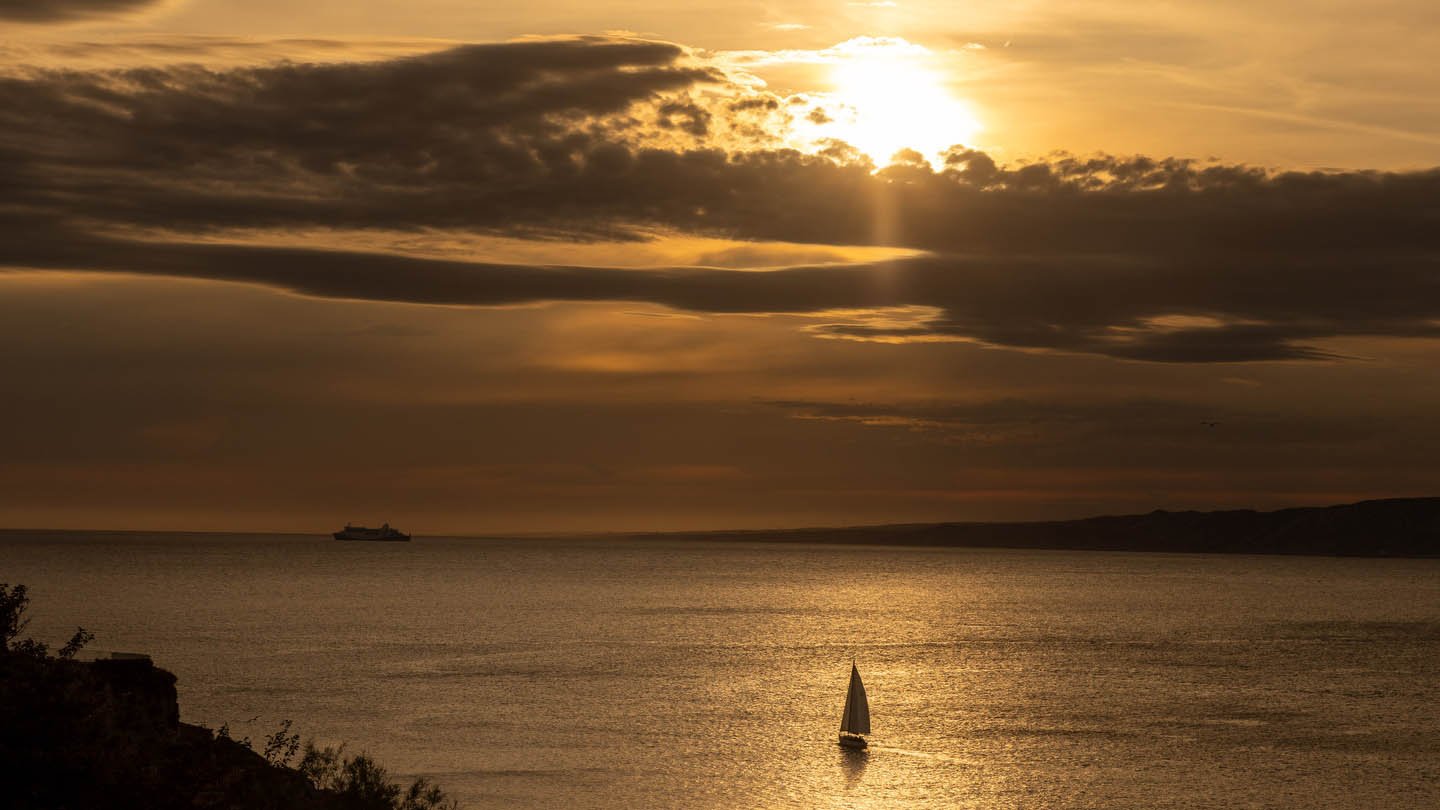
Sunset from Palais du Pharo.
Eating Bouillabaisse in Marseille
In Marseille, bouillabaisse is treated with the kind of respect usually reserved for fine art or sacred tradition. What began as a practical fisherman’s meal has evolved into one of France’s most ritualized culinary experiences, and locals take the difference between “real” bouillabaisse and a tourist imitation very seriously.
Originally, bouillabaisse was a humble, no-frills stew cooked by fishermen using bony Mediterranean rockfish they couldn’t sell at the market. Nothing fancy, nothing wasted.
Over time, though, this once “poor man’s stew” made a dramatic leap from the docks to white-tablecloth dining rooms. Today, a proper bouillabaisse at a respected restaurant often costs €75–€95 per person — or more, reflecting not just the quality of the fish, but the time, technique, and ceremony involved.
To protect the dish from being watered down for tourists, a group of local restaurateurs created the Bouillabaisse Charter in 1980. According to the charter, an authentic version must include several specific species of Mediterranean fish, with rascasse (scorpionfish) considered essential. The fish must be cooked whole, and in traditional service, they are presented and filleted tableside, reinforcing that this is not just a soup, but an experience.
That experience also unfolds in two distinct stages. First comes the deeply flavored, saffron-tinged broth, ladled over garlic-rubbed croutons and topped with rouille — a fiery blend of garlic, olive oil, and chili. Only after the broth is enjoyed do the fish appear, arranged on a separate platter and served with care. It’s deliberate, theatrical, and unhurried — very Marseille.
Top Bouillabaisse restaurants in Marseille
Chez Fonfon This is the kind of place you dream about when you think of the South of France. It’s tucked away in the Vallon des Auffes, a tiny fishing inlet that feels like a hidden village. They’ve been at it since 1952, using fish caught practically at their doorstep. It’s cozy, incredibly authentic, and the perfect escape if you want to get away from the hustle of the city center for a few hours.
Le Miramar If you want to stay close to the action, this is the spot. It’s right on the Vieux Port, but don't let the "tourist" location fool you - they are founding members of the official Bouillabaisse Charter. This means they follow strict rules on how the dish is prepared and served. It’s a bit more formal and "gourmet," but sitting there with a view of the harbor and the Basilica is a true Marseille "moment."
Chez Michel For the purists, there is Chez Michel. Located near Plage des Catalans. This place has been a Michelin-starred staple since 1946. It’s famous for its old-school service and "no-nonsense" approach to tradition. Every morning, they display the fresh catch of the day for guests to see before it ever hits the kitchen. It feels like stepping back into a more elegant era of French dining.
Le Rhul Perched high on the cliffs of the Corniche Kennedy, Le Rhul offers a view that is hard to beat - a full 180-degree sweep of the Mediterranean. It’s a 1948 legend and another Charter member. They are particularly known for the "traditional service," where they bring the rich broth out first, followed by the filleted fish on a separate platter. If you want a long, lingering lunch with a sea breeze, this is it.
L’Épuisette If you’re celebrating a special anniversary or just want to splurge, L’Épuisette is spectacular. It’s a Michelin-starred gem literally hanging over the water at the edge of the Vallon des Auffes. Their take on Bouillabaisse is a bit more refined and "aromatic" than the rustic versions found elsewhere. It’s often called the most elegant version in the city, and the "feet-in-the-water" setting is absolutely unforgettable.
Pro tip - Because these restaurants buy their fish fresh from the boats every single morning, reservations are a must. They only prepare enough for the guests they're expecting that day.
Expert Tip: The Bouillabaisse Warning
In Marseille, "real" Bouillabaisse is a serious multi-course event, not just a simple fish soup.
The 2026 Price Check: A legitimate Bouillabaisse at a reputable restaurant (like Le Rhul or Chez Fonfon) will cost between €60 and €95 per person. If you see it offered for €20 or €25 in the Vieux Port, it is almost certainly a tourist-trap version made with frozen fish. If the price is too low, skip it and order the Mussels (moules) instead!
Le Panier - the old section
Marseille was born 600 years BC in the Le Panier area. The Greeks picked this location because of its wonderful location near the sea and high on a hill.
In the 18th and early 19th centuries Le Panier was the “bad” section of the town. Near the turn of the 21st century, a huge urban development plan took place and now the district is home to restaurants, artists’ studios, and countless shops.
The narrow streets and colorful street art only add to the charm.


Among the highlights of Le Panier are pretty squares such as Place des Pistoles and Place de Lenche, featuring many nice restaurants.
The Cathedral of La Major is one of the oldest churches in France, having been originally built in the 4th century. It’s certainly worth a visit, plus it’s free.

The Cathedral of La Major at dusk.
Château d'If
Just offshore from the Vieux Port sits Château d'If, a 16th-century island fortress that Alexandre Dumas made famous as the prison in The Count of Monte Cristo.
Boats run regularly from the port, and the round trip costs around €18. The island offers great views back toward the city and, if you've read the book, a genuinely fun piece of literary history to walk through.
Notre-Dame de la Garde
Located on a hill high atop the city Notre-Dame de la Garde is the most visited site in Marseille. Not only is the church amazing, but its location treats visitors with fantastic panoramic views.
Construction of the basilica began in 1853 on the site of an ancient fort on the highest point in Marseille.


While the location offers amazing views, it is also a bit of a challenge to get there. Of course, you can walk, but it’s about a 45-minute uphill journey from the port area.
There are two much less exhausting options available.
The number 60 bus takes you conveniently to the base of the Basilica’s steps. Many tourists walk to the Basilica and regret it halfway up. We highly recommend the #60 Bus from the Vieux Port. It winds through the narrow streets of the 7th arrondissement and drops you right at the base of the Basilica, saving you a 25-minute uphill trek.
The Petit Train de Marseille (Route #1) from the port directly to the Basilica. Aside from convenient transportation, you’ll also get to see much of the city along the way.
The “train” leaves from 174 quai du Port, about 150 metres from the Town Hall and costs 11€ for adults.
Palais Longchamp
Palais Longchamp was built to bring water to the city and is surrounded by a beautiful park.
In 1835, a cholera epidemic hit Marseille because of a water shortage. After the tragic epidemic, the city began excavating an 85km canal to bring water from the Durance River to Marseille.
In addition to the beautiful building and park, there are two museums at Palais Longchamp. The Museum of Fine Arts contains 17th and 18th-century paintings and sculptures. The Natural History Museum is one of the most visited museums in France. It contains thousands of fossils and other specimens.
And best of all, everything at Palais Longchamp is free.
Vallon des Auffes
A short walk along the Corniche from the port, Vallon des Auffes is one of those Marseille spots that stops you in your tracks.
It's a tiny, old-fashioned fishing inlet hidden right below the road, with small colorful boats bobbing in the water and weathered stone buildings on all sides.
It feels nothing like a city. This is also where you'll find Chez Fonfon, one of the best bouillabaisse restaurants in Marseille, tucked in along the water. Even if you're not eating, it's worth a 10-minute detour just to look.
The Calanques: Marseille's Natural Wonder
No guide to Marseille is complete without at least mentioning the Calanques.
This stretch of dramatic limestone cliffs and turquoise coves runs along the coast just south of the city, and it's one of the most stunning natural landscapes in all of France.
The easiest way for most visitors to see the Calanques is by boat. Tours leave from the Vieux Port and range from a few hours to a full day. You'll float past sheer white cliffs and into hidden coves with water so clear you can see straight to the bottom.
If you prefer hiking, the park is accessible by bus from Marseille. The trails can be rugged, so bring sturdy shoes and plenty of water. One note for summer visits: access to the popular Calanque de Sugiton requires a free advance reservation from June through September. Check the Calanques National Park website before you go.
For a deeper dive into this area, we have a full post on nearby Cassis, which sits right at the eastern edge of the park.
Getting around Marseille
Marseille Logistics & Costs (2026)
| Service | 2026 Price | Empty Nest Expert Tip |
|---|---|---|
| RTM Transit (Bus/Metro) | €1.70 – €2.00 | Tap-to-Pay is live! Just tap your credit card/phone on the yellow reader when boarding. No more ticket machines. |
| Petit Train (Tourist Train) | €10.00 | The easiest way to reach Notre-Dame de la Garde without the steep climb. Catch it at the Quai du Port. |
| Ferry Boat (Cross Port) | €0.50 | The world’s shortest ferry ride! It saves you a 15-minute walk around the harbor for just 50 cents. |
| Château d’If Boat | €18.00 (Round Trip) | Book 24 hours ahead in summer. The "Count of Monte Cristo" island is a must for fans of the novel. |
The Marseille tramway
The Marseille tramway consists of three lines with 32 stations. The tramway usually runs from 5:00 am to midnight every 5 to 10 minutes on weekdays and 10 to 15 minutes on weekends.
Since tramways are above ground you’ll also get to see other areas of the city along the way.


The Marseille Metro
While a smaller system than the tramway, the Metro serves many popular destinations.
The Metro operates daily between 5 am and 1 am.
There are several types of tickets, and all of them work on all the mass transit options. A one-trip ticket costs 2€ and a ten-trip card costs 15€.
Tap-to-pay works perfectly and is the easiest way to pay for the Metro.
| HOTELS | Booking.com Lots of search options. The customer reviews are very helpful. | Link ↗ |
| ACTIVITIES | Viator A wide variety of tours, food experiences and historical guides. | Link ↗ |
| AIRFARE | FareDrop Alerts for cheap flights customized by your home airport. | Link ↗ |
| PHONE | Airalo Easy to use eSIM for data and calls in every country. | Link ↗ |
| TRAIN TRAVEL | Trainline We book all our trains here. Easy to use and comprehensive listings. | Link ↗ |
Where to stay in Marseille
Hôtel Carré Vieux Port
Where we stayed for one night. One block from the port and very close to the Metro.
“Very good” on booking.com

InterContinental Marseille hotel entrance at night
InterContinental Marseille - Hotel Dieu
We stayed at this classic luxury hotel for two nights with a wonderful view of Notre-Dame de la Garde overlooking the city. It’s expensive but “wow”.
Hôtel Maison Montgrand - Vieux Port
The moderately priced hotel is located in the center of Marseille with a very nice courtyard.
The hotel has received almost 2,000 “very good” reviews on Booking.com
About the Authors

|
John and Debbie O'Boyle are the team behind The Empty Nest Explorers. John is a professional photographer whose work has been published by The New York Times, NBC News, and Getty Images. He is a member of the American Society of Media Photographers, has been part of a Pulitzer Prize-winning team, and has received two New York Emmy nominations. Debbie is a writer and photographer with 30+ years of experience, formerly with The Star-Ledger and NJ.com. Together, they create in-depth travel guides for couples and empty-nest travelers who want to make the most of every destination. |
Some well reviewed Marseille tours:
Other France blog posts you might like:


We have found that the South of France is not only incredibly beautiful but also very easy to visit. Most of the towns along the French Riviera are connected by train and driving between them is easy too.