When Debbie and I first traveled in Spain, Renfe was the only game in town. That's changed. Spain now has four operators competing on the main routes, and that competition has been great news for travelers. Fares that used to top €150 for Barcelona to Madrid have come way down.
Here's the quick rundown on each one.
Renfe AVE is the national operator and still the most popular choice. They run the most departures, cover the most destinations, and have the most flexible luggage policy. If you're bringing full-size suitcases, AVE is the easiest option, with no extra fees and no one measuring your bag at the gate. Trains run in Standard class (seats in a 2+2 layout) and Comfort class (2+1, wider seats, meal included). We traveled on AVE for two of our three journeys and loved it.
Iryo is the newer private operator and runs Italian-built Frecciarossa trains. They're stylish, the food is genuinely good, and their website is much easier to use than Renfe's. Pricing is competitive, especially if you book early. One thing to watch: the cheapest Iryo fare (called Inicial) only allows a carry-on bag. If you've got a full suitcase, you'll need to book a higher fare tier or pay extra. They cover Madrid, Barcelona, Seville, Valencia, Malaga, and are a strong alternative to AVE.
Ouigo is the French budget operator. Fares can be incredibly cheap, but it's an airline-style experience. There are strict baggage limits, no frills, and they check bags at the boarding gate. WiFi costs extra. If you're a light packer and the price is right, Ouigo works fine. Just add the suitcase fee when you book, not at the station.
Avlo is Renfe's own budget brand. Similar to Ouigo, they have cheap base fares. Carry-on luggage included, extra for a large bag, and no food service at all (bring your own snacks). On the basic fare, you don't get to choose your seat. For a quick hop between cities without much luggage, it does the job.
For most visitors doing a Barcelona-Madrid-Seville loop with normal travel bags, I'd recommend either AVE or Iryo. The price difference over the budget carriers is usually modest once you add luggage fees, and the experience is much more relaxed.
| Operator | Type | Classes | Luggage | Food & Bar | Book Via | Best For |
|---|---|---|---|---|---|---|
| Renfe AVE | Full Service | Standard (2+2) & Comfort/1st class (2+1, wider seats, meal included) | Generous No extra fees for suitcases. No weighing. | Cafe-bar car on board. Meal served at seat in 1st class. | Trainline.com or renfe.com | Most frequent departures. Best coverage of destinations. Our top pick. |
| Iryo | Full Service | Inicial (2nd class) up to Infinita Bistro (1st class with meal & wine) | Watch Out Cheapest Inicial fare: carry-on only. Upgrade needed for a full suitcase. | Excellent bistro car. Top class includes meal & wine at seat. | Trainline.com or iryo.eu (easier than Renfe) | Modern trains, great food, very competitive pricing. A strong alternative to AVE. |
| Ouigo | Budget | Economy only (2+2). XL seats (2+1) available for a small extra fee. | Airline-Style Small bag included. Pay €5 extra for a suitcase. Staff checks at boarding. | OuiBar cafe on board. WiFi costs extra. | Trainline.com or ouigo.com | Rock-bottom fares. Good if you're travelling light. |
| Avlo | Budget | 2nd class only (2+2 or 2+3). No seat choice on basic fare. | Airline-Style Carry-on included. €10 extra for a large suitcase. Strict enforcement. | No cafe car. No food service. Bring your own. | renfe.com or Trainline.com | Cheapest fares. Good for short hops if you're travelling carry-on only. |
Luggage: What You Need to Know
This is the one area where Spain's trains trip up travellers, especially Americans used to checking bags with no fuss.
On AVE, you're fine. No extra charges, no strict size limits, no one at the gate with a tape measure. As long as you can manage your bags yourself and you're not trying to ship your household goods, nobody bothers you. Same general situation on Iryo, unless you've bought the cheapest Initial fare, in which case you're limited to a carry-on.
On Ouigo and Avlo, it's a different story. Both operators run airline-style baggage checks at the boarding gate. A standard suitcase costs €5-10 extra and needs to be added when you buy your ticket. If you show up at the gate with an oversized bag and haven't paid, the on-the-spot fee can be €30 or more.
The practical advice: if you've packed for a two-week trip with real suitcases, book AVE or Iryo. If you're doing a weekend trip with a backpack, Ouigo or Avlo can save you some money.
One more thing, on the Iryo Inicial fare specifically, the allowance is very tight (one small personal item and one cabin-size bag). No backpack, no regular suitcase. If you're comparing prices and an Iryo Inicial fare looks like the best deal, check first whether you need to upgrade to carry your bags.
How to Get Cheap Train Tickets in Spain
Spain has some of the best train prices in Europe right now, mostly because of the competition between operators. On a good day, you can find Barcelona to Madrid for under €20. We've seen Ouigo fares as low as €9.
A few things that actually make a difference:
Book early. Fares on all operators work just like airline pricing; the cheapest seats go first, and prices climb as the departure date approaches. Iryo and Ouigo tend to release tickets further in advance and can have great early-bird deals. Renfe has historically been slower to open bookings (sometimes only 30-60 days out), which means their cheapest fares are often gone by the time tickets appear on their site.
Use Trainline to compare everything. For us, every train trip starts with Trainline. Trainline shows AVE, Iryo, and Ouigo side by side in one search, with real prices and the ability to select your exact seat. It's the easiest way to see who has the best deal on your specific dates without jumping between three different websites. The Renfe site works, but it's clunky. I've had pages refuse to load in English and had trouble with seat selection.
Consider the budget operators for short trips. If you're doing a quick city hop and travelling carry-on only, Ouigo or Avlo can be fantastic value. Just add the suitcase fee at checkout if you need it.
Don't forget the free suburban connection. This is something a lot of visitors miss entirely. When you travel on AVE or Iryo, your ticket includes a free Cercanías (suburban train) connection at both ends of your journey. In Barcelona and Madrid, that means you can transfer between main stations without buying another ticket. It's called Combinado Cercanías, and the QR code on your main ticket activates the suburban train gates. A small thing, but worth knowing.

A Renfe AVE train at the Barcelona train station.
Should you book on Trainline or direct with the train operator?
I've used both, and my honest answer is: use Trainline.
For our Spain trips, I started on the Renfe website, mostly because booking direct felt like the right thing to do. The search worked fine, but when I tried to select seats, the interface was clunky, and some pages wouldn't translate to English. It wasn't a disaster, but it wasn't smooth either.
Trainline fixed all of that. The site is clean, the seat map lets you pick your exact seats (something Renfe's own site wouldn't let me do at the time), and it covers all the Spanish operators in one place. I saved the tickets to both the Trainline app and the Renfe app as a backup, and everything worked perfectly at the gates.
A few practical notes:
Trainline may occasionally show fares a euro or two higher than booking direct, but the markup is small, and the convenience is worth it for most people. For Ouigo specifically, their own website can have issues with foreign credit cards, so using Trainline sidesteps that problem entirely.
Whether you book direct or through Trainline, save your tickets to your phone wallet before you travel. Both the Trainline and Renfe apps let you do this. You'll scan your QR code at the security checkpoint and again at the platform gate, so having it easily accessible matters.
Please note: we are Trainline affiliates and receive a small commission if you book through our links, but we were fans before we were affiliates.
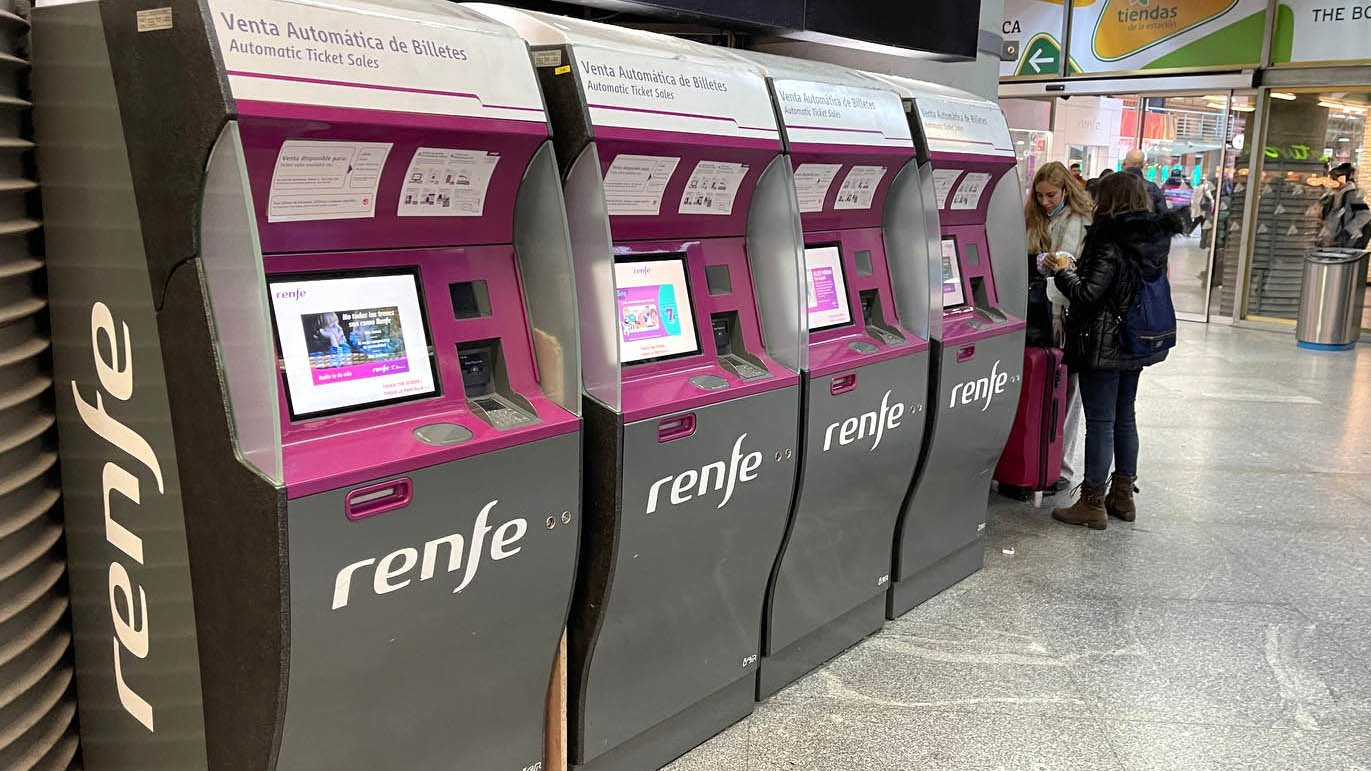
Buying tickets in advance is recommended but there also are ticket machines in the train stations.
First class or standard class seats?
On Renfe AVE, there are two classes, Standard (2nd class) and Comfort (1st class).
Iryo has a similar setup with their own class names. The budget operators Ouigo and Avlo are economy only.
On previous trips to Europe, we traveled Standard class and loved it (read about traveling by train in Italy). The seats have plenty of legroom and are far more comfortable than flying in economy.
For this trip to Spain, I decided to try Comfort (1st class) seats, mostly so I could write this blog post.
Now I’m hooked on the first-class seats.

A first class car on a Renfe AVE train between Barcelona and Madrid.
Our initial 1st class trip was from Barcelona to Madrid. There was a long line in the terminal waiting to board the train but I noticed that the two first-class cars had a separate line with no waiting at all.
Although I didn't see a separate first-class line on our other trips, we were off to a great start.
The seats in Comfort (1st class) are in a 2-1 configuration instead of a 2-2 configuration. The seats are wider and considerably more comfortable.
While in Spain, we took three high-speed train trips, two in Comfort (1st class) and one in Standard (2nd class). While the pricing on each trip varied, the difference between the two classes is minimal, unlike with airlines.
From now on, I think we’ll be sitting in 1st class whenever possible.
What are high-speed trains like in Spain?

Lots of leg room in the first class car.
Unlike most of Europe, Spain requires high-speed train passengers to pass through airport-style security. While it does slow the boarding process, it’s much less intrusive than airport security.
The details below are based on our time on Renfe AVE. Budget operators like Ouigo and Avlo have a more basic setup, no cafe car, no meals, and tighter seating.
Since reservations are required, boarding the trains is very orderly and simple. Both your car and seat number are printed on your ticket.
In Standard class, the seats are configured with two seats on either side of the aisle, while in Comfort class, they are configured with two seats on one side and a solo seat on the other side.
Our other Spain travel posts:

A standard class car between Seville and Madrid.
Most seats face the direction of travel while some face the opposite direction.
Some seats face each other with a table in between. While those sets of seats might work well for families with kids, keep in mind that you’ll be knocking knees with the person across from you if everyone is an adult.
Each seat has a European-style power outlet and a large tray table. Wifi is available throughout each car.
There is a cafe-bar car on each train. They are spacious with lots of room to linger if you’d like to escape your seat for a bit.
At the ends of each car is a large storage area for luggage plus room above your seat for smaller bags.

Luggage storage areas are located on each train car.
Bottom line - Traveling by high-speed train in Spain is a joy. Loads of legroom, comfortable seats, and centrally located train stations make it the easiest way to travel between the big cities.
This post was researched and written by John O'Boyle of The Empty Nest Explorers.
John is a professional photographer and videographer whose work has been published by the New York Times, NBC News, and Getty Images. He has been part of a Pulitzer Prize-winning team and nominated for New York Emmy Awards. You can learn more about John and the Empty Nest Explorers here.
Read all our blog posts about traveling in Spain here.
Well reviewed Spain tours:
Other travel blog posts you might like: