
Driving in France: Tips for Americans (What You Need to Know)
While we love traveling by train in France, sometimes renting a car and driving makes more sense. Our recent trip to the French Riveria was a perfect driving trip. While I would never drive in Paris, exploring the French countryside in a car is a treat.

Renting a car allows you to explore the French countryside. John behind the wheel of our rental car
| Quick Facts: Driving in France | |
|---|---|
| Driver's License | US license valid for tourists. Carry an IDP from AAA ($20) just in case. |
| Drive on the | Right side of the road (same as the US) |
| Autoroute (highway) speed limit | 130 km/h (81 mph) dry / 110 km/h (68 mph) in rain |
| N & D roads (outside towns) | 80 km/h (50 mph) — some sections posted at 90 km/h |
| Within towns and cities | 50 km/h (31 mph) |
| Blood alcohol limit | 0.05% (lower than the US — plan accordingly) |
| Required car equipment | Reflective yellow vest + warning triangle (both legally required; €135 fine if absent) |
| Transmission | Manual is standard — request automatic specifically when booking |
| Tolls | Most autoroutes are toll roads. Credit card tap works at most plazas. |
| Speed cameras | Extensive network — fines go to the rental company and get charged to your card |
⚠️ France rolled out AI-powered speed cameras in 2025 that can issue multiple fines in a single pass — for speed, phone use, seatbelts, and tailgating. Radar detectors are illegal.
Can I use my American Driver’s License in France?
Yes, you can drive on an American driver’s license in France. You’ll probably want to carry your passport also since police often ask for one.
Just to be safe I always carry an international driver's license too. An international driver’s license is just a version of your home license translated into multiple languages.
You can receive the license from the American Automobile Association for $20. https://www.aaa.com/vacation/idpf.html
I receive them at a nearby AAA office but you can also receive one via mail.
Renting a car in France
You can rent a car in France with an American driver’s license. Many familiar American rental car companies have large operations in France in addition to the European rental agencies.
Manual transmission cars are very common in France but automatic cars are available too. Be sure to specifically ask for an automatic transmission or you’ll find yourself with the more common manual car.
The streets in charming French towns are very small so renting a small car is a good idea.
Many of the same procedures for renting a car in the United States apply to renting a car in France. You’ll need a driver’s license, credit card for payment, and proof of insurance.
It is required by French law that drivers carry unlimited third-party liability insurance so liability coverage is automatically included in the price of all car rentals.
In the United States, I rely on additional insurance coverage from a premium credit card (either my Amex Platinum or Chase Sapphire Reserve). This works well in the United States and theoretically should work well in France.
Unfortunately, there are way too many stories about rental car companies in Europe finding any tiny bit of damage. Many times this damage is greatly exaggerated,
Since I don’t want to deal with the hassles of fighting with a rental car company in another country after I get home I’ve decided to just get the extra insurance through the rental car company. Since I have personal auto insurance and premium credit card insurance it’s certainly not required but the added expense might be worth it for not having to deal with the hassles.
Tip - Closely inspect and photograph the rental car when you both pick it up and drop it off. Make sure any damage is noted on the rental agreement before driving away.
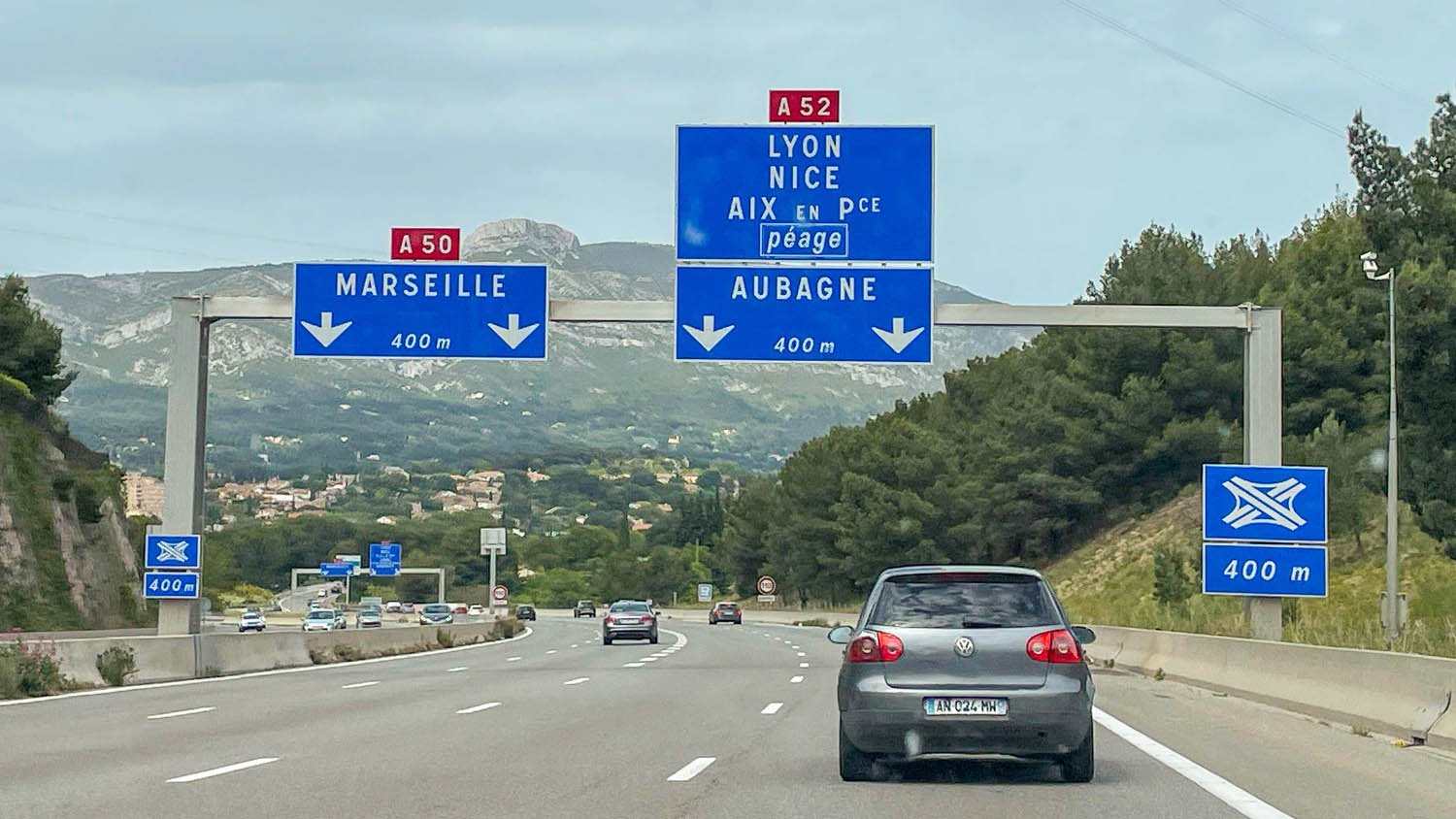
Is it easy to drive in France?
The good news is that you’ll drive on the right-hand side of the road. The types of roads you’ll encounter are similar to those in the United States.
Types of roads
Autoroutes

You can pay the tolls on highways by tapping a credit card. Just keep an eye out for the lane with the credit card symbol.
In France, the highways are called autoroutes and are labeled with an A, such as A6 between Paris and Lyon. These highways are less scenic but are the fastest routes between major cities.
Most autoroutes have tolls that can be paid with a credit card or cash.
The speed limit for these roads is 130 km/h, and 110 km/h when it rains.
Route Nationales
These routes are major thoroughfares but connect smaller cities. They are designated with the letter N and then a number,
Routes DepartementalesThese are smaller roads that are designed with a D and a number. The more digits, the less significant the roadway. These roads connect smaller towns.
Speed limits
Speed cameras are everywhere in France. And when I say everywhere, I mean it. There's no relying on the police to catch you. The cameras catch you, the rental company gets the bill, and then they charge your card when you get home. Use Waze. It's a lifesaver.
Here are the limits to know:
Autoroutes: 130 km/h (about 81 mph) in dry conditions, dropping to 110 km/h (about 68 mph) in rain
Dual carriageways with a center divider (separate lanes): 110 km/h
N and D roads outside of towns: 80 km/h (about 50 mph) in most areas, though some sections are posted at 90 km/h
Inside towns and villages: 50 km/h (about 31 mph)
One thing that catches a lot of Americans off guard: you don't always see a speed limit sign when you enter a village. The town name sign on the side of the road is enough. The moment you see it, the speed drops to 50 km/h, whether there's a sign or not.
In 2025, France also rolled out a new generation of AI-powered speed cameras that can issue multiple fines in a single pass. One camera can cite you for speed, phone use, not wearing a seatbelt, and tailgating all at the same time. This is not the place to be sloppy.
How tolls work
Most autoroutes use a ticket system. You take a paper ticket when you enter, then pay based on how far you've traveled when you exit. Tap-to-pay credit cards work at most toll plazas and make the process pretty smooth. I keep a card close to the driver's seat so I'm not fumbling around when I pull up to the gate.
If you want to avoid tolls entirely, the N and D roads do not have them. You'll trade speed for scenery, which is honestly not a bad trade in France.


What you need to have in the car
French law requires two items to be in every car at all times: a reflective yellow vest and a warning triangle. Most rental cars already have them. But check before you drive off the lot. If you break down or get into an accident and can't produce them, you're looking at a €135 fine on top of everything else.
The vest needs to be inside the car within easy reach, not buried in the trunk. If you have to get out of the car on the side of a road, you put it on before you exit.
A word about fuel
Before you leave the rental lot, ask the agent what type of fuel the car takes and write it down.
At the pump, you'll see options labeled "essence" (unleaded gasoline) and "gazole" (diesel). These are not interchangeable. More than one American traveler has made a very expensive mistake at a French gas station by grabbing the wrong nozzle.
Yield to the Right or Priorité à Droite
This one is very difficult for American drivers to understand.
A big difference in France is a driving rule called “priorité a droite,” which means that you must yield to traffic coming in from your right. There are many exceptions to this rule. You are most likely to encounter the rule in small towns and villages.
Most modern-day roundabouts give priority to the vehicle which is already on the roundabout.
So keep your eyes open and be ready to stop where you might not have to at home.
Much is written about this but honestly, I didn't think about it once while driving in France. Just stay cautious and don’t drive aggressively.


Parking in French towns
Parking spaces in France are noticeably smaller than what Americans are used to. This is worth keeping in mind when you're choosing a rental car. Rental companies will often try to upgrade you at pickup. My advice: resist the upgrade. A compact car is your friend in the narrow streets and tight parking garages of French towns.
In most towns, you'll find paid parking lots near the center. They're well-signed. Underground garages are common in cities. Street parking is available in many smaller villages, often free outside the center.
Don't leave valuables visible in the car, particularly in cities and popular tourist areas.
For more info on exploring French towns, check out our post: French Riviera: 5 great towns to visit
Phone use while driving
Using a phone behind the wheel is illegal in France, including handheld calls, texting, and even earbuds or a headset. Only a fully integrated car speaker system is legal. The fine starts at €135. Hands-free mounts for navigation are fine as long as you're not holding the phone.
Do not drink and drive
This is good advice anywhere, but particularly in France since the blood alcohol limit is .05%.
If you happen to come upon a DWI checkpoint, every driver is required to blow into a breathalyzer, not just those who might show signs of drinking.
The French take this very seriously.

Renting a car allows you to visit many of the world-class destinations in France. I would not hesitate at all to rent a car and go exploring.
If you'd rather skip the driving for a day and let someone else navigate, Viator has a wide range of guided day trips from Nice, Marseille, and other French Riviera cities.
About the Authors

|
John and Debbie O'Boyle are the team behind The Empty Nest Explorers. John is a professional photographer whose work has been published by The New York Times, NBC News, and Getty Images. He is a member of the American Society of Media Photographers, has been part of a Pulitzer Prize-winning team, and has received two New York Emmy nominations. Debbie is a writer and photographer with 30+ years of experience, formerly with The Star-Ledger and NJ.com. Together, they create in-depth travel guides for couples and empty-nest travelers who want to make the most of every destination. |
Some well-reviewed France tours:
Note - This blog post contains affiliate links. This means that if we are recommending a product, activity, or hotel, we might be receiving a small commission if you buy or book from these links. This is done at no additional cost to you. We only recommend products we have personally used or have thoroughly researched.
Other travel blog posts you might like:


We have found that the South of France is not only incredibly beautiful but also very easy to visit. Most of the towns along the French Riviera are connected by train and driving between them is easy too.