

Le Jardin de l'Hôtel de Dieu (Espace Van Gogh).
Updated: July 31, 2026
The renowned Post - Impressionist artist Vincent Van Gogh spent a little over a year living in Arles, but it was an extremely prolific period for him, creating over 300 drawings and paintings here between February 1888 and May 1889.

The Van Gogh Pedestrian Path in Arles consists of about a dozen locations that have been identified as the likely spots where Van Gogh set up his easel for well-known paintings. Signs are set up in these areas showing photos of his works juxtaposed against the real life streets and landscapes that inspired his masterpieces. The signs are quite informative. Once you find them.
You would think this “path” would be easy to find and navigate, but surprisingly, it’s pretty challenging to do on your own.
Van Gogh’s presence is felt very strongly in Arles. In fact, the first thing I noticed when I got off the train was a little Vincent santon in a shop window. (Santons are small clay figurines that depict all sorts of aspects of life in Provence. They are traditional crafts of the region and are popular souvenirs.)
But not one of Van Gogh’s original paintings is on permanent display in Arles! (However, one was on temporary loan from Musée d’Orsay for a short time during the summer of 2024.)
And although “pedestrian path” sounds like a formal trail of some sort, it really isn’t one. If you are expecting to find the type of marking of the Freedom Trail in Boston, which is literally a red line through the city, forget it. Yes, there are markers on the sidewalk pointing to the locations when you are reasonably close to them, but unless you come across them serendipitously or already have some knowledge of where the locations might be, they aren’t really of much use.
We heard a passing Dad tell his son that they were on a “scavenger hunt” for the paintings, and indeed, that is a good description! But c'mon now, all you really need is a map.
| 🗺️ The trail | About a dozen marked easel spots scattered around town. There is no painted line to follow. |
| 🎫 Cost | Free to walk on your own. |
| ⏳ Time needed | Around 2 to 3 hours for the main stops at a relaxed pace. |
| 🚩 Start here | The Yellow House site at Place Lamartine, a short walk from the train station. |
| 📍 Getting a map | No printed map at the tourist office. Ask for the QR code, or use the Wivisites map linked in this post. |
| 🖼️ See a real Van Gogh? | None on permanent display. The Fondation Vincent van Gogh usually has a borrowed work or two on show. |
| ☕ Café Van Gogh | Closed since 2023. You can still photograph the yellow facade on Place du Forum. |

The Arles tourism office.
But good luck finding one! Even at the very nicely appointed Tourism Office (located on Boulevard des Lices), which has posters of the artist in great abundance, you’ll not find a single printed map on the Van Gogh Path! However, a very nice staff member (who didn’t seem to mind my spotty French) was very helpful in pointing me to a QR code for a link that listed the various sites to see in Arles, including the Van Gogh stops. Here’s a link to that specific Wivisites page with a map of the Van Gogh painting sites.
(We just saved you a lot of trouble. You’re welcome!)
Van Gogh was one of the earliest artists to use color as something more than representative of real life. He preferred to use color as an expression of his feelings about the subject. He also used quick, dynamic brush strokes to capture the energy and emotion of the scenes he depicted, which garnered some raised eyebrows from more deliberate artists who were his contemporaries.
But Van Gogh knew what he was doing. His quickness was purposeful and meant to capture something fleeting; the light, the moment, a gesture, the feeling. His style is referred to as Post-Impressionist.
It is very inspiring to see his interpretations of these somewhat ordinary scenes, and the kinds of things he focused on.
We didn’t get to all of them - but perhaps you can!
How to walk the Van Gogh trail in Arles, in order
The Van Gogh trail in Arles is not one clear path with a line to follow. It is about a dozen spots scattered around town. The signs are wonderful once you find them. Finding them is the hard part.
We spent a good chunk of time doubling back and getting turned around. So we worked out an order that flows from one stop to the next. It starts at the train station end and finishes on the far side of town. Follow it, and you will not backtrack much.
The walking route
1. The Yellow House site, Place Lamartine. Start here. It is about a hundred meters south of the train station, so it is the natural first stop off the train. The house is gone, but the view is recognizable.
About 2 minutes down to the river.
2. Starry Night on the Rhône, Quai du Rhône. Walk to the east bank and follow the water. You can see Vincent's view without hunting for the exact sign.
About 8 to 10 minutes south along the quay.
3. Trinquetaille Bridge (Pont de Trinquetaille). The stairway stop, with the grown-up plane tree and the weeds in the steps. If you walk downstream another 200 meters, you get the longer bridge view he also painted.
About 5 minutes inland from the river.
4. Fondation Vincent van Gogh, rue du Docteur Fanton. The one museum on the walk. Good place to duck in if you want to see borrowed originals and cool off on the roof terrace.
About 3 minutes to the square.
5. Place du Forum, the café site. The famous yellow café facade. Still worth a photo even though the café itself is shut.
About 4 to 5 minutes to the garden.
6. Espace Van Gogh (Jardin de l'Hôtel-Dieu). The best coffee break on the route, in the garden that mirrors his painting. A natural halfway rest.
About 5 minutes, slightly uphill, to the arena.
7. Les Arènes (Roman Amphitheater). The big one. Climb the towers for the city views even if you never find the easel.
About 6 to 8 minutes south to the boulevard.
8. Jardin d'Été, Boulevard des Lices. The public garden he painted several times. The sign sits by the main gate.
About 15 minutes southeast to the cemetery.
9. Les Alyscamps. The tree-lined Roman cemetery, and a quiet place to end. It is on the way out of town toward the Langlois bridge, so it works well as your last stop.
That core loop runs roughly 2 to 3 hours or up to 4 hours at a relaxed pace.
Two stops that are not really on the walk:
Pont Van Gogh (the Langlois bridge). This one sits about 3 km south of the center, so it does not fit the walking loop. You have three ways to reach it. Drive and park right next to it. Take a local bus toward Barriol and get off at the Pont Van Gogh stop, which runs about 13 minutes and costs a euro or two. Or walk the signposted canal path, which is around 2.7 km of willows and houseboats each way. If you have a car, pairing it right after Les Alyscamps makes the most sense.
The Old Mill (L'Ancien Moulin), rue Mireille. A minor stop on the southern edge that most people skip. Only worth adding if you are a completist or already headed that way.
| 1. Yellow House site | Place Lamartine, by the train station. The natural place to start. |
| 2. Starry Night on the Rhône | Quai du Rhône. A short walk to the river, then follow the water. |
| 3. Trinquetaille Bridge | The stairway view, with the grown plane tree and weedy steps. |
| 4. Fondation Van Gogh | Rue du Docteur Fanton. The one museum, with borrowed originals and a roof terrace. |
| 5. Café site, Place du Forum | The yellow facade. Worth a photo, though the café is closed. |
| 6. Espace Van Gogh | Best coffee break on the route, in the garden that mirrors his painting. |
| 7. Les Arènes | The Roman amphitheater. Climb the towers for the views. |
| 8. Jardin d'Été | Boulevard des Lices. The sign sits by the main gate. |
| 9. Les Alyscamps | The Roman cemetery. A quiet place to end, on the way out of town. |
Famous paintings featured along the Van Gogh Pedestrian Path in Arles
La Maison Jaune (The Yellow House)
In 1888, Vincent rented several rooms at number 2 Place Lamartine. Unfortunately, the original yellow house and some other buildings associated with the painting no longer exist - they were destroyed during WWII as Allied bombers were aiming for the nearby train station but missed. But you can visit the location and see the view from where Van Gogh set up his easel, and even without the house, the location is recognizable. This location is about 100 meters south of Arles train station and is a good starting point for a do-it-yourself walking tour.
The Starry Night on the Rhône

The site of The Starry Night on the Rhône.
An earlier companion piece to the more famous Starry Night (which was actually painted in St Remy de Provence and depicts that town) was inspired by the view from the Quai du Rhône (the bank - or “quay” - on the east side of the Rhône) which is just a short walk from the Yellow House location.
You don’t even need to walk all the way to the exact location of the posted sign to immediately see that this was clearly Vincent’s view. This is a nice walk along the river bank and fun for seeing some of the small river cruise ships that dock here.
Les Arenes

The Roman Amphitheater in Arles
Van Gogh painted the Roman Amphitheater, which is a dominating feature of the town and probably the biggest tourist site in Arles. Interestingly, Vincent made the crowd the focus of his painting instead of the “scene” as he was usually inclined to do. The spectators in the painting are watching a bullfight. The arena is still used for bullfighting today.
We spent a lot of time at the Amphitheater and never actually found the Van Gogh easel that is supposed to be here, but no matter! This is one of the best things to do in Arles, and we highly recommend seeing it. You can just wander about in it, and unlike the Colosseum in Rome, which it is modeled after, you can find yourself alone a good deal of the time. Also, the views of the city from the higher tiers and towers are just so classic and beautiful.
The Roman Amphitheater is just one of several Roman ruin sites to visit in Arles. For info on visiting them and lots of other things to see in Arles beyond Van Gogh, check out our other blog post on the town, Visiting Arles, France: a little city in Provence with big things to see.
Café Terrace at Night (Terrasse du café le soir)

The yellow facade of Terrasse du café le soir.
The café scene Van Gogh painted is located at The Place du Forum, which was the historical city center of Arles. This is one of my favorite Van Gogh paintings for its sultry evening feel and dreaminess.
Unfortunately, the Café Van Gogh, as it has been renamed, was closed and not in business at the time of our visit. The other shops around the Café certainly seem to take advantage of having a famous neighbor.
Note: The café on Place du Forum has been closed since July 2023, following a tax fraud case against its operators. You can't stop for a drink there right now, and its future is uncertain. Even so, the square is still one of Arles' most iconic Van Gogh spots. The yellow façade, painted in the 1990s to match his canvas, remains one of the city's most photographed sights.
Just a personal take - and maybe it was just because the place was shut up looking forlorn when we were there, or because we were there in daylight hours - but this was one of the more disappointing Van Gogh stops for me. I definitely got more of the sultry ambiance and heavy atmosphere captured in Terrasse du café le soir while wandering around in the village of Eze at night!
Below is John’s homage to Van Gogh - night photos in the French village of Eze. See the post here: Photo Gallery: Eze, France photographed at night
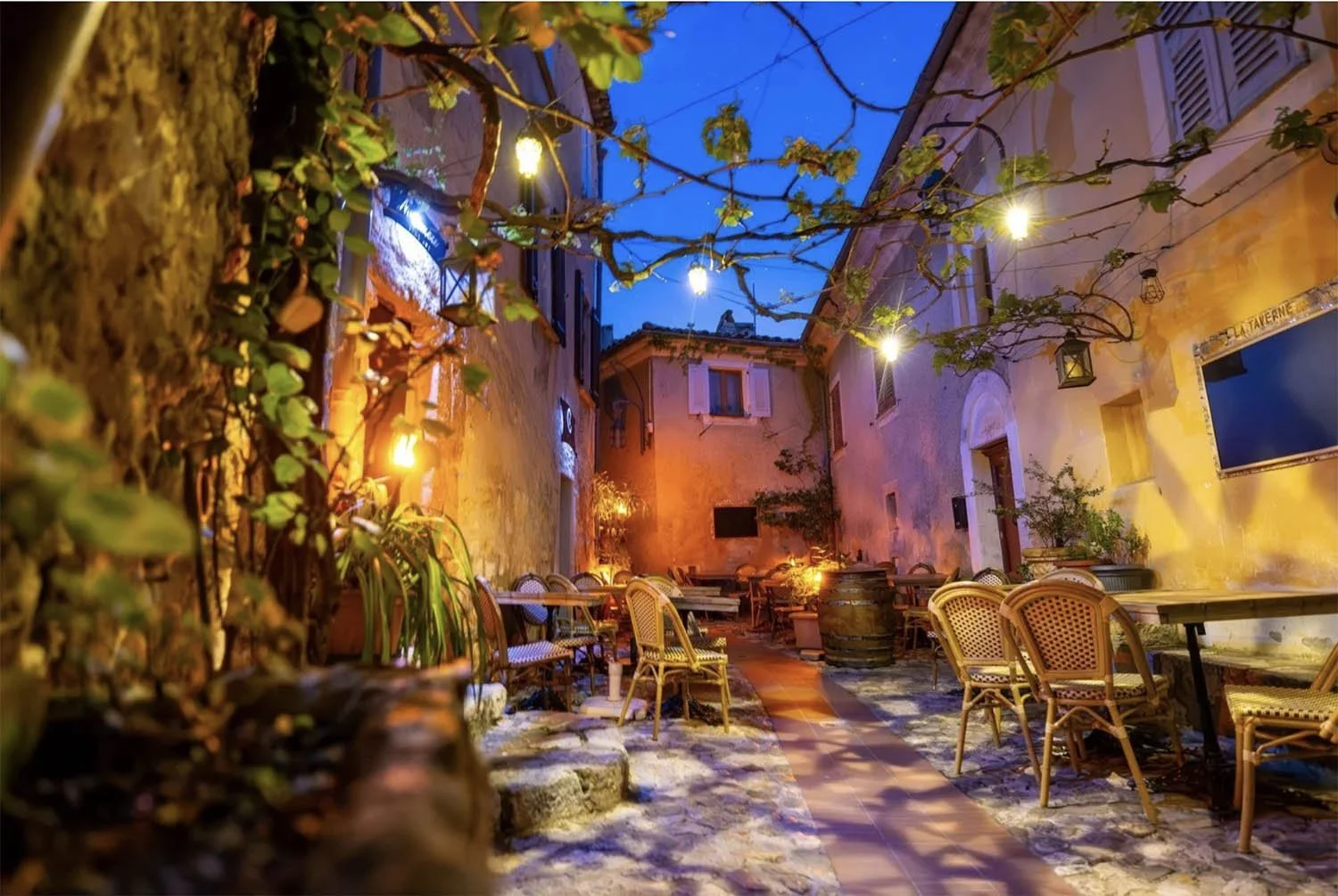
Walking around the empty streets of French Village of Eze at night was remarkable.
Trinquetaille Bridge in Arles

Even the weeds growing on the steps looks the same in Trinquetaille Bridge
Van Gogh painted several views of le Pont de Trinquetaille. He was intrigued by the geometry of it, and painted the stairway and the arch where the road passes underneath.
Bridges have crossed the Rhône at this place since Roman times, but this particular bridge was a fairly new one in Vincent’s day. A fun detail - the little sapling Vincent depicted in his 1888 painting of the stairway is now a large, mature plane tree.
I really enjoyed this stop - for so much of it is still the same yet different. Besides for the now grown sapling, there are weedy growths in the cracks of the stone steps just like Vincent painted. I guess some things never change! To me, this painting feels like “everyday life”, full of the busy energy of people going off to work or wherever, and that definitely is still going on there today.
If you walk downstream about 200 meters, you can get the longer view of the Pont de Trinquetaille that he also painted.
Le Jardin de l'Hôtel de Dieu

We had coffee and tea at Espace Van Gogh. It was like having a snack inside a Van Gogh painting.
Van Gogh spent time at the city hospital, the Hotel Dieu, while recovering from a nervous breakdown that led to him famously cutting off part of his own ear. He often sat in the interior gardens, where he produced one of his most famous paintings. He did well recovering in the peaceful surroundings.
Today the former health center is known as Espace Van Gogh, and houses the town library, exhibition spaces, souvenir shops and a cafe. Ironically, these days the gardens are painstakingly arranged to mirror Van Gogh’s painting. I wonder what he would have thought about that!
Even if you visit no other Van Gogh site, do visit this one. It is not only one of the more tangible locations when in search of the man Vincent was (you can plainly appreciate the balcony where he observed and painted the garden during his convalescence), but it is also a perfect place for a break to have a coffee, tea, or snack.
The cafe serves tasty treats and drinks, and you can sit out at a bistro table and take in the serene surroundings. Several Van Gogh-themed walking tours came through as we were sitting; small, quiet, guided groups that didn't stay long, so it never felt overwhelmed with crowds.
Having a nice cup of French coffee here and people watching in the garden was definitely a highlight of the day for me! I imagine Vincent had much of the same experience.
Le Jardin d’Été
On the Boulevard des Lices, there is another public garden that Van Gogh painted several canvases of. A sign on the left-hand side of the main gate shows you where Van Gogh stood to paint ordinary people strolling through the gardens.
Legend has it that the paintings he created here caused the arguments he had with a fellow artist about the speed in which Vincent captured a scene. But Vincent defended his quick strokes:
“When someone says that such and such was done too quickly. . . they looked at it too quickly. "
Le Pont Langlois
Outside the city center, the little wooden lifting bridge Van Gogh painted that he called Le Pont Langlois after its owner, used to cross a canal that fed the Rhône. Today it has been moved down a ways south to an unused part of the canal, and is known as Van Gogh Bridge (Pont Van Gogh). The scene he painted was vibrant and full of happy color. The modern view doesn't really do it justice.

There is no shortage of Van Gogh inspired gifts in Arles.
Les Alyscamps
The tree-lined old Roman cemetery of Les Alyscamps was immortalized in several Van Gogh paintings. With its lines of ancient stone sarcophaguses, it's a strange spot for him to have created his colorful landscapes. You really wouldn’t guess it was a cemetery from his artwork.
Les Alyscamps is outside the old city limits because Roman cities traditionally forbade burials within the city. For this reason, it was common for the roads immediately outside a city to be lined with tombs and mausoleums.
You can walk there in about 15 minutes from the city center, or alternatively you can take a local bus for about €2.
La maison de La Crau (L'Ancien Moulin) (The Old Mill)
The old mill painted by Van Gogh once stood on the edge of town, against a bucolic view of the plain of La Crau. Today, the mill sits on rue Mireille, and the scene Vincent captured isn’t quite the same, as it is much more developed. But the decaying roundish tower still stands.
Fondation Vincent Van Gogh Arles
Arles is home to several museums, but if we are talking specifically about Vincent Van Gogh, the Fondation Vincent Van Gogh Arles is the one that might interest you most. The Foundation honors the work of Van Gogh through exhibits of contemporary artists who are inspired by him, exploring Van Gogh's weighty impact on art today.
Here is the part that surprised us. Not one of Van Gogh's paintings is on permanent display anywhere in Arles. But the Fondation usually borrows a real canvas or two for whatever show is running. So there is often a genuine Vincent to see here, even though the town owns none of its own.
The exhibits rotate through the year, and each one pairs modern artists with a Van Gogh loan or two. It is worth a quick look at their site to see what is on when you visit.
You can find the current show and visiting details on the Fondation Vincent Van Gogh Arles website.
Hope this little post about beloved Vincent, a monumental figure of the art world, leaves you with a good post-impression. (See what I did there?)
About the Authors

|
John and Debbie O'Boyle are the team behind The Empty Nest Explorers. John is a professional photographer whose work has been published by The New York Times, NBC News, and Getty Images. He is a member of the American Society of Media Photographers, has been part of a Pulitzer Prize-winning team, and has received two New York Emmy nominations. Debbie is a writer and photographer with 30+ years of experience, formerly with The Star-Ledger and NJ.com. Together, they create in-depth travel guides for couples and empty-nest travelers who want to make the most of every destination. |
Some well-reviewed Arles tours:
Note - This blog post contains affiliate links. This means that if we are recommending a product, activity, or hotel, we might be receiving a small commission if you buy or book from these links. This is done at no additional cost to you. We only recommend products we have personally used or have thoroughly researched.
Other travel blog posts you might like:


We have found that the South of France is not only incredibly beautiful but also very easy to visit. Most of the towns along the French Riviera are connected by train and driving between them is easy too.