
Visiting the Roman Colosseum: tips and advice for 2026

The Roman Colosseum at dusk is beautiful. All Photos by John O’Boyle / The Empty Nest Explorers
The Colosseum is one of those places that genuinely lives up to the hype. John and I have been there multiple times, and it was amazing. But we'll be honest with you; getting tickets and navigating the whole experience is more complicated than it should be.
The good news is it's very manageable once you know what you're doing. That's exactly what this post is for, and we hope you’ll find our insights helpful.
The official ticketing site, run by Parco Colosseo, has improved a lot in the past couple of years. It's still a little confusing the first time you use it, though, so we walk you through the key choices below. There are also several types of tours to choose from, and the options aren't always clearly explained on the site. We'll explain the options.
A quick note on third-party ticketing sites: not all of them are reputable. We use and recommend Viator and Get Your Guide for guided tours. We use both on pretty much every trip we take, and they're the real deal.
In this post, we cover how to buy tickets, which tour option makes sense for most people, how to get there, what to bring, and what to see nearby.
If you have a trip to Rome coming up, the Colosseum is definitely worth visiting, but you just need a plan. Unfortunately, it’s not a site where you can just “wing it “ easily these days. Like many historical sites in Rome, there are more visitors at the current time than ever.
To make your planning easier, we’ve put together some tips to help you plan an enjoyable visit to the Roman Colosseum.
| Address | Piazza del Colosseo, 1, 00184 Rome |
| Getting There | Metro Line B to Colosseo station — 2-minute walk |
| Opening Hours |
8:30am daily (year-round) Spring/Summer (late Mar–Sep): closes 7:15pm Winter (late Oct–Feb): closes 4:30pm Last entry: 1 hour before closing |
| Standard Ticket (2026) |
€18 per adult — includes Roman Forum & Palatine Hill Under-18s free (reservation still required) |
| Book in Advance |
Tickets released 30 days ahead on the official site ticketing.colosseo.it — see all tour types & options here |
| Our Advice |
We highly recommend taking a guided tour for the best experience. It's the smoothest way in with the least headaches. We use
Viator
and
Get Your Guide. Note: This blog post contains affiliate links. If we recommend a product, activity, or hotel, we may receive a small commission if you buy or book through these links, at no additional cost to you. We only recommend products we have personally used or thoroughly researched. |
| Free Entry Days |
FREE First Sunday of each month Also: April 25, June 2, November 4 No advance tickets on free days — expect long lines |
| Time to Allow | 75–90 min for the Colosseum; 3+ hours if adding Forum & Palatine Hill |
| Closed | December 25 & January 1 |
| Bring Your ID | REQUIRED Tickets are issued in your name — you must show a valid photo ID at the entrance |
| Bags | Backpacks and rolling luggage not permitted |
| Water | No full bottles allowed — bring an empty bottle and fill at fountains inside |
| Free Audio Guide | Download the official MyColosseum app (iOS & Android) before your visit |
| Official Website | colosseo.it/en |
Why should I visit the Colosseum in Rome?
It’s one of the New Seven Wonders of the World. That puts it in pretty good company with the likes of The Great Wall of China and the Christ the Redeemer statue in Brazil. C’mon, this is why we travel, right? Seeing something for yourself opens up a different kind of understanding. As my dear sister Celeste would say - “Go! Travel! See Europe!” I think everyone needs a Celeste in their life encouraging them to see things.
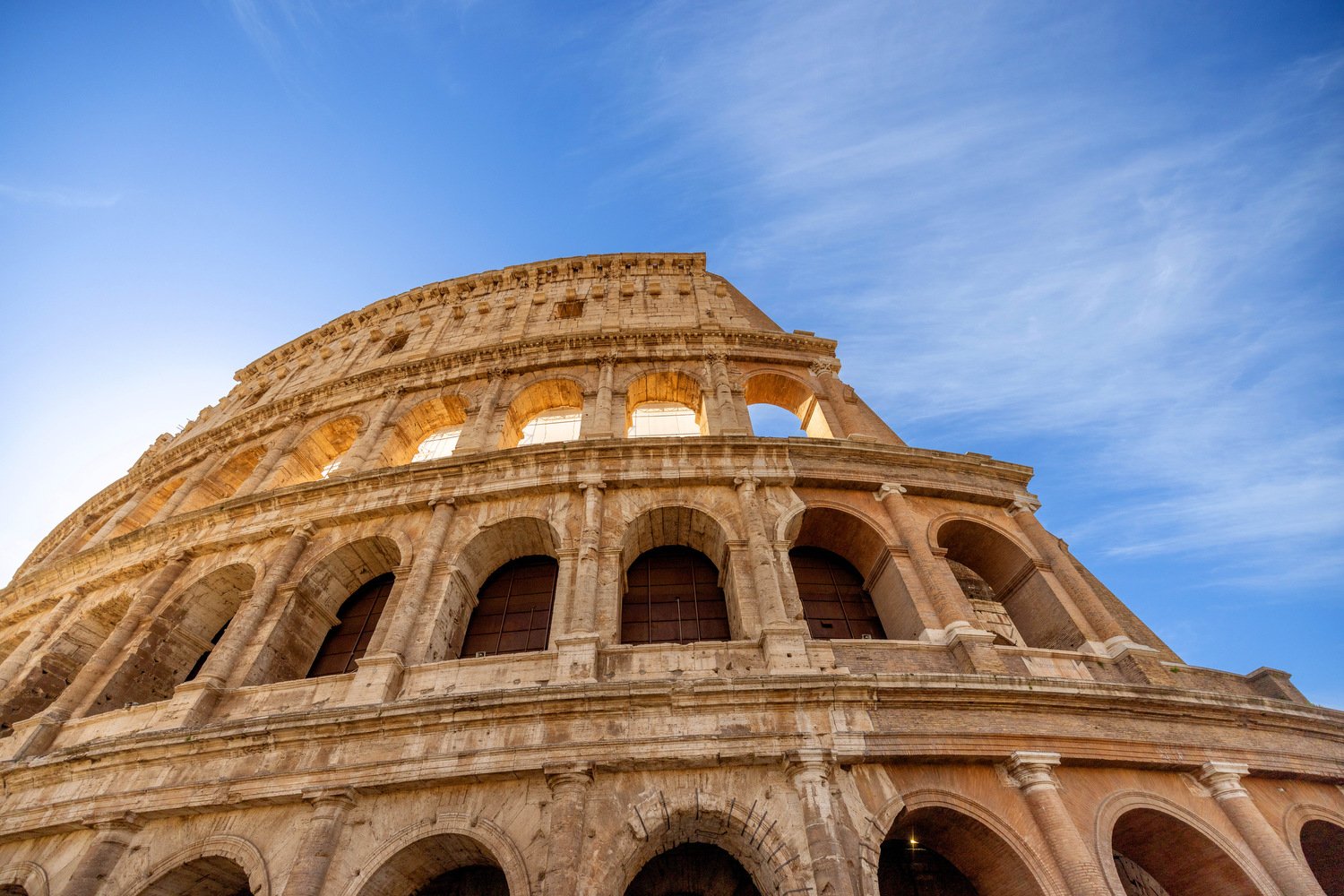
As “big tourist sites” go, the Colosseum in Rome just might outdo them all. Built nearly 2000 years ago, it is still the biggest amphitheater in the world. Despite its age, no modern structure has yet to surpass it. Although missing a few pieces, it has survived fires, earthquakes, war, and neglect throughout its long history. Its solidly imposing presence certainly gives the impression that it will be standing for another 2000 years! Nothing you can see in the US is this old.
The ticket to the Colosseum also includes admittance to The Roman Forum and The Palatine Hill. These are significant ruins to explore in their own right, so that makes a pretty good bang for your buck! You can wander around these sites and really get the feel of early Roman life. The Roman Forum was an important location for daily activities like hearing public speeches, discussing politics or just visiting shops and taverns.
The Colosseum has a very interesting story to tell stretching from the once vast Roman Empire into more “modern” times. You might be surprised to learn that gladiator fights were not exactly as they are depicted in movies. Or that the Colosseum became a symbol of the international campaign against capital punishment, which was abolished in Italy in 1948, and became the site of anti-death penalty demonstrations in 2000. In fact, there are many chapters in the building’s life that may surprise you!

The interior of the Roman Colosseum.
Getting tickets to the Colosseum in Rome
Pro tip: More than any other big historical attraction we have ever visited, the Roman Colosseum is one where it is definitely worth it to use Viator or GetYourGuide to handle your ticket purchase.
Even though the new official site is better than the old one, it’s still a little confusing. One example of this is how when the site is translated from Italian to English, the Guided Tours section translates as “Educational Tours”. The unsuspecting English-speaking visitor may think that refers to school tours and skip it, when all it really means is a guided tour option - which may actually be what you are looking for.
Do yourself a favor and make your life easier this time by purchasing through Viator or GetYourGuide, whether you want a guide or not.
Note - This blog post contains affiliate links. This means that if we are recommending a product, activity, or hotel, we might be receiving a small commission if you buy or book from these links. This is done at no additional cost to you. We only recommend products we have personally used or have thoroughly researched.
Ok, let’s break down the official website method.
The official website for purchasing tickets to the Colosseum in Rome is Parco Archeologico de Colosseo.
It is best to purchase a timed ticket ahead of time online, since lines can be very long to purchase a ticket in person, and you may have to wait to enter even after you buy the ticket. Also, tickets may run out before you get to the front of the queue!
The relatively new website makes purchasing tickets much easier than it used to be, but it can still be a little confusing, so here are some clarifications:
You can choose between several language translations, and the very first thing you see at the top of the page is the four different categories of ticket offerings. They are labelled “Educational Tours”, “Individual”, “Groups” and “School”.
“Individual tickets” refers to the general admission, self-guided tickets. There are a few different options in this category the cost is €18.00. So click on that tab if that’s what you are looking for..
“Educational tours”, as referenced in our “pro tip” above, refers to guided tour options. It’s just a quirk of translation, so don’t confuse it with tours for school groups, which can be found under the Schools tab. You can book an “educational” (a.k.a, guided tour) ticket for an individual or up to 8 people. For 9 or more people, you should look under the Groups tab.
The most available ticket, and therefore easiest to book, is the Individual ticket, which is self-guided and gives you access to the main level of the arena and the Roman Forum and Palatine Hill. Most visitors would be satisfied with this level of ticket, unless you have a very keen interest. You can also use the handy free app for an audio tour as you go at your own pace. The Parco Archeologico de Colosseo MyColosseum app can be downloaded from the Apple App Store or Google Play Store.

The Roman Forum is adjacent to the Colosseum and is a perfect additional stop.
I think the best general guided tour offering for most people would be the standard €26.00 “Colosseum Educational Tour” (remember “educational just means “guided” tour), which takes you through the main floor of the Colosseum with lots of information and includes entry into the Roman Forum and Palatine Hill (but for that part, it would not include the guide.)
There are several variations of “Full Experience” guided tours, for full descriptions, check out this page. For the most part, these are more expensive and more restricted.
Touring the Underground of the Colosseum is a very high demand ticket and very restricted in numbers because it is an archeologically sensitive area. Unfortunately, these sorts of things sometimes become “trendy” as the coolest way to see a place. Honestly, you can see most of the Underground from above, since the “roof” of the Underground is missing. There’s only a very small section of it that is still enclosed. So no need to overpay for the experience!
An interesting new Individual ticket offering is the new 24-Hour Arena Only ticket. This includes one admission to the Arena floor only at a booked time, through a designated entrance. You enter the floor, spend 20 minutes or so, then exit the Arena. It also includes one admission to the Roman Forum-Palatine archaeological area and Imperial Fora, entry to SUPER sites, and any exhibitions that may be in progress in the Roman Forum-Palatine archaeological area.
This ticket might be a good choice for anyone who wants to see the Arena but doesn’t want to spend a lot of time there. It may be a good option with children.
Though the Colosseum is open year-round, last admission in winter may be as early as 4:30 pm, so always check the website before you go. The Colosseum is closed on January 1st and December 25th.
If booking your tour through a third party affiliate, use a reputable tour operator, such as Viator or Get Your Guide.
Important note: Italy's culture ministry announced last year that it plans to introduce Colosseum tickets with the names of visitors printed on them. Ticket-holders may now be required to present "a valid identification document, as happens for football matches". So remember to bring your ID to the Colosseum.

Walking out from the interior of the Roman Colosseum.
Why take a guided tour of the Colosseum?
Firstly, tours can get you in early with “skip the line” convenience. We went early in the morning and had a great experience as there were much fewer people milling around. Even though tickets must be purchased ahead and you can’t get a ticket by just showing up and waiting in line anymore, it can still be a confusing scene around the Colosseum. And even with your timed ticket, you still have to get in the queue. Tour operators generally take care of all that “hard stuff” for you.
It can be a little dry to visit the Colosseum site on your own. It’s not well marked, so it’s hard to appreciate what you are looking at or learn anything. But if you have your heart set on going it alone, we would recommend at least using an audio tour - use the free official app MyColosseum from Parco Colosseo or use one that Rick Steves offers through his Audio Europe App.
Tour guides know things! We had a delightful Viator guide who was also an archeological master’s degree student who had lots of insight into the different time periods and up-to-date information on new discoveries and ideas. She was happy to answer our questions as well. Tour guides have a lot of experience with the site and know what is going on. Even by sharing something silly like the story of the cat who lives in the Colosseum and is somewhat of an unofficial mascot, they can make it all easier to connect to in modern life.
Note - The most well-known cat of the Colosseum, called Nerina, died in 2021 after ten years of popularity, but an orange tabby seems to have taken her place.
How to get to the Colosseum in Rome
The Colosseum is located about 1 km southeast of the historic center of Rome.
By train -The metro is the easiest and fastest way to reach the Colosseum. Take the “B Line”(Blue Line) towards the Colosseo station. This puts you right in front of the amphitheater. Can’t miss it!
From Roma Termini, it takes only about 2 to 4 minutes by metro to reach the Colosseum.
By bus - Bus is another option, but it takes longer, about 12 minutes from Roma Termini.
To reach the Colosseum by bus, lines 38 and 75 depart from the northern regions of Rome. From the south, use buses 175 and 271.
The Colosseum has its own bus stop at Piazza del Colosseo, right in front of the entrance.
By tram - The tram is another option to get to the Colosseum. Board Tram line 3 or 8 to The Piazza del Colosseo tram stop.
All of Rome’s public transportation is run by one company called ATAC. You can use the same ticket for metro trains, trams, buses, and light rail. We got a multi-day pass that was most convenient for our stay in Rome.
We purchased our passes at the metro station, and they are also available at most “tabacchi” – tobacco stores, distinguished by the “T” sign outside.
As of January of 2023, a Tap-&-Go system was being rolled out by the ATAC; metro stations fitted out with turnstiles accepting contactless credit and debit card payments, as well phone payment systems like Apple Pay and G-Pay.
Buses and Trams are now being added to the Tap&Go system.
Some practical tips for your visit to the Roman Colosseum
- No re-entry! - You can go straight from the Colosseum to the Roman Forum, but you cannot re-enter once you leave.
- Restroom facilities - There’s only one bathroom at the Colosseum. As you enter the arena, to the left of the ticket booths, you will see the toilets. Use it when you get there because a guided tour generally takes about 2 hours.
- What to wear - Dress comfortably - more for a hike in summer than for a breezy photo op. Sorry Instagrammers! Wear comfortable shoes - there are very old, surprisingly steep steps everywhere, at the Roman Forum as well. Also, wear sunscreen and you may also want a hat, even in winter. The Roman sun is hot! There is a lot of walking involved in visiting both the Colosseum and the other ruins around it and not too many places to hide or rest, but we did manage to find some rocks under the trees at the Forum to take a short break.
- Bags - Backpacks and rolling bags are not allowed; if you show up with one, you will be denied entry. I had a small purse and that was no issue.
- Food - As a World Heritage site, the Colosseum does not have dining options within its walls. You can bring a few snacks to munch on while you walk, but there is nowhere to sit and dine.
If you would like to have lunch or dinner after you exit, there are lots of places just outside, but we STRONGLY recommend you try to get out of the immediate area. These are generally tourist traps; expensive, food not so great, and you might get scammed or intimidated into leaving unnecessary gratuities, making for a disappointing experience. We talk more about this and other tips in our blog post Essential Italy Travel Tips for 2026.
- Water - You definitely need to hydrate while visiting the Colosseum - remember there’s no roof so you will be in the sun! However, glass bottles or full plastic ones are not allowed. But you can bring in an empty bottle and fill it inside the Colosseum or the Roman Forum at one of the many “nasoni” - water fountains.
- Book early - Although the new Parco Colosseo website has made buying tickets much, much easier than it was in the past, it’s still a very popular attraction, so demand for tickets is high. As soon as you know when you are going to be in Rome, book your tour or buy your tickets.
- Visit at off times - The Colosseum is obviously a very popular tourist destination and it’s guaranteed to be crowded inside. Book the earliest tour that you can for the best experience. Opening times are seasonal, but generally, it’s either 8 or 9am.
- Visit off-season - Summer is a busy tourist season and it’s also incredibly hot in Rome at that time. So if it is possible to be flexible with your travel dates, try visiting Rome off-season. The Colosseum is open year-round except for January 1 and December 25. Take note, however, that last admission in winter may be as early as 4:30 pm, so always check the website before you go.
Winters are mild in the Mediterranean climate, but if you still like it a little warmer, consider visiting between April and early May or between late September and October. We went in May and the mornings were beautiful though afternoons got hot.
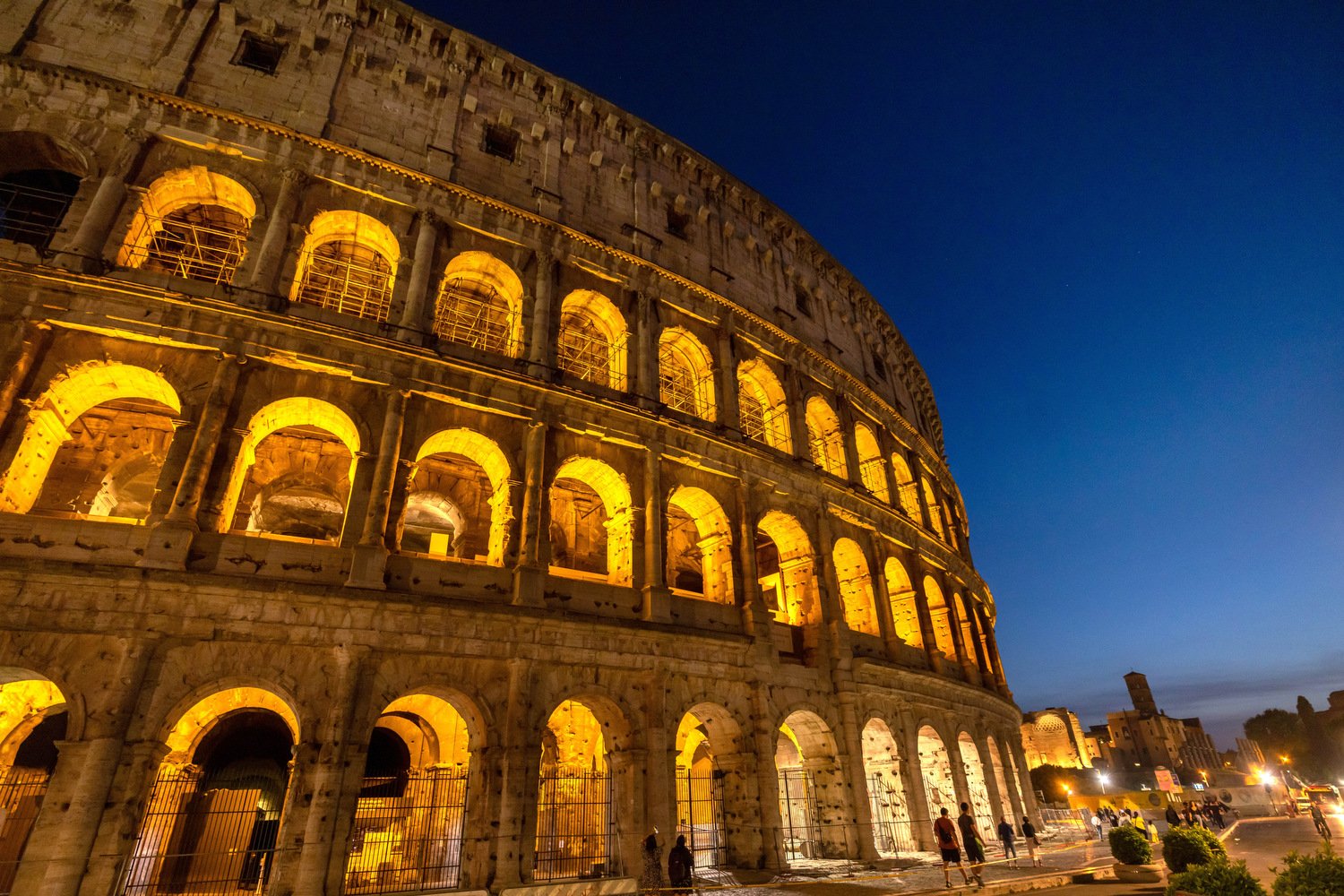
The Colosseum at night - it is lit beautifully and it is cooler - a great combination.
The Colosseum at Night
For beautiful photos, don’t forget to come back and experience the Colosseum at night! It is dramatically lit and against an azure evening sky, with perhaps a few stars twinkling - or even Jupiter as we were lucky to see - it is really so romantic and lovely. Go ahead - take some pictures!
We also enjoyed watching preparations for the Republic Day parade (June 2) - always something going on in Rome!

John photographing. the exterior of the Roman Colosseum at night.
What else can I see in the area around the Roman Colosseum?
Rome is a great walking city, with things to see everywhere you look! While visiting the Colosseum, the Roman Forum, and Palatine Hill, here are some other points of interest not too far away!
The Great War Memorial

The huge Great War Memorial
Not far from the Colosseum, on the Capitoline Hill, in the symbolic center of ancient Rome, stands the Vittoriano, a large national monument built between 1885 and 1935 to honor Victor Emmanuel II, the first king of a unified Italy.
You really can’t miss it, as it’s enormous, and it is topped with imposing statues of chariots that rise high into the sky, not to mention the GIANT statue of Emmanuel himself on horseback in front.
The marble structure itself is meant to represent a sort of modern forum, though it is sometimes uncharitably called a “wedding cake” or “typewriter” by those who find it to be rather a miss architecturally. As with a lot of historical features of Rome, this monument has a bit of a complicated history, but after World War I, the Tomb of the Unknown Soldier was placed here, and thus it became somewhat regarded as a War Memorial, though that wasn’t the original theme.
Its pure size is what makes it impressive, and also what makes it controversial in many ways. From the onset of it being built, the ostentatious use of marble and just the excessiveness of it all ran counter to the image of Rome as the capital of classicism. It still triggers mixed emotions today.
For 12 Euros, you can go inside. There is a museum, but most interesting to me is the roof! You can take a lift up to the Panoramic Terrace and experience stunning views of the city, including the Colosseum and the Roman Forum. It’s a little expensive just for a view, but I do enjoy a good vista!
Rome Rose Garden

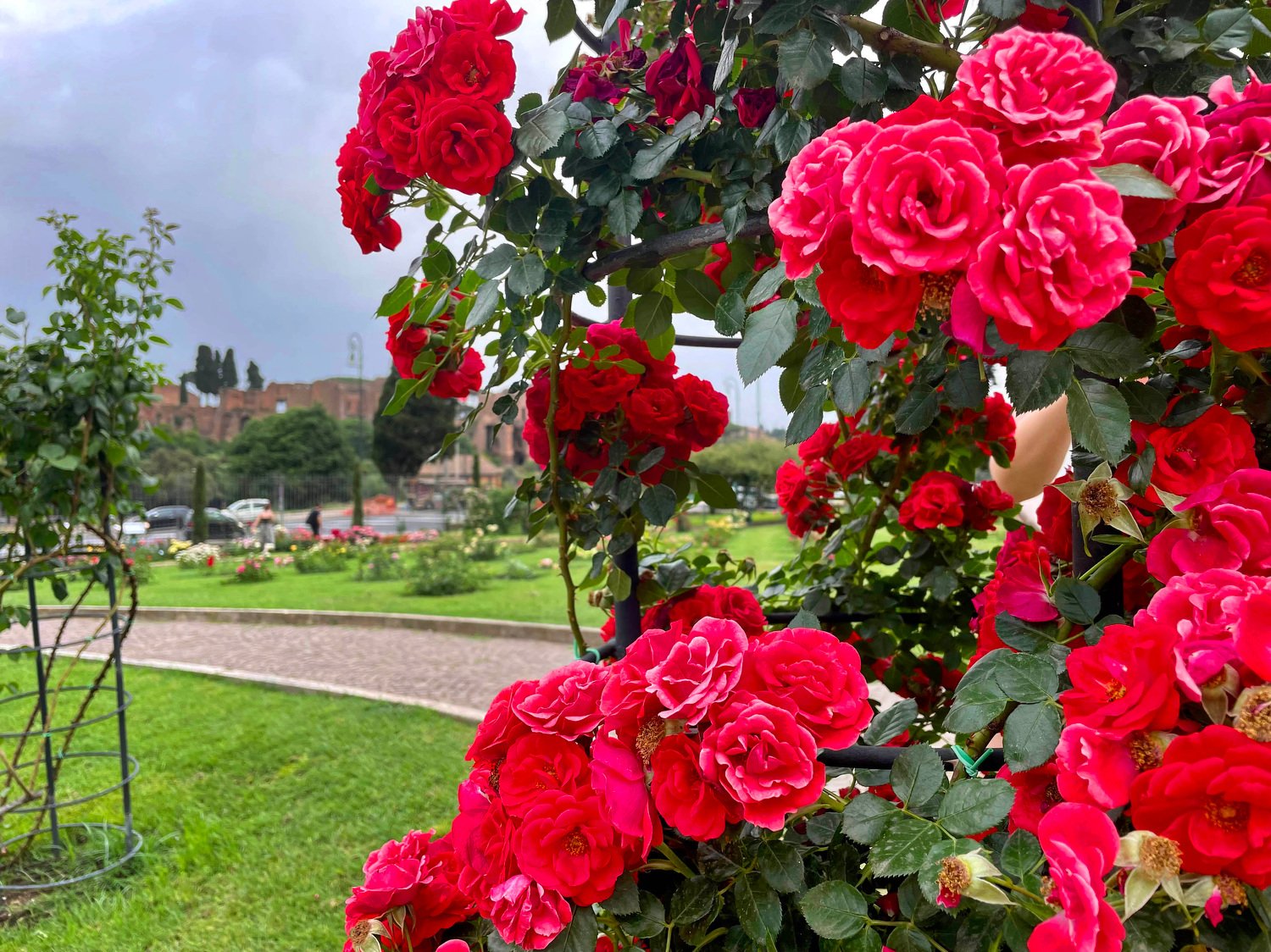
Roses bloom at the Rose Garden in Rome
As this area of Rome can be pretty exhausting with the hustle-bustle of the busy city plus all the tourist activity, the Rome Rose Garden (The Roseto Comunale) is a nice relief from the sensory overload. Italy has long adored the rose, in fact, there originally were public rose gardens located at the Colosseum!
But those were destroyed during WWII. Eventually, in 1950, the tradition of the Roman public rose garden was re-established at the site we see here today, about a 15-minute walk from the Colosseum. Entry is free but it’s only open to the public for a short period of time, from late April through the middle of June.
The Rome Rose Garden boasts over 1,100 varieties of roses, and we loved it so much, we wrote a whole post about it - The Rose Garden of Rome. Take a look at lots of information.
Circus Maximus

Circus Maximus
If you haven’t had your fill of ruins yet, Circus Maximus is not far away! It’s quite close to the Rose Garden and has its own metro stop. Circus Maximus was the largest stadium in ancient Rome and was built for chariot races.
It’s pretty low-key to visit; you can just walk around at your own pace. You can also see great views of the ancient structures of the Park of the Aqueducts from there.
Trastevere
Evening diners in Trastevere
For a calm ending to a busy day, we highly recommend dinner in Trastevere Rome’s charming neighborhood that features some great restaurants.
It’s about a 15-minute walk from the Rose Garden, or 30 minutes if you are coming straight from the Colosseum. Crossing over the Tiber River, you will feel the vibe change and slow down, and you’ll be in for a lovely evening.
The Colosseum's surprising second life
Did you know - the Colosseum wasn’t always truly appreciated for the historical treasure it is?
In fact, it went through various periods of neglect.
With the fall of the Roman Empire, the Colosseum fell into a state of abandonment. Powerful Romans would often use ruins as a quarry, carting away stones and precious metals.
The travertine stone of the Colosseum was used in the building of Palazzo Barberini, the Basilica of Sant’Agostino, Palazzo Venezia, Palazzo della Cancelleria, and even for some parts of St. Peter’s Basilica! It was also used to build the containing walls of the Tiber River. It’s everywhere! No wonder so much of it is missing!
Also, in the years after World War II, the Colosseum became a location for black market activity, as many items had become scarce after the war. It was considered a seedy neighborhood at that time, and a good spot to carry out illegal transactions. You can still see markings on the walls (pointed out by our tour guide) where sellers advertised their goods and prices.
It only became a World Heritage Site in 1980! And it wasn’t even elected as one of the New Seven Wonders of the World until 2007. I find that pretty astonishing.
With recent news stories about tourists carving their initials into the Colosseum's walls, I thought maybe we should all stop and take a moment to give this magnificent artifact a little love and consideration. After all, it has seen a hell of a lot and has much to tell us.
Now “Go! Travel! See Europe!” - you said it, sister!
About the Authors

|
John and Debbie O'Boyle are the team behind The Empty Nest Explorers. John is a professional photographer whose work has been published by The New York Times, NBC News, and Getty Images. He is a member of the American Society of Media Photographers, has been part of a Pulitzer Prize-winning team, and has received two New York Emmy nominations. Debbie is a writer with 30+ years of professional photography experience, formerly with The Star-Ledger and NJ.com. Together, they create in-depth travel guides for couples and empty-nest travelers who want to make the most of every destination. |
Some well-reviewed Rome tours:
Our other Italy travel posts:




The Colosseum lives up to the hype, but getting tickets is more complicated than it should be.
John and I walk you through everything, how to buy tickets, which tour is worth it, what to bring, and what to see nearby.