
Palais Garnier Paris: Complete Visitor Guide 2026
Updated: August 6, 2026
For pure grandeur, nothing is quite like a visit to the Palais Garnier - the Opera House of Paris, located at Place de l'Opera in the 9th Arrondissement.
Even if taking in a ballet or opera performance is not on your agenda, you can still experience this magnificent building that is a homage to French decorative architecture of the late 19th century. All you need to do is buy an admission ticket for a self-guided tour of the interior of the Opera House.

Interior of the Paris Opera House All photos by John O’Boyle / The Empty Nest Explorers
| Address | Place de l'Opéra, 75009 Paris (entrance at corner of Rue Scribe and Rue Auber) |
| Hours | Daily 10am to 4pm (10am to 5pm mid-July through August). Last entry 1 hour before closing. |
| Self-Guided Tour | From €15 per adult. Book online in advance at operadeparis.fr. No tickets sold on-site. |
| Guided Tours | Several options available. Check operadeparis.fr for current pricing and availability. |
| Auditorium Access | Frequently closed for rehearsals. No ticket guarantees access to the performance hall. |
| Metro | Opéra station (Lines 3, 7, 8) or RER Line A (Auber station) |
| Best Time to Visit | Early morning, especially 10am to noon for natural light in the Grand Foyer |
What to expect while visiting the Palais Garnier in Paris
Like many of France’s famous museums and arts spaces, the Palais Garnier is in itself a masterpiece, and a walk through its rooms is immersively theatrical in its own right. The overarching color scheme is sumptuous gold and rich velvety red - said to have been chosen to "complement the ladies' blushing low necklines". Oh my!
It’s really hard to describe - and even harder to take in - the sheer opulence of Palais Garnier. Everything is gilt, palatial and ornate: towering marble columns, bronze statues, crystal chandeliers, rich paintings and detailed frescoes.
The main attraction is the marble staircase of the Grand Escalier, with its thirty-meter-high vaulted ceiling and myriad colors of exquisite marble. It branches into a double staircase leading to the various foyers, rooms and the theater.
And this certainly is an attraction.
At many beautiful sights we have visited in our travels, we are used to encountering large crowds of people feeding their Instagram accounts. That’s normal and expected. As photographers ourselves, we appreciate that so many people enjoy taking pictures. We get it.
But, wow, the Instragram posing at the grand staircase was like nothing we ever experienced before! More so than at the Eiffel Tower, more so than in front of the Spanish Steps of Rome, more than anytime at Times Square in NYC. So many people came dressed up and decked out to pose on the staircase, that it was almost a little hazardous getting through!

The Paris Opera House grand staircase.
But I don’t want to sound like a cranky tourist about it - we all enjoy beautiful settings, after all. I guess this just really drove home to us how spectacular these surroundings are.
Just saying, don’t expect to be alone on your visit, even if there is no line outside to get in! Granted, we did go in the middle of the afternoon, and I imagine had we gone at 10 am when it opened, there may have been a few less people.
One important thing to know before you go: tickets are no longer sold at the door.
When we visited, we were able to walk up and buy tickets at the box office, but that policy has changed. You now have to book online in advance at operadeparis.fr. Given how popular the Palais Garnier is, that's probably a good thing. Slots sell out, especially in the summer.
The auditorium was closed when we visited, which happens often due to “theater activity”. Understandably, of course, the auditorium needs to be closed when the stage is set for a performance, but I thought there should be some discount on the ticket when the auditorium is closed. For the 15€ entrance fee, you are really only getting access to the foyers and stairwells if the auditorium is closed, and missing out on a lot by not seeing the theater space. That’s where the famous chandelier is after all!
But I enjoyed peeking in the windows on the doors to the private boxes and imagining who may have used them. The Opera House has long been a main attraction for state visits and such, so I’m sure I was walking in the steps of royalty, famous dignitaries and celebrities.

Photographing the Palais Garnier
The Palais Garnier is one of the most photogenic interiors in Paris. If you like to shoot, plan a little for it.
Personal photography is allowed throughout the public rooms. Flash is not. It can damage the artwork, and it bothers other visitors. You will get better results without it anyway, since the interior light is warm and even.
Tripods are not permitted. Neither are selfie sticks or other stabilisers. If you want a steady shot in low light, brace your camera on a railing or a wall. The railings are very wide so it’s easy to brace a camera.
The Grand Staircase is the shot everyone wants. It is also the most crowded spot in the building. We found that there is no way to get the staircase without people, so just embrace the scene. It's fun to watch everyone all dressed up trying their perfect poses for Instagram.
If the only camera you have is your phone, you’ll do fine here. The rooms are bright enough. If you are bringing a camera, a wide lens helps with the ceilings and the scale of the staircase. While it’s hard not to get swept up in the beautiful sweeping wide shots, don’t forget to get close-up detail photos of the ornate decor.
| Personal photos | Allowed in all public visitor areas |
| Flash | Not allowed. It can damage the artwork. |
| Tripods & stabilisers | Not allowed |
| Selfie sticks | Not allowed |
| During performances | No photos, filming or recording |
| Professional shoots | Need prior permission by email |
| Best light | Grand Foyer, mid-morning, 10am to noon |
Visitor information for the Paris Opera House
Hours: The Palais Garnier is open daily from 10 am to 4 pm. From mid-July through the end of August, it stays open until 5 pm. Last entry is one hour before closing. The building is closed on January 1st and May 1st.
Tickets: Self-guided tours start at around €15 per adult. Check operadeparis.fr for current prices, since there are different rates for EEA residents, students, seniors, and other categories. Children under 12 get in free. Book online before you go. No tickets are sold on-site.
Guided tours are available in several formats. Book those well in advance. They fill up fast.
The auditorium: Plan around the possibility that it will be closed. Rehearsals often close without much notice. We missed it entirely on our visit. It is genuinely disappointing to miss the chandelier and Chagall ceiling up close. But even without it, the foyers and the Grand Staircase are worth every euro.
If you can manage it, go in the morning. The Grand Foyer looks best between 10 am and noon, when natural light comes through the windows and the crowds haven't fully built up yet. By mid-afternoon, the staircase is absolutely packed.
For reasons related to theater activity, the auditorium is regularly inaccessible to visitors and some areas may be closed.

An ornate ceiling in the Paris Opera House
Palais Garnier is located at:
Place de l’Opéra,
75009 Paris
Entrance at the corner of Scribe and Auber Streets
The entrance was a little tricky to find. At first we accidentally went into the exit, which is at the front of the building and not really marked as such. And, judging by how quickly a staff member redirected us, I don’t think we were the only people to make that mistake!
Getting to the Palais Garnier:
Metro: Opéra station (lines 3, 7 and 8)
RER: Auber station (line A)
Bus: lines 20, 21, 27, 29, 32, 45, 52, 66, 68, 95
Car park: Q-Park Edouard VII - Rue Bruno Coquatrix 75009 Paris (in front of 23 Rue de Caumartin)
Official website also gives you a link to reserve a parking space

The exterior of the Paris Opera House
Finding your way through the Palais Garnier
Once you're inside, the building unfolds in stages. You enter through the Subscribers' Rotunda, a circular domed space where Paris's most prestigious opera patrons used to gather before performances. It sets the tone immediately. The scale and the detail tell you right away that this is not a normal building.
From there, the Grand Escalier draws you in. You've probably seen photos of the staircase, but nothing quite prepares you for standing at the bottom of it and looking up at that thirty-meter ceiling.
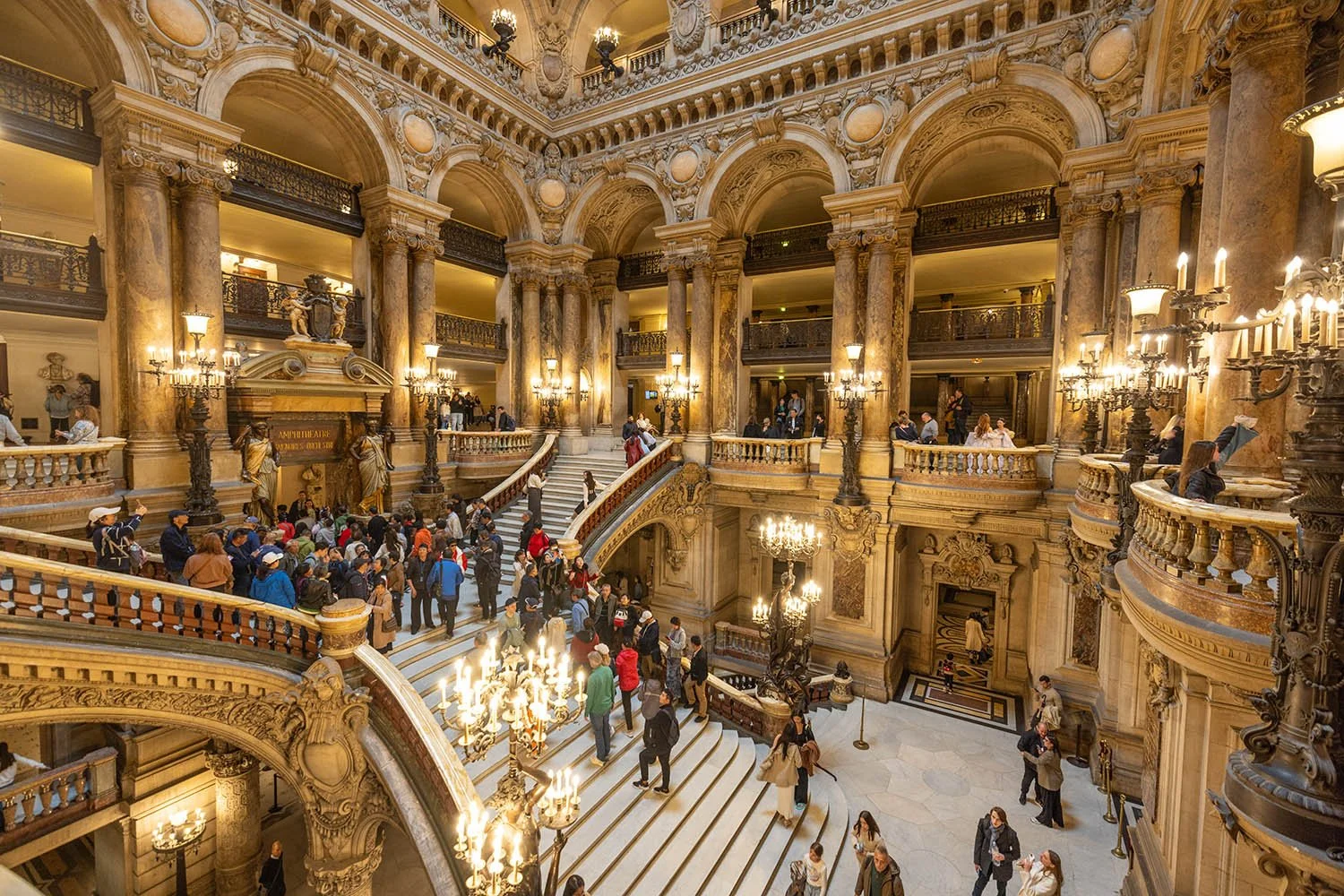
In addition to the amazing architecture the Grand Escalier is a great spot for people watching.
The Grand Foyer, which runs along the front of the building, is where I stopped and just stood there for a moment. Every single inch of it is covered in either gold leaf or an ornate painted scene. Mirrors, gilded pilasters, and painted ceiling vaults. It goes on and on. It feels less like a lobby and more like a palace hall, which was very much the point. Going to the opera in the 19th century was as much about being seen as it was about the performance, and the Grand Foyer was where that happened.
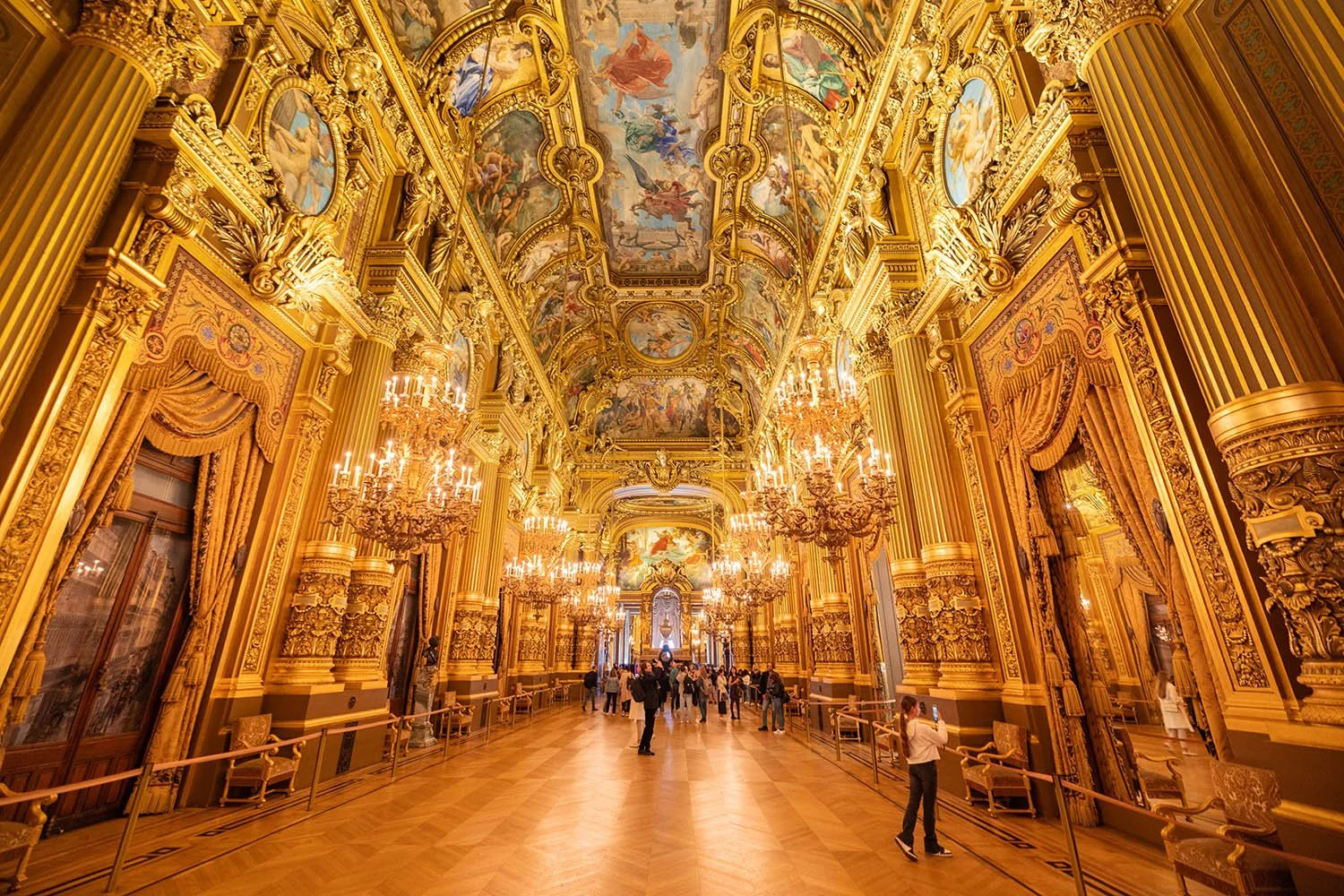
It’s hard to believe that The Grand Foyer is real, but it is.
Off the Grand Foyer, you'll find the Salon du Glacier, the old refreshment room. After all that gold, it gives your eyes a slight break. But the room more than holds its own. It's a gorgeous circular space with an ornate painted ceiling and a beautiful wood floor in an intricate pattern. Don't skip it.
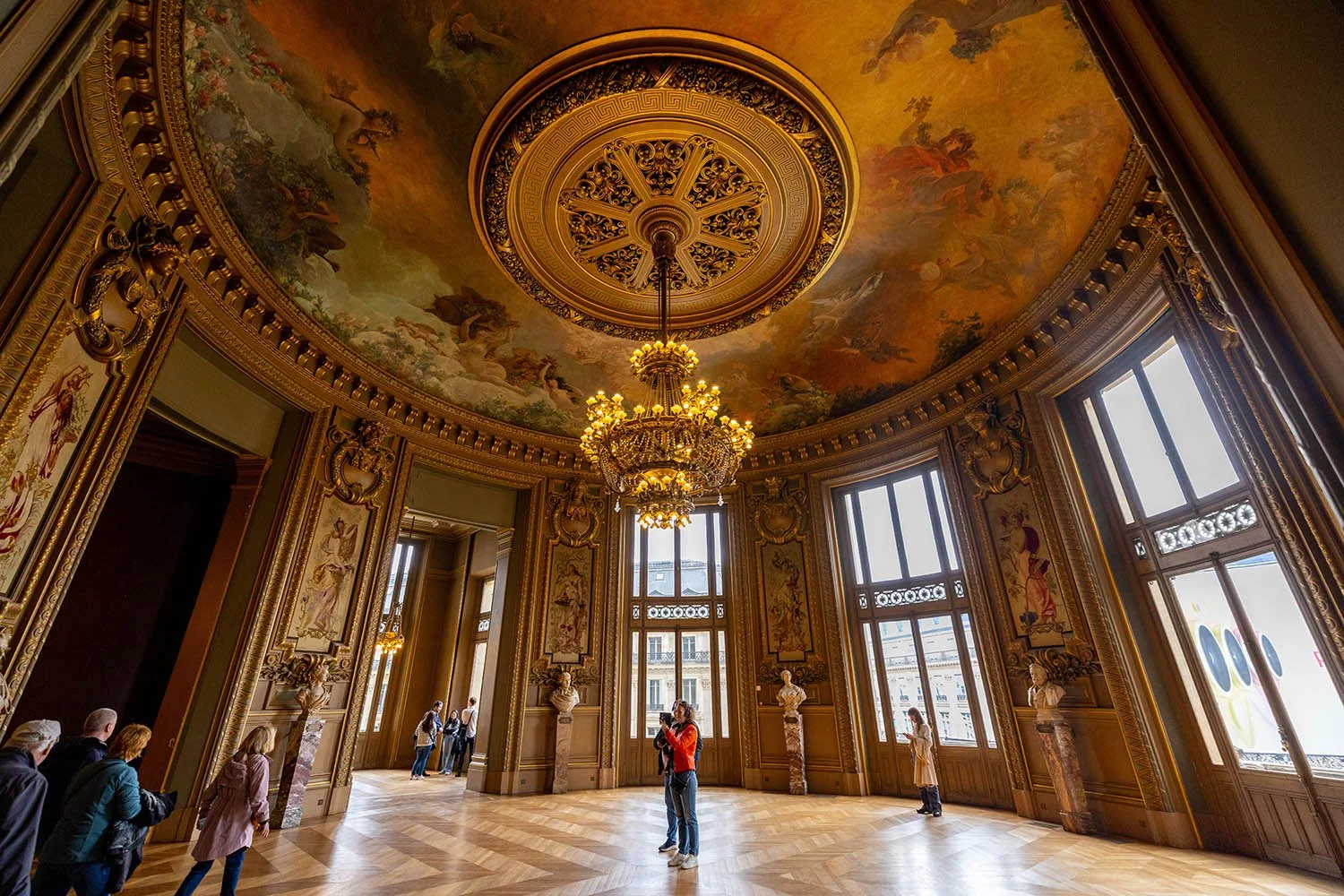
The Salon du Glacier is less ornate than other rooms but equally impressive.
| HOTELS | Booking.com Lots of search options. The customer reviews are very helpful. | Link ↗ |
| ACTIVITIES | Viator A wide variety of tours, food experiences and historical guides. | Link ↗ |
| AIRFARE | FareDrop Alerts for cheap flights customized by your home airport. | Link ↗ |
| PHONE | Airalo Easy to use eSIM for data and calls in every country. | Link ↗ |
| TRAIN TRAVEL | Trainline We book all our trains here. Easy to use and comprehensive listings. | Link ↗ |
The auditorium, and our one honest gripe
The auditorium was closed when we visited. That happens a lot, usually for rehearsals. It holds the Chagall ceiling and the famous chandelier. Missing it is a real letdown.
Here is our one honest gripe. The ticket cost the same whether the theater was open or not. We paid full price and saw less. It felt like the price should drop when the auditorium is closed.
Still, the staircase and the foyers carried the whole visit. We walked out happy anyway. This is one of the most beautiful interiors in Paris.
The Palais Garnier is heading into a major renovation. The theater and stage, home to the Chagall ceiling and the famous chandelier, are set to close from mid-2027.
Recent reports suggest the work could run as long as 2032, after lead was found near the stage. The Grand Staircase and Grand Foyer are expected to stay open through most of it. Some areas may close off at times.
If seeing the auditorium matters to you, plan your visit before mid-2027. Even now the theater is often shut for rehearsals, so access is never a sure thing.
We missed the auditorium on our own visit and still loved every minute. Check operadeparis.fr for the latest before you book.
Some history and interesting facts about the Paris Opera House
The stunningly ornate Palais Garnier was completed in 1875 and named after its architect, Charles Garnier. It has been classified as a historic monument since 1923.
Garnier was unknown at the time when he won the commission. He used his Beaux-Arts training to create an expressive, eclectic design that featured layered arcades, columns and alcoves, crowned with a dome, giving it the grandeur of a palace. It was his over-the-top design that won the competition for the job.
Garnier insisted that no trees be planted on the street leading up to the building, in order to emphasize its monumental size and to not block views of it.
The ornate front facade features seven archways and massive columns that contain six types of stone and precious metals. Between the columns are gilded bronze busts of great composers.
Palais Garnier serves as the setting for Gaston Leroux’s The Phantom of the Opera, first published as a serial novel in 1909 and 1910. The character of the Phantom is loosely based on two different real-life characters: a pianist who was badly burned in an 1873 fire at the Palais Garnier’s precursor, the Salle Le Peletier, and an assistant to Garnier who disappeared during construction.
The falling chandelier in The Phantom of the Opera was based on a real incident which occurred in 1896. During a performance, a short-circuit caused a counterweight from the chandelier to fall, killing a woman in the audience and injuring several more people. Leroux was a journalist at the time with a Paris newspaper and reported on the story.
Wait, there’s still more “Phantom” history: While the foundations for the opera house were being dug, workers hit a hidden arm of the Seine, causing water to flood the site. They could not remove all the water, so crews had to contain it with a massive concrete reservoir with a vaulted ceiling from which water is still pumped today. This “lake” was also featured in The Phantom of the Opera as the stomping grounds of the Phantom.
Palais Garnier is the primary venue for the national ballet company of France, the Paris Opera Ballet. You can find their schedule at Programme & Tickets - Opéra national de Paris.
The current ceiling in the theater of the Palais Garnier was painted by Marc Chagall. One hundred sculptors and painters worked on the art of the opera house.
John and I saw Chagall’s gravesite on a recent visit to Saint Paul de Vence. It’s a charming medieval hill town in the South of France. We highly recommend a visit if you have the opportunity: Visiting Saint Paul de Vence: the oldest medieval town in the South of France
So yes, the Palais Garnier is still a must-go in Paris. We would send anyone here. Go in knowing the theater may be closed. Check the current rate on operadeparis.fr before you book, so you know what your ticket covers.
Palais Garnier FAQs
Is the Palais Garnier free to visit?
No. A self-guided daytime visit starts at around €15 for adults. Children under 12 get in free. Reduced rates apply for EEA residents, students, seniors, and a few other groups. Check operadeparis.fr for the current rates.
What are the Palais Garnier opening hours?
The Palais Garnier is open daily from 10 am to 4 pm. From mid-July through the end of August, it stays open until 5 pm. Last entry is one hour before closing. It is closed on January 1st and May 1st.
Can you buy Palais Garnier tickets at the door?
Booking online ahead of your visit is the safest bet. Slots sell out in summer. Walk-up tickets may be available at the box office on some days, but that is not guaranteed. When we visited, we bought at the box office, though we would book ahead now. Check operadeparis.fr before you go.
Is the Palais Garnier worth visiting?
Yes. It is one of the most spectacular interiors in Paris. The Grand Staircase and Grand Foyer alone are worth the ticket. It is also an easy visit that does not need much planning.
Can you go inside the Palais Garnier without seeing a show?
Yes. You do not need a performance ticket. A self-guided daytime visit lets you walk the public rooms on your own, including the staircase and the foyers.
Will you see the auditorium and the Chagall ceiling?
Maybe. The auditorium closes often for rehearsals, with little warning. No ticket guarantees access. We missed it on our visit. The staircase and foyers are still worth it if the hall is closed.
What is the best time to visit the Palais Garnier?
Early morning, ideally 10 am to noon. Natural light fills the Grand Foyer, and the crowds are thinner. By mid-afternoon, the staircase gets packed.
What arrondissement is the Palais Garnier in?
The 9th. It sits at Place de l'Opéra. The entrance is at the corner of Rue Scribe and Rue Auber. Take the Metro to Opéra station on lines 3, 7, or 8.
Is the Palais Garnier closing for renovation?
The building is heading into a major renovation. The auditorium, with the Chagall ceiling and the chandelier, is set to close from mid-2027. Recent reports suggest the work could run until 2032 after lead was found near the stage. Daytime visits to the staircase and foyer are expected to continue, though some areas may close at times. Check operadeparis.fr for the latest before you book.
About the Authors

|
John and Debbie O'Boyle are the team behind The Empty Nest Explorers. John is a professional photographer whose work has been published by The New York Times, NBC News, and Getty Images. He is a member of the American Society of Media Photographers, has been part of a Pulitzer Prize-winning team, and has received two New York Emmy nominations. Debbie is a writer with 30+ years of professional photography experience, formerly with The Star-Ledger and NJ.com. Together, they create in-depth travel guides for couples and empty-nest travelers who want to make the most of every destination. |
Some well-reviewed Paris tours:
Note - This blog post contains affiliate links. This means that if we are recommending a product, activity, or hotel, we might be receiving a small commission if you buy or book from these links. This is done at no additional cost to you. We only recommend products we have personally used or have thoroughly researched.
Other travel blog posts you might like:


We have found that the South of France is not only incredibly beautiful but also very easy to visit. Most of the towns along the French Riviera are connected by train and driving between them is easy too.