
Visiting Glamis Castle in 2026: Our Complete Guide
Glamis Castle, one of the grandest old castles in Scotland, has long been on my bucket list. Famous for its towering fairytale turrets, storied royal history, and deep ties to Scottish legends, a visit to Glamis is, in my view, a quintessential Scotland experience.
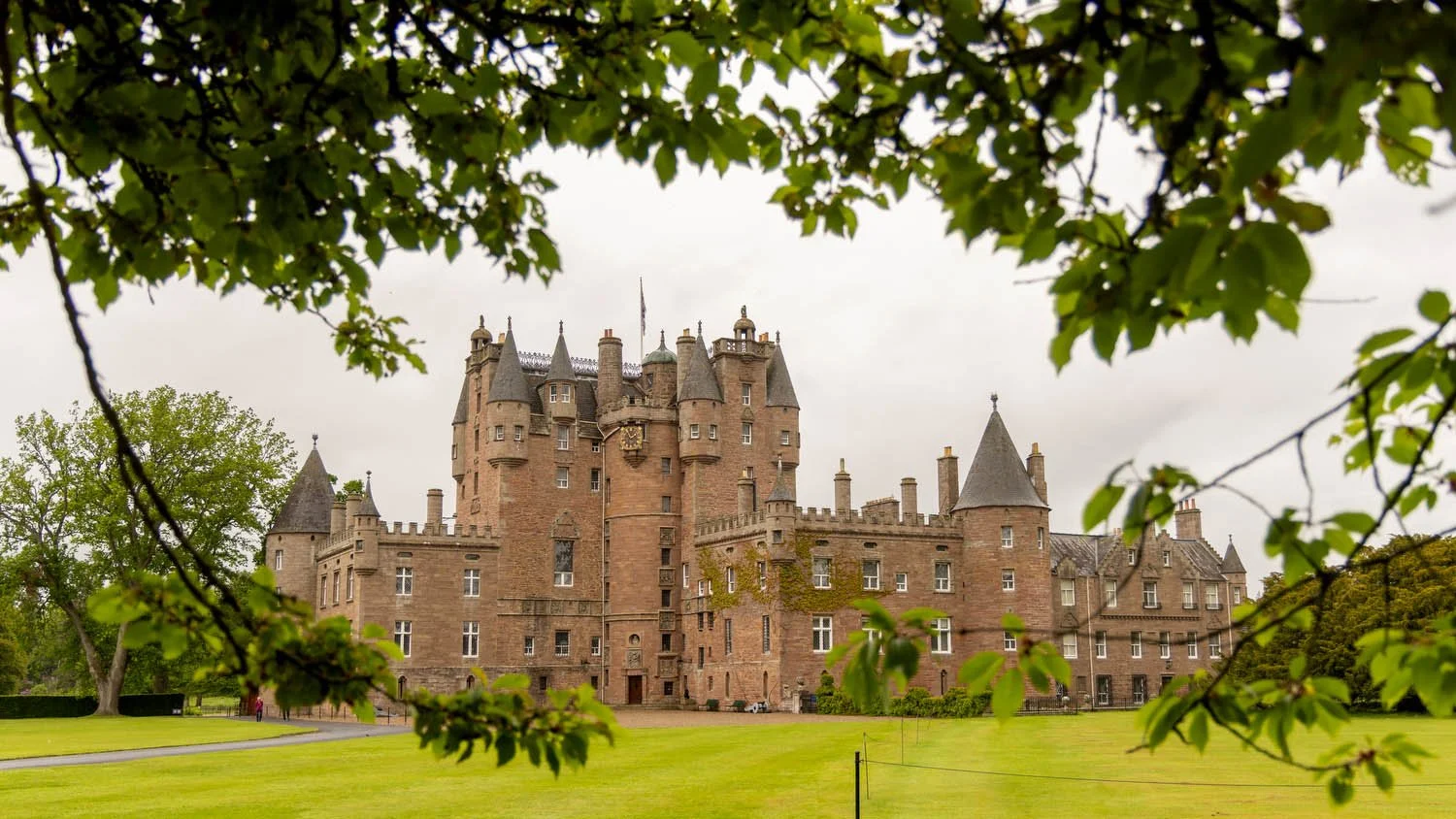
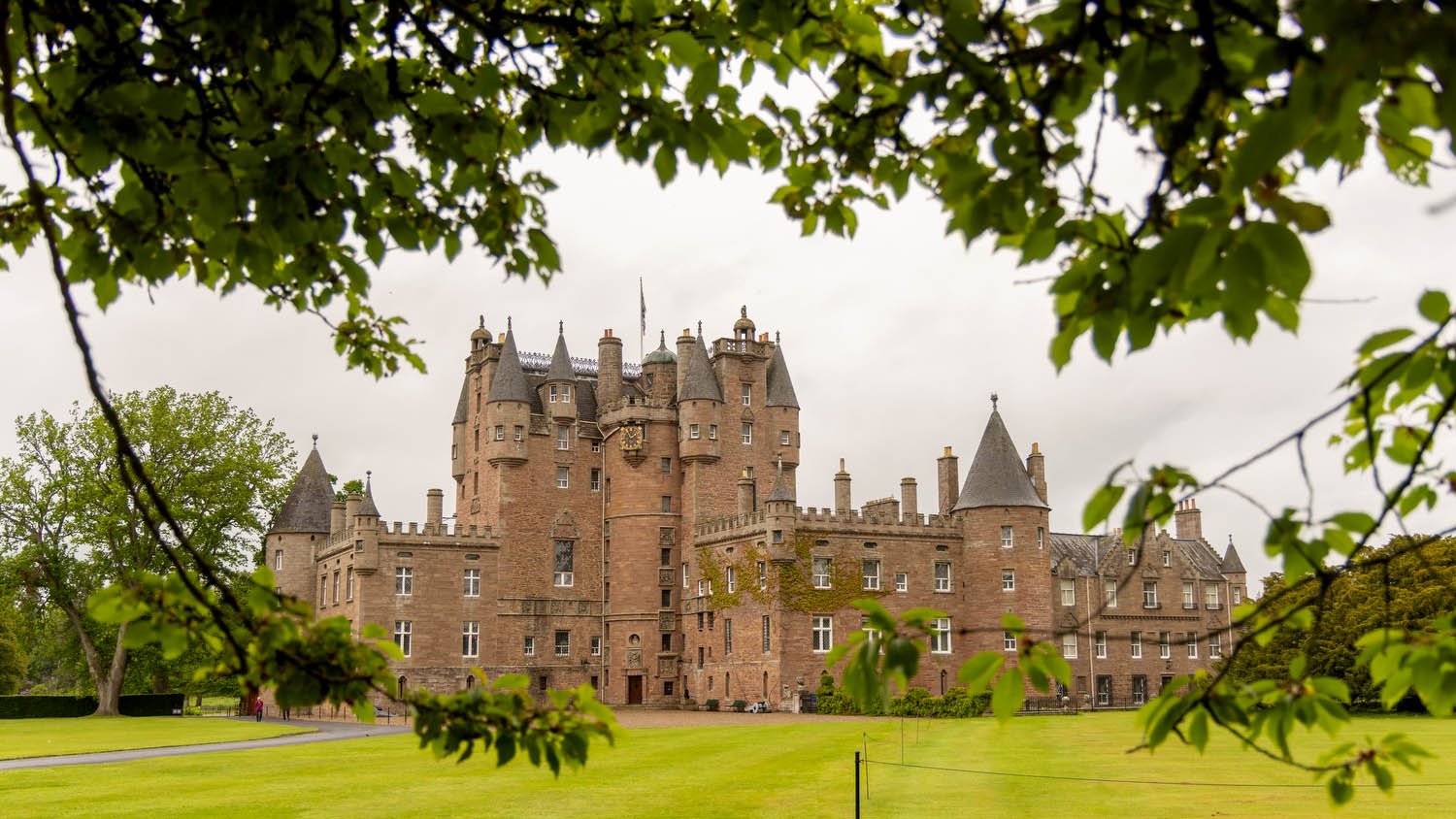
Beautiful Glamis Castle, in Angus, Scotland. All photos by John O’Boyle / The Empty Nest Explorers
We visited in the late spring with gardens abloom and rain on and off - which seemed appropriate for visiting a Scottish castle. From beginning to end, Glamis did not disappoint in any way!
The legendary long approach to the castle serves as a dramatic introduction. The straight driveway, almost a mile in length and lined with grand old oak trees, telescopes your view of the pink sandstone medieval castle at its end. It’s pretty epic. The slow drive up takes a few minutes (it felt longer to me, but John says that’s because I was holding my breath! 😂)
| 📍 Location | Glamis, Angus, in eastern Scotland. Put postcode DD8 1QJ into your sat nav. |
| 🎟️ Tickets | Castle Tour around £19.50 adult, which includes the gardens, grounds and any seasonal exhibition. Gardens and Grounds only from £9.50. Book at glamis-castle.co.uk. |
| 🕐 Hours | Open daily 20 March to 31 October 2026, 10am to 5pm. Last entry and final tour at 4.30pm. Gardens and grounds stay open 1 November to 22 December, but the castle interior closes. |
| 🏰 The Tour | The castle interior is guided only and no photos are allowed inside. Your ticket is general admission for the day, so you arrive and join the next available tour. Tours run about 50 minutes. |
| ⏳ Time Needed | A full day does it justice. Allow time for the guided tour, the gardens, and lunch. |
| 👑 Royal Link | Childhood home of Queen Elizabeth the Queen Mother and birthplace of Princess Margaret in 1930. |
| 🚗 Getting There | Driving is really the only practical option. Around 25 to 30 minutes from Dundee and roughly an hour and a half from Edinburgh. Free parking is included with your ticket. |
| 🍽️ Eat | Castle Kitchen Restaurant, set in the original Victorian kitchen. Casual counter service, with afternoon tea by reservation. |
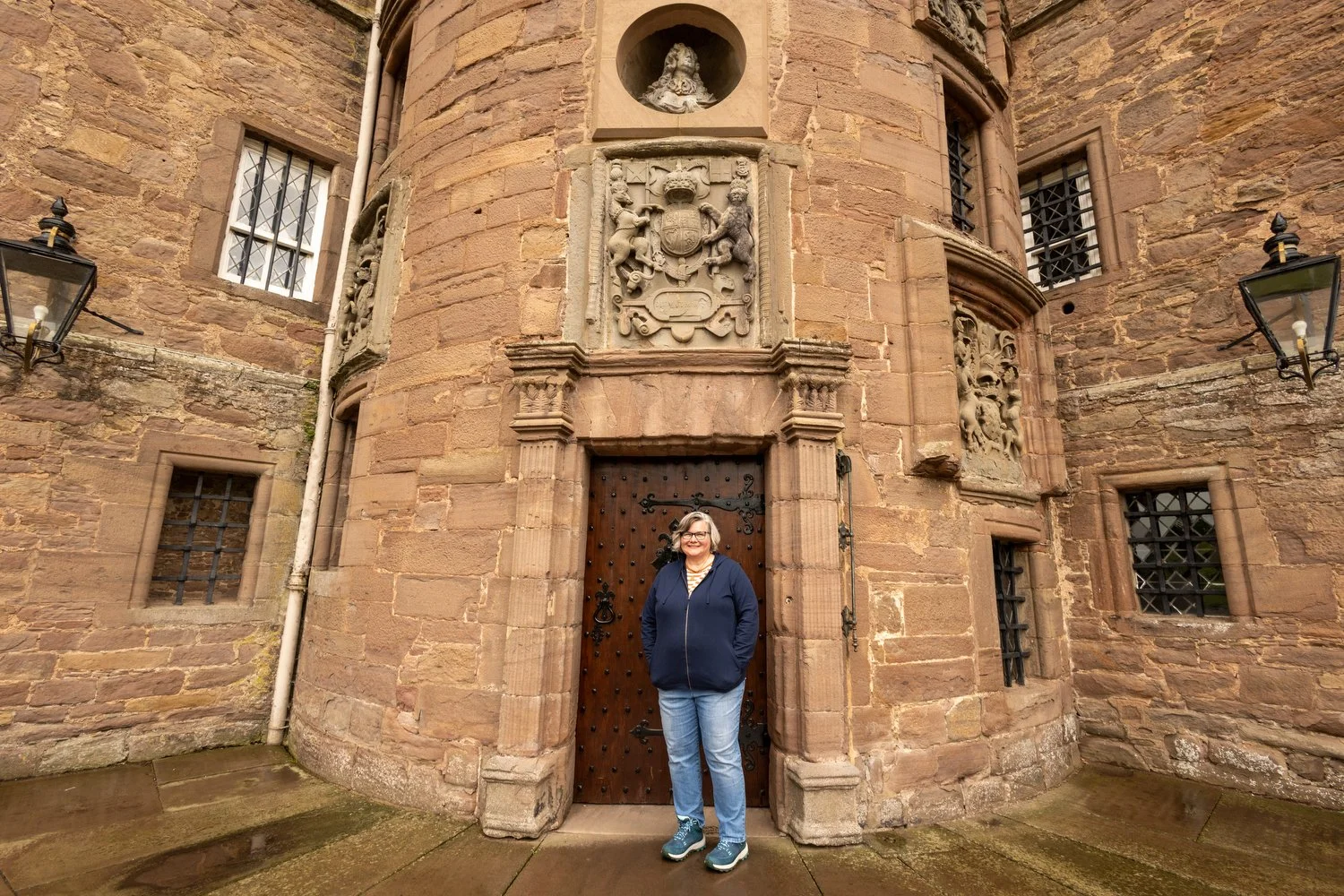
Debbie poses at the main entrance of Glamis Castle - a long anticipated visit! (But you really don’t enter that way.)
Why visit Glamis Castle
Castles are on most people’s lists when they visit Scotland, and Glamis out-castles most castles. It’s full of ghost stories - which the tour guides handle with humorous aplomb; it has a Shakespeare connection - with a certain myth we will bust a little further down this post; and, most significant to me, it has an important connection to my favorite historic figure, King George VI, as it was the Scottish childhood home of Queen Elizabeth the Queen Mother, his wife and Queen Consort.
Royal connections aside, the castle has appeal even if you don’t care much about that. As an attraction, it is very unique in character. With its heavy stone walls, medieval crypt and spiraling staircases, it looks very much like a fortress. Yet it has the sophistication of an aristocratic home, featuring functional rooms with personal touches - like the embroidery on the bedcovers that is the personal handiwork of Cecilia, Countess of Strathmore, and the art, china, furniture and personal effects collected by a family who has occupied it for generations. Changes and periodic improvements to the house are layered upon each other, but the old haunted layers have never gone away, giving it an almost theatrical feel.
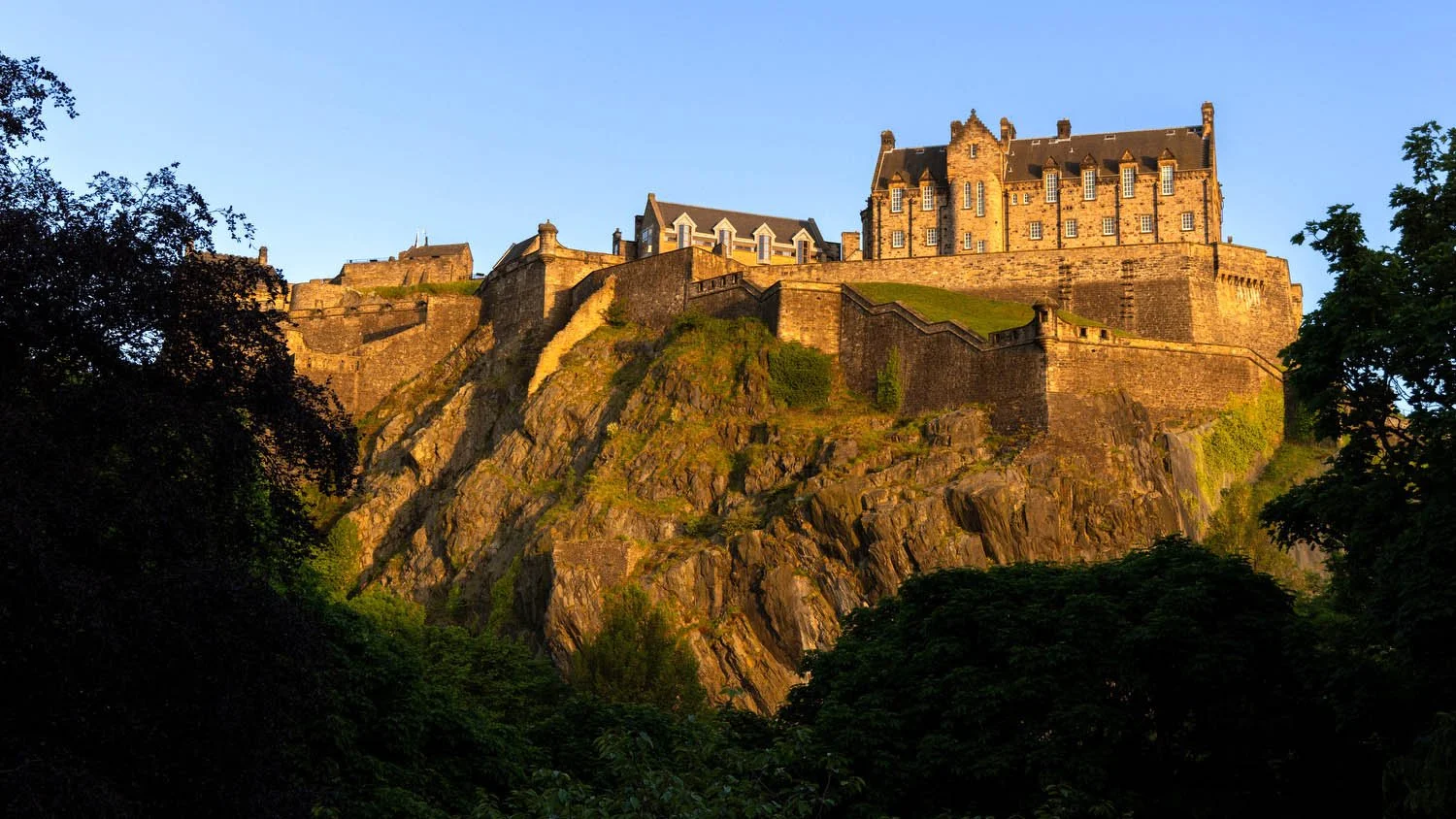
If you are visiting Edinburgh, we think you’ll also enjoy Edinburgh Castle, a classic castle on a hill. We have all the details you need in our post - Is Edinburgh Castle Worth Visiting? Our Honest Review
Along with the beautiful gardens and walking trails that anyone can appreciate, Glamis is an exceptional site to visit. The grounds continue to be a lively place, hosting seasonal events that focus on Scottish culture. Something always seems to be going on at Glamis, as their very active Instagram account attests.
Glamis is not just a historic site - it is still an active and well maintained home, belonging to the current Earl of Strathmore. For this reason, only certain areas of the castle are open to visitors (by guided tour only) and you can’t take photos on the tour.
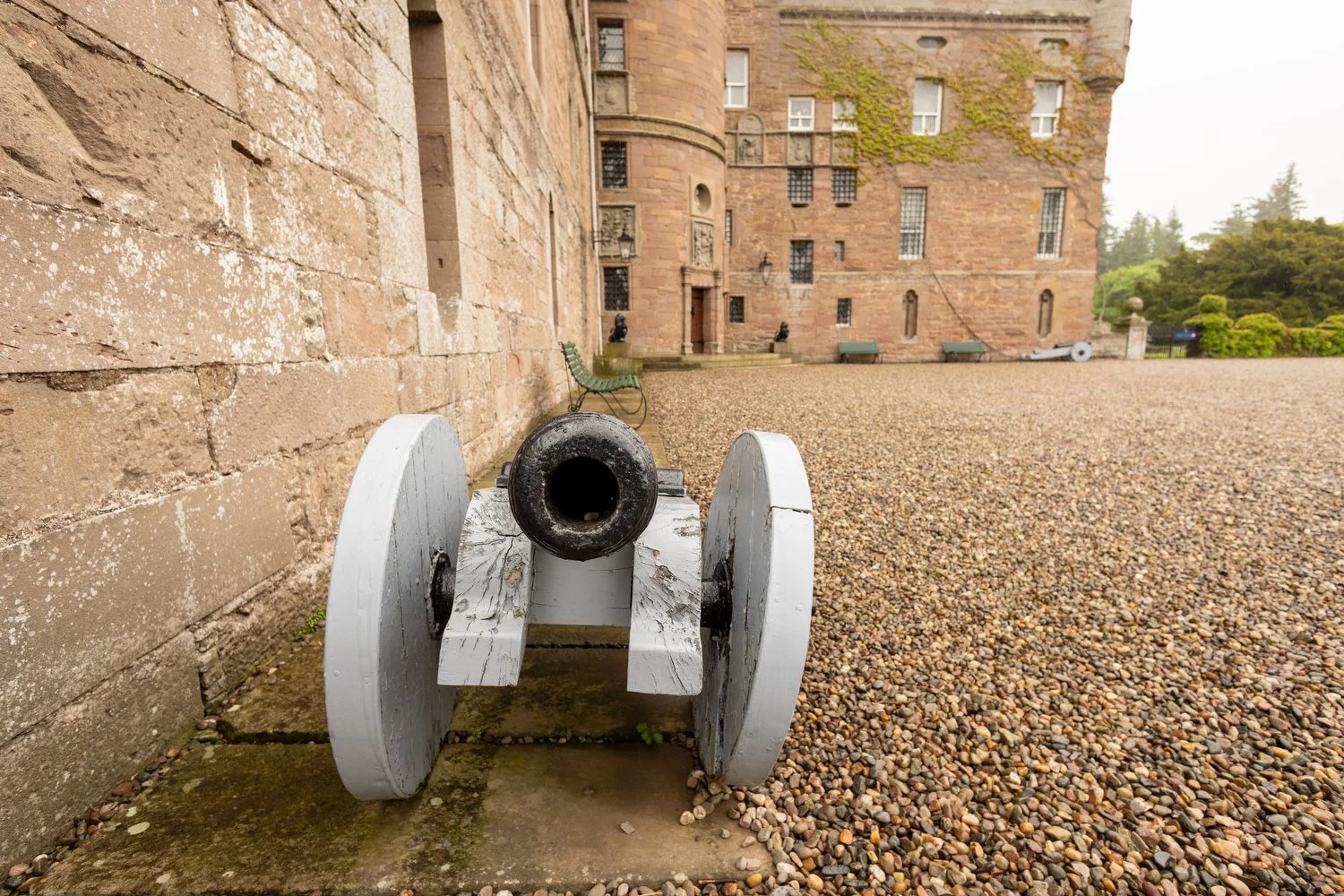
A canon outside Glamis Castle - a very “castley” castle!
The downside of visiting Glamis is that it’s a little out of the way. It is located in Angus (historically known as Forfarshire) in eastern Scotland, so you do need to make a plan. I can’t thank John enough for making it his mission to get me to Glamis on our recent Scotland holiday!
I’ll address getting there more specifically a few sections down in this post, but I’ll cut to the chase right now and say that driving is really the only realistic way to get to Glamis.
It’s about an hour and a half drive from Edinburgh, which is mostly highway driving. We did it as an add-on to a broader trip driving through the Highlands and the Isle of Skye, so our drive was through some rural areas. The prettiest stretch of that whole trip was the drive from Edinburgh through Glencoe.
Some of it was a bit hair-raising! But John did splendidly, even though we are used to driving on the opposite side of the road.
It’s a full-day visit if you want to take the guided inside tour (which I highly recommend you do) and explore the grounds and gardens.
I would also recommend lunch at Castle Kitchen Restaurant, located inside the original Victorian kitchen. It serves sandwiches, soups, sweet treats, and afternoon tea in an informal setting.
The food is quite good, and the atmosphere is just castle-perfect.
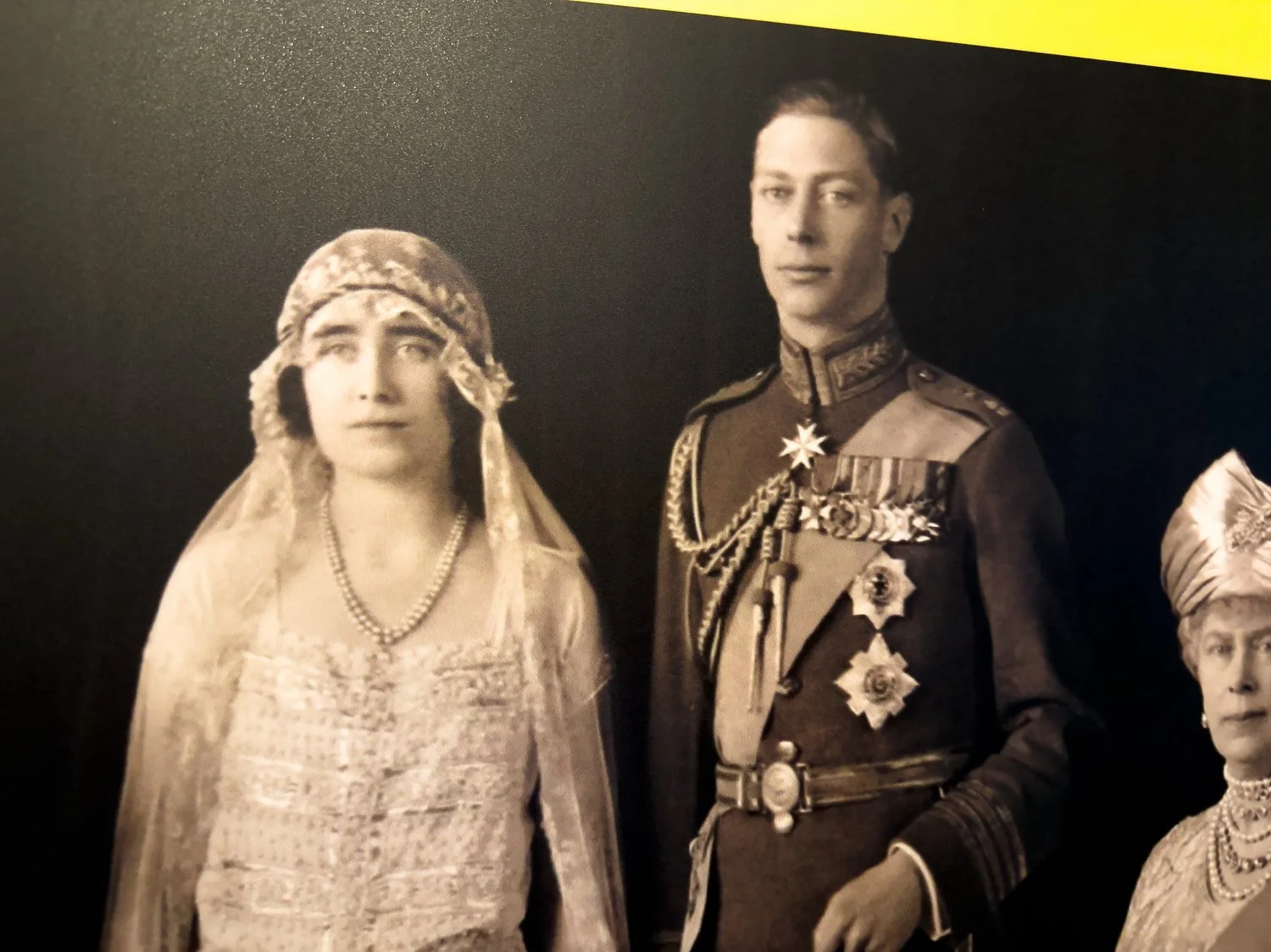
Queen Elizabeth the Queen Mother’s connection to Glamis Castle
On your visit to Glamis, you will see a good amount of focus on Queen Elizabeth, the Queen Mother. When Elizabeth was about four years old, her father Claude Bowes Lyon became the 14th Earl of Strathmore and Kinghorne, inheriting the castle along with several other properties.
Much has been written about the carefree and spirited childhood days she spent roaming the acres of the estate, gobbling strawberries in the kitchen garden, and pranking visitors with her younger brother David. Together they poured “hot oil” - really freezing water - from the ramparts on arriving guests. The youngest of ten children, the castle was their playground and the fairytale environment contributed much to Elizabeth’s vibrant personality - puckish, graceful in the spotlight, and oftentimes enigmatic.
As a young debutante on the social scene, she entertained many “charmers and society beauties” for shooting parties at Glamis, where she was the belle of the ball and much admired by the men and women alike. One of those admirers was her future husband, Prince Albert, the Duke of York (later King George VI). The playful youngest daughter of a Scottish earl had caught the eye of the son of a king.
Though it’s not where they met, Elizabeth Bowes Lyon’s relationship with the Duke of York developed at Glamis. The courtship had its ups and downs - Lady Elizabeth turning the Duke’s proposals down twice - but he steadily and determinedly won her over, leading to one of the most successful royal marriages of all time.
Albert not only fell in love with Lady Elizabeth, but with the warm, affectionate family atmosphere at Glamis. It was life-changing for him.
The couple spent part of their honeymoon at Glamis, and in the ensuing years, it became the setting for many happy summer holidays. The private suite of rooms they used while staying at the castle is part of the guided tour today - this was a highlight for me!
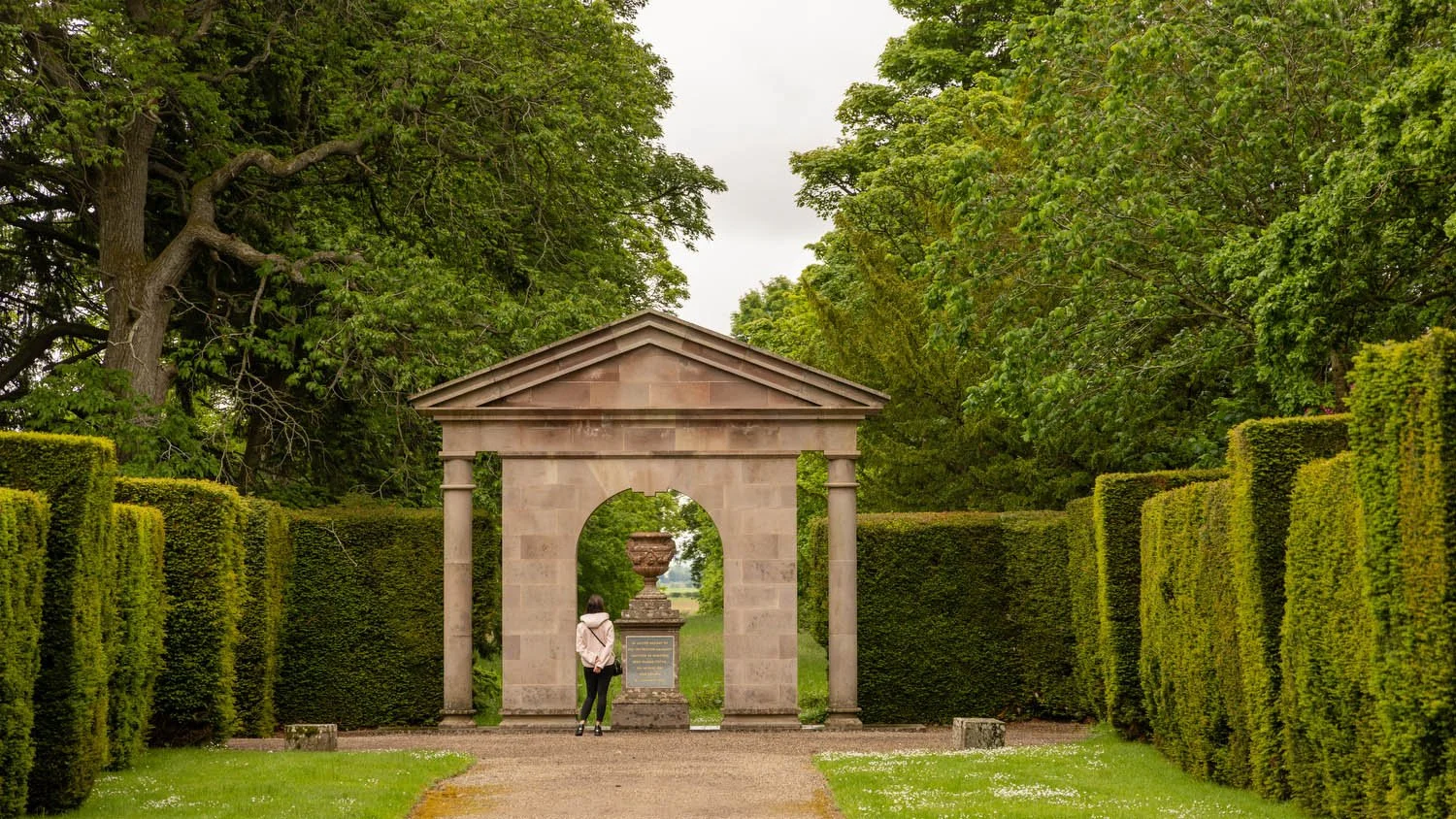
A memorial to Princess Margaret, who was born at Glamis in 1930, occupies a peaceful spot in the Castle Gardens.
Their younger daughter, Princess Margaret, sister of Queen Elizabeth II, was born at Glamis in 1930, the first senior member of the British royal family to be born in Scotland in over 300 years. It was a big deal at the time.
Today there is an affectionate memorial to the Princess near the Italian Garden.
So if you enjoy exploring royal history in your UK travels (guilty - well, at least sometimes!) seeing Glamis brings this part of the family's story vividly to life. Unlike more “official” palaces and castles which have touched many generations of royalty, Glamis’ royal connection is more personal. Not a Crown property or royal palace, but a very special retreat enjoyed by George VI and his Queen Elizabeth and their daughters, one who would grow up to be a beloved Queen herself - their little nuclear family, which he affectionately referred to as “Us Four”.
I dive deeper into Glamis’ role in the sweet and often overlooked love story of Prince Albert and Lady Elizabeth in a separate post, King George VI at Glamis Castle: a royal love story in Scotland.
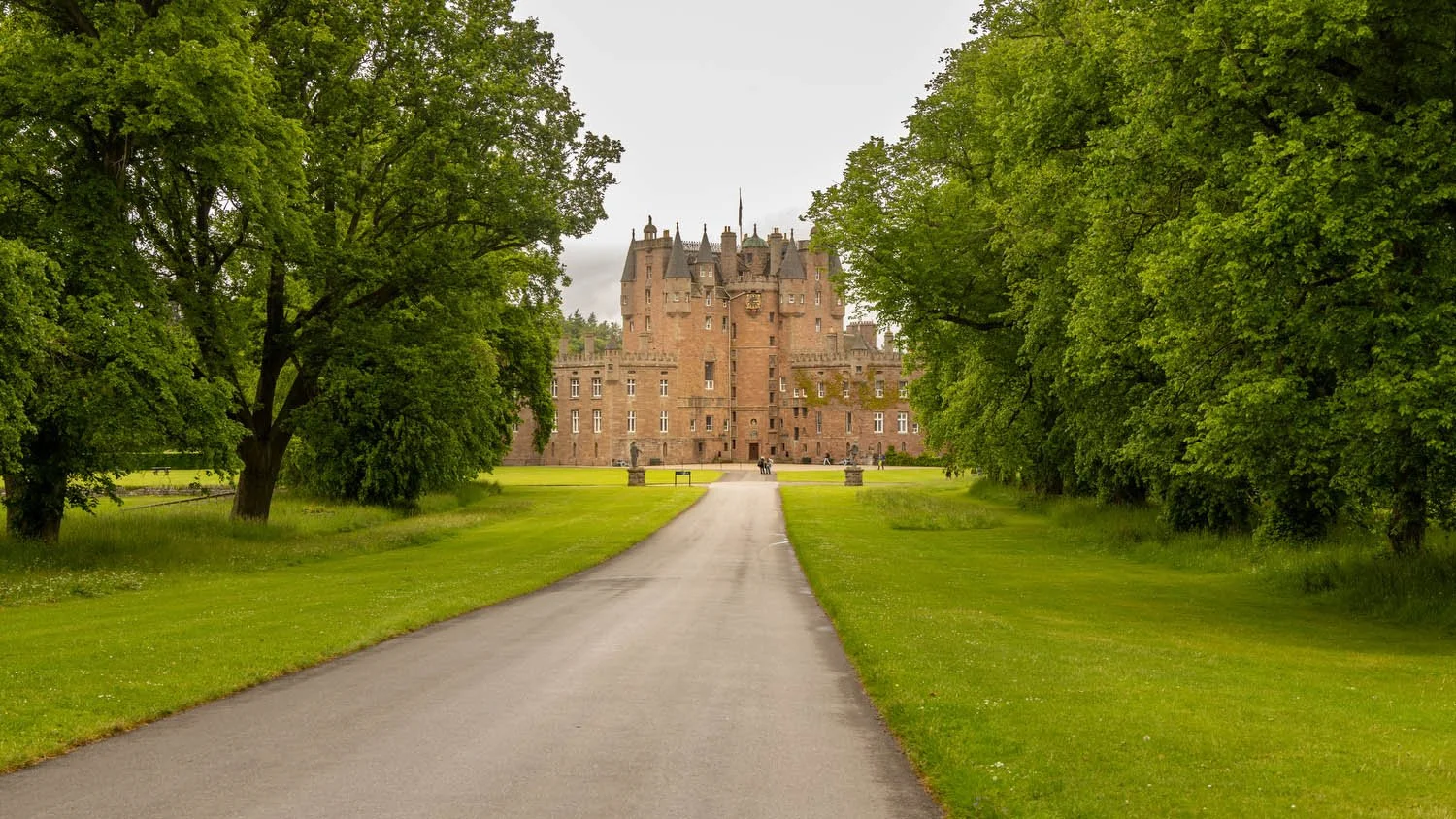
The long approach to Glamis Castle provides a dramatic introduction.
A short history of Glamis Castle
Glamis Castle -pronounced “glahms” - has belonged to one family for more than 650 years. In 1372, King Robert II (King of Scots - this predates Scotland being part of Great Britain) granted the lands, the old Thanage of Glamis, to Sir John Lyon, and the Lyon family, later the Bowes Lyon family, have held the place ever since. That is one unbroken thread stretching back nearly seven centuries, which is rare even by the standards of old Scottish houses.
The castle you see today is mostly the work of the 1600s, though its bones are much older. The oldest part is the medieval tower, rebuilt as an L-plan tower house in the early 15th century, and you can still feel that age down in the vaulted crypt at the heart of the building.
The dramatic silhouette, all conical turrets and warm pink sandstone, owes most to Patrick, 3rd Earl of Strathmore and Kinghorne, who returned in 1670 to find the place near-ruinous and spent close to two decades restoring it. He raised the great tower and laid out a baroque garden, and the result is a curious and rather lovely thing: a Scottish tower house dressed in the manner of a French chateau.
The family's full name comes from titles that arrived in stages. The head of the family became Lord Glamis in 1445, Earl of Kinghorne in 1606, and Earl of Strathmore and Kinghorne by royal charter in 1677. The Lyon name was replaced by Bowes when John, the 9th Earl, married Mary Eleanor Bowes, heiress to a County Durham coal fortune. Part of her father’s will stated that any future husbands should take the name of ‘Bowes’ to ensure it survived. Both the 9th and 10th Earls took the name ‘Bowes’ but the ‘Lyon’ surname was used again when the 11th Earl inherited the title – firstly as Lyon-Bowes, then Bowes-Lyon.
However, the descendants of the 14th Earl do not use the hyphen, hence The Queen Mother was Lady Elizabeth Bowes Lyon.
Like most ancient houses, Glamis has collected its share of dark stories and famous faces. Mary, Queen of Scots, stayed here in 1562. William Shakespeare borrowed the name for Macbeth, who is the "Thane of Glamis" in the play, though the castle as we know it came along long after the real eleventh-century Macbeth, and there is no genuine link between the two. (Myth busted!) Our tour guide thanked the old Bard for the free publicity! 😄
Nonetheless, the Macbeth connection is celebrated in garden sculptures on the grounds.
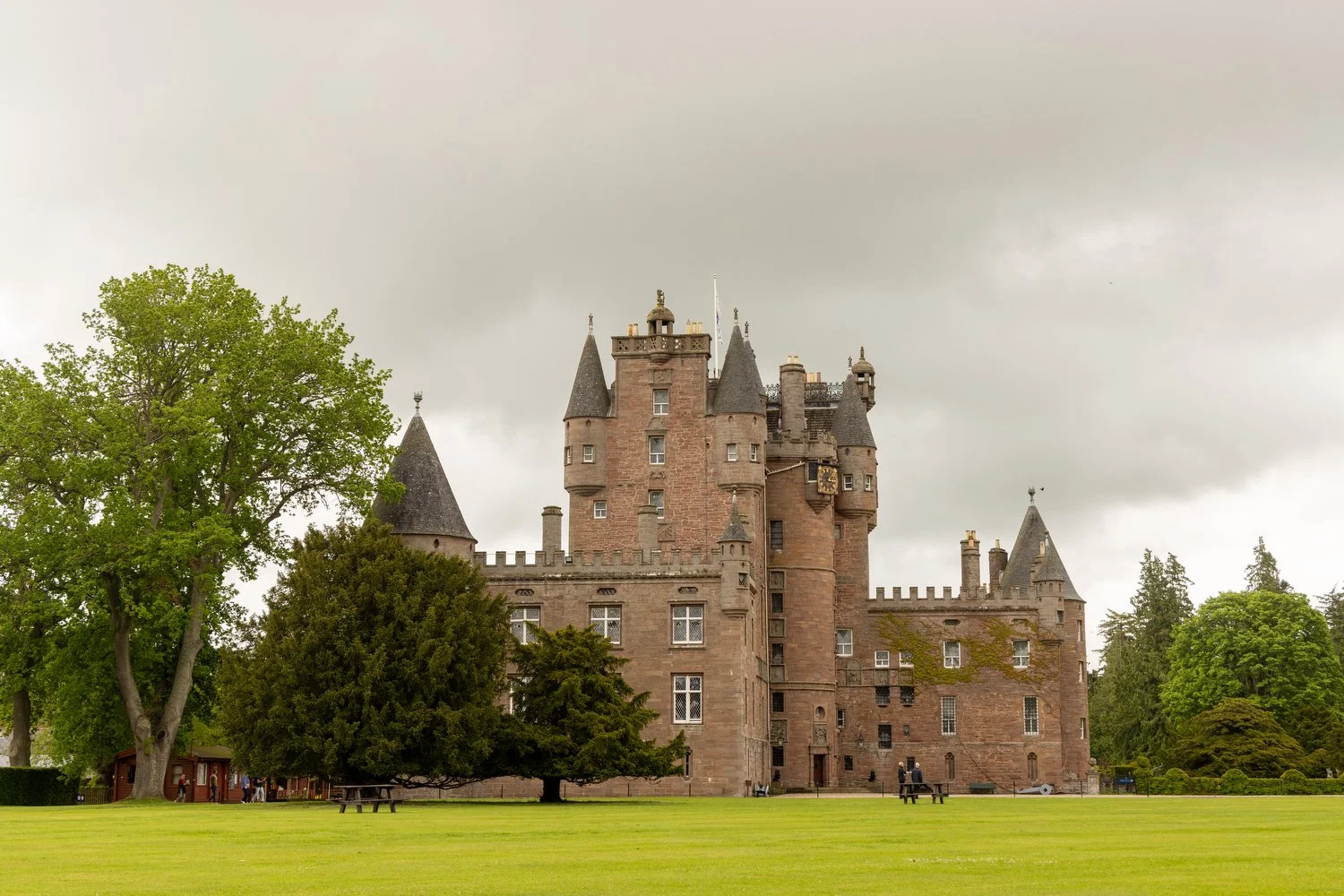
Glamis Castle looking moody on a cloudy day. Most of the existing building dates to a massive late-17th-century reconstruction by Patrick Lyon, 3rd Earl of Strathmore.
While there are certainly royal connections to the house, the Bowes Lyons were never courtiers. They felt that they were aristocratic enough on their own and weren’t overly impressed by royalty. The Queen Mother’s father, the 14th Earl, has been said to have been somewhat suspicious of royalty, and never wanted any of his children to be courtiers. Naturally, he worried about his youngest daughter giving up her carefree life for the fishbowl of royalty, as any father would. So it is rather ironic when you think that she grew up to be probably one of the most beloved and iconic royal figures ever.
(But I do think it was young, earnest Prince Albert who won him over.😉 Anyway, as teased above, I saved Albert and Elizabeth’s story for its own post, because it deserves the room.)
Perhaps what really soured the family on royalty is a story that dates way back in 1537. The wife of the 6th Lord, Janet Douglas, was burned at the stake for treason in Edinburgh on charges that look a great deal like a royal grudge, which is the seed of the Grey Lady story you will hear inside. She is said to haunt the family chapel, where she has allegedly been seen quietly sitting in her favorite seat.
I’m a ghost story scoffer myself, but embracing that sort of thing at Glamis is part of the fun. And very Scottish! You can actually feel the humor and the particular brand of joie de vivre of the Bowes Lyon family throughout the castle - from the ridiculously oversized billiards table (how did they play on that??) to the strange portrait of the rather theatrical 3rd Earl in his leather body suit (you read that right) that hangs prominently in the Drawing Room.
These stories playfully told by the wonderful guides and the somewhat peculiar interiors make the inside tour of Glamis definitely worth taking.
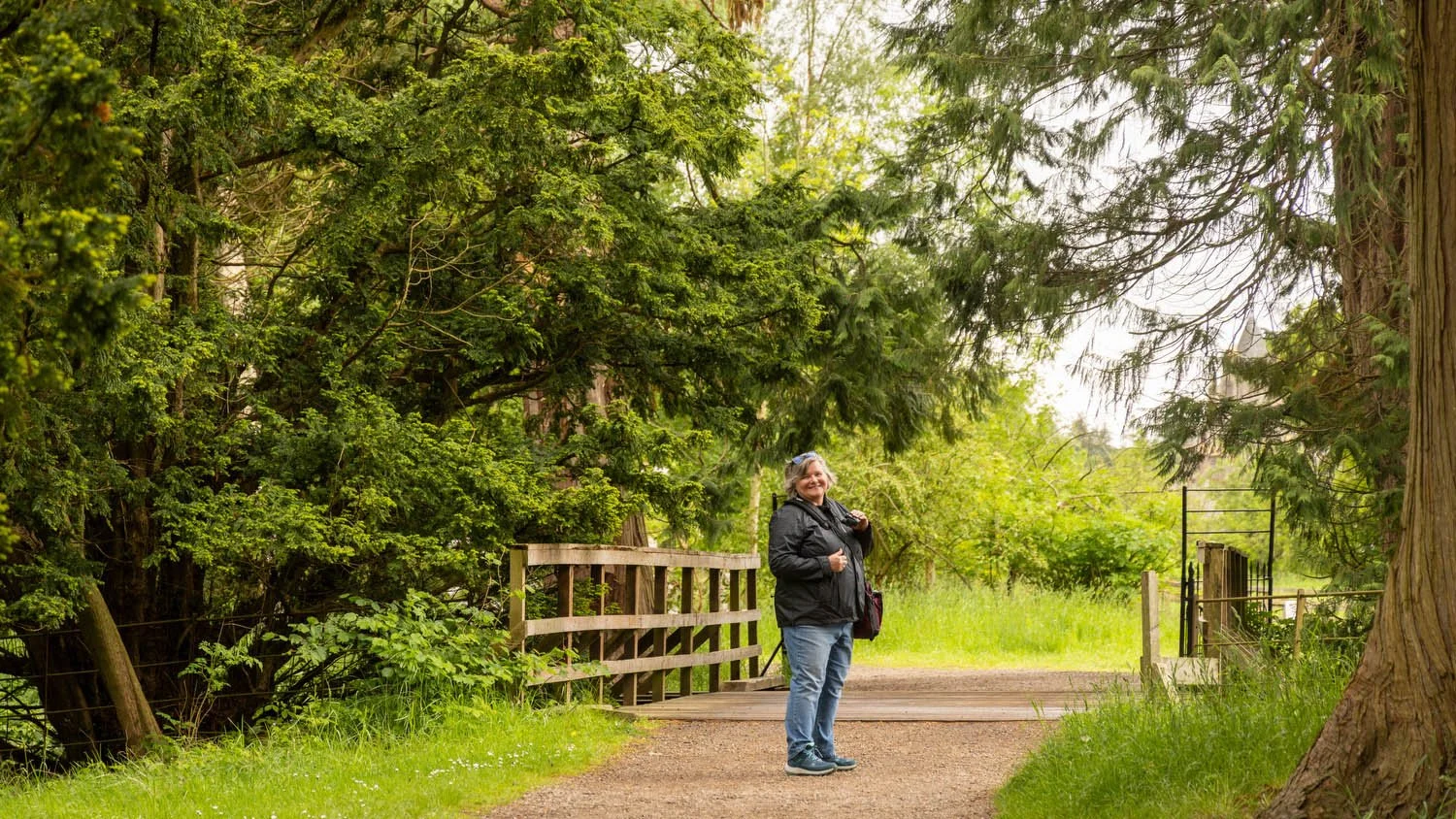
Debbie happily walking the grounds at Glamis and doing a little birdwatching
How to Get to Glamis Castle
Glamis sits in the heart of Angus, in the wide farmland of Strathmore, just off the A90, the main road up the east coast, so most visitors arrive by car. John did the driving for us to both Balmoral and Glamis.
When we went to Glamis, we had been to Balmoral the day before, and had stayed the night in Stonehaven at the historic Ship Inn that dates from 1771. The drive from that area is rather rural. It’s more of a highway drive if you are coming from Edinburgh.
A quick note: some links here are affiliate links. That means if you book or buy something through them, we earn a small commission. You pay nothing extra, and it helps keep this blog going. We only recommend things we actually believe in.
The ruggedness of the drive illustrated to me why royals and aristocrats have always liked to come to this area of Scotland on holiday - it’s completely out of the way, so they can let their hair down without too much interference.
Although public transport in rural Scotland seems to be shockingly available (from the perspective of Americans who never see that many bus stops in rural places), we can’t in good faith advise taking public transit there, even though technically it can be done.
There is no railway station at Glamis. The nearest is Dundee, 12 miles away, and from there you would have to make your way to the Seagate Bus Station (postcode DD1 2HR) to pick up a bus. Stagecoach runs a service from Dundee up to Kirriemuir that stops at Glamis, with links to nearby Forfar as well. But you would need to check timetables and deal with those limitations on your visit. Glamis website offers links for the available public transport in the How to Find Us section.
| Driving from | Distance | Approx. drive time |
|---|---|---|
| Dundee | 12 miles | 25 to 30 minutes |
| Perth | 25 miles | About 40 minutes |
| Aberdeen | 50 miles | A little over an hour |
| Edinburgh | 80 miles | About 1 hour 45 minutes |
But that all seems somewhat difficult. If you want to go to Glamis, driving is truly your best option.
By car, the simplest instruction is the one the castle gives itself: put the postcode DD8 1QJ into your navigation system or phone and follow it. Dundee is about 12 miles to the south, so coming up from there is a drive of roughly 25 to 30 minutes. Aberdeen sits 50 miles to the north, a little over an hour away. Perth is around 25 miles to the south-west, about 40 minutes. And from Edinburgh you are looking at roughly 80 miles and the better part of two hours up the M90 and A90. All of these figures are of course approximate and depend on traffic.
There is plentiful parking on the grounds, which is not always the case at grand houses.
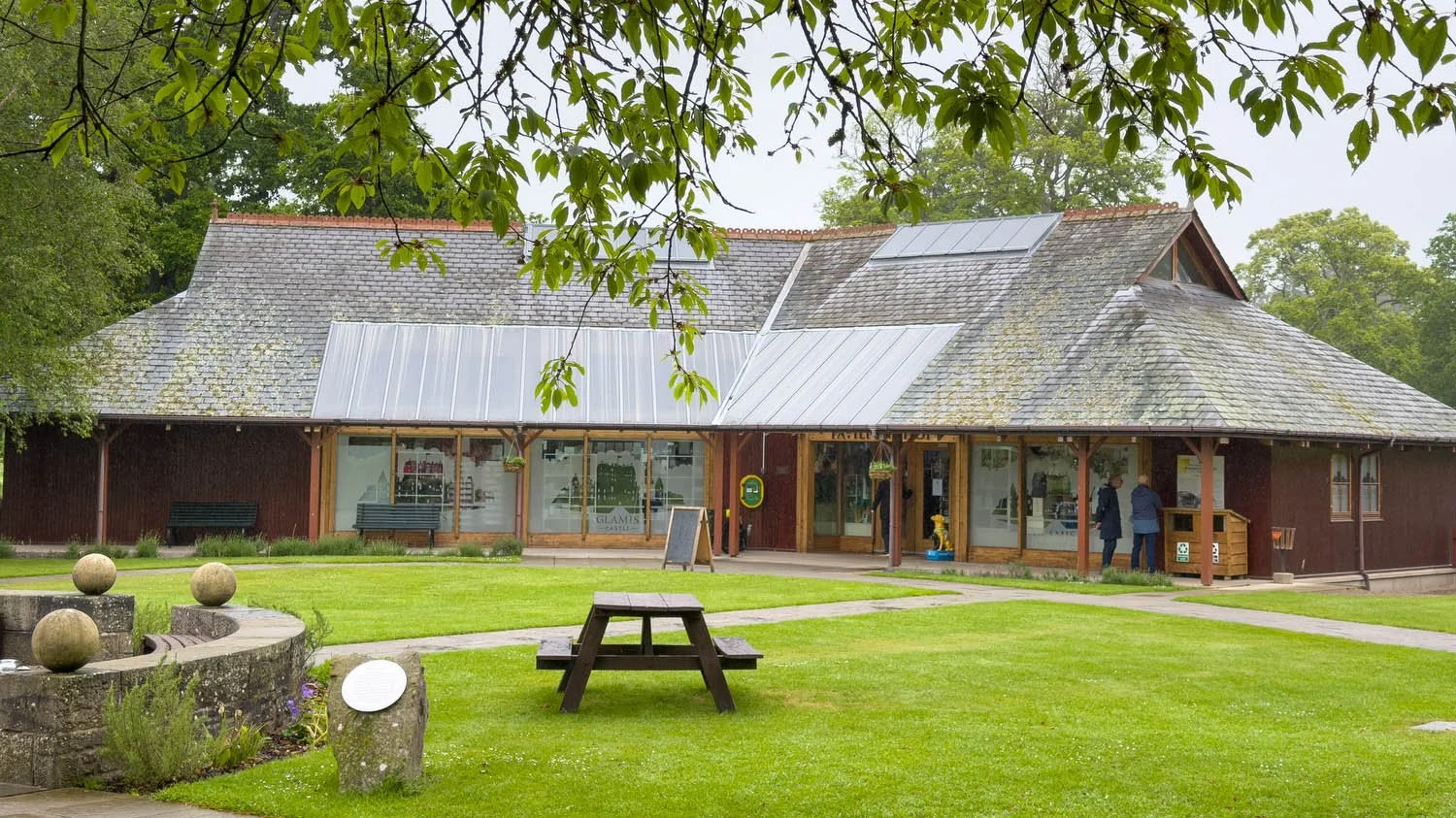
There is ample car and coach parking behind the Pavilion Shop, a short and level walk from the castle, and it is included in every ticket, so there is no separate fee to think about.
Since Dundee is rather close by, some travelers find the simplest answer is to base themselves in Dundee and take a taxi each way. It costs more, but it removes all the fuss.
Glamis Castle Tickets and Opening Times in 2026
Here is how things stood when we visited in 2026, but as these things do change, be sure to check out Glamis Castle website for the most up-to-date information on planning your visit.
Opening times: The castle, gardens, shop and restaurant are open daily from 20 March to 31 October 2026, from 10am to 5pm, with the last entry and the final tour at 4.30pm.
After the main season, from 1 November to 22 December 2026, the gardens and grounds stay open and note that the castle and gardens are both open four days a week from Thursdays to Sundays.
Tickets: There are two options. The Castle Tour ticket covers the guided tour of the castle plus all-day access to the gardens, grounds and any seasonal exhibition. The Gardens and Grounds ticket covers everything outside and the temporary exhibition.
2026 the Castle Tour prices:
Adult: £19.50
Senior (60 and over): £17.00
Student: £17.00
Child (5 to 16): £11.00
Family (two adults and up to three children): £65.00
Under 5: free
The Gardens and Grounds only ticket, during the main season, is £9.50 for adults and £6.00 for children.
Pro tip: The senior rate begins at 60, so bring something that shows your age and save yourselves a few pounds each. Also, if you think you might return, the Friends of Glamis annual pass is £100 and covers you and up to four others for unlimited visits across the open season. That pays for itself faster than you would think if you are staying in the area or passing through more than once.
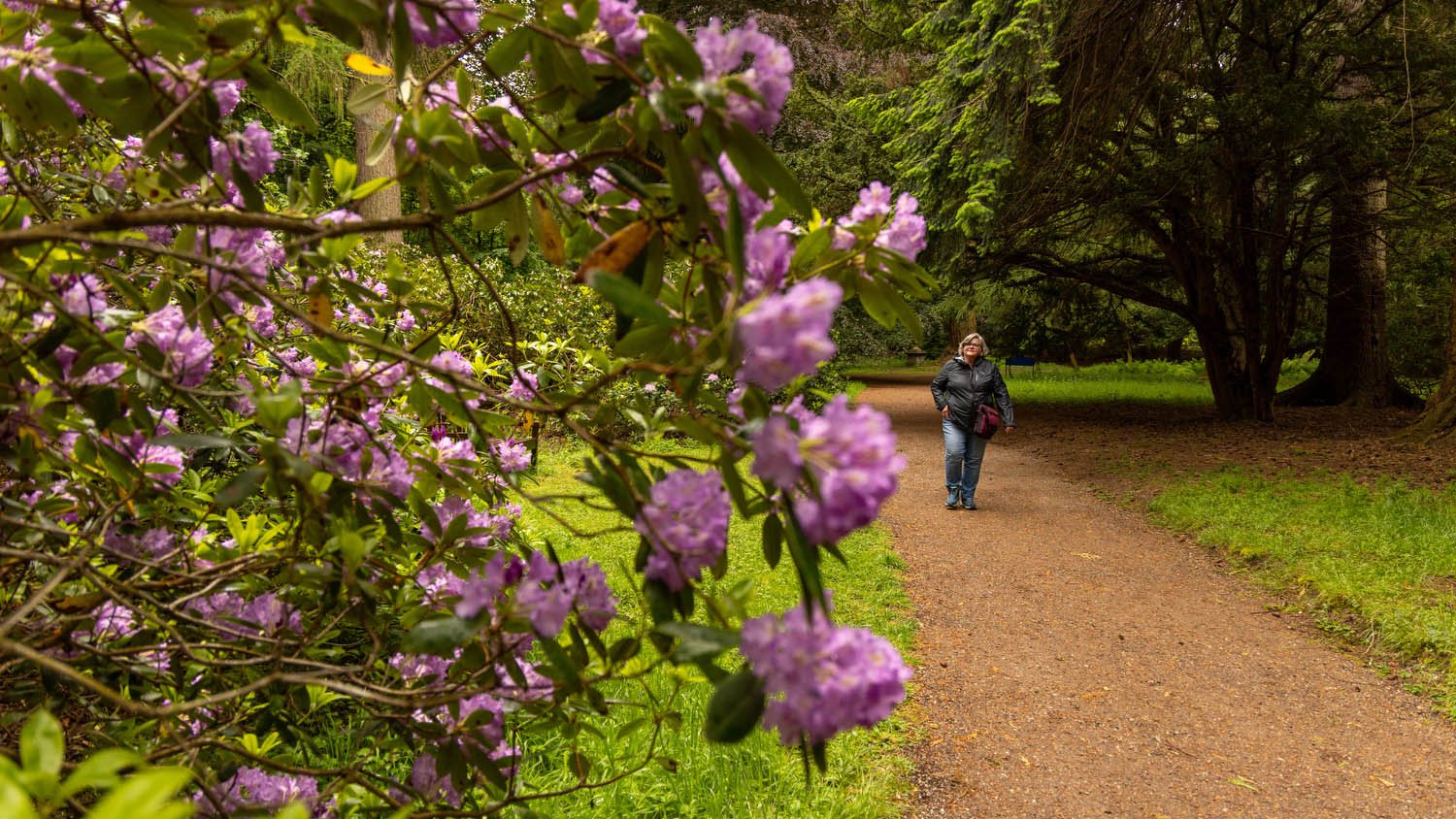
You can enjoy the lovely grounds with the Gardens and Grounds ticket. For a guided tour inside the Castle, purchase the Castle Tour ticket.
What the ticket actually buys you
The castle interior is seen only on a guided tour, which is included in the Castle Tour ticket. Your ticket is general admission for the day rather than a booking for a set time, so you arrive any time from 10am, make your way to the Head of the Stairs, and join the next available tour.
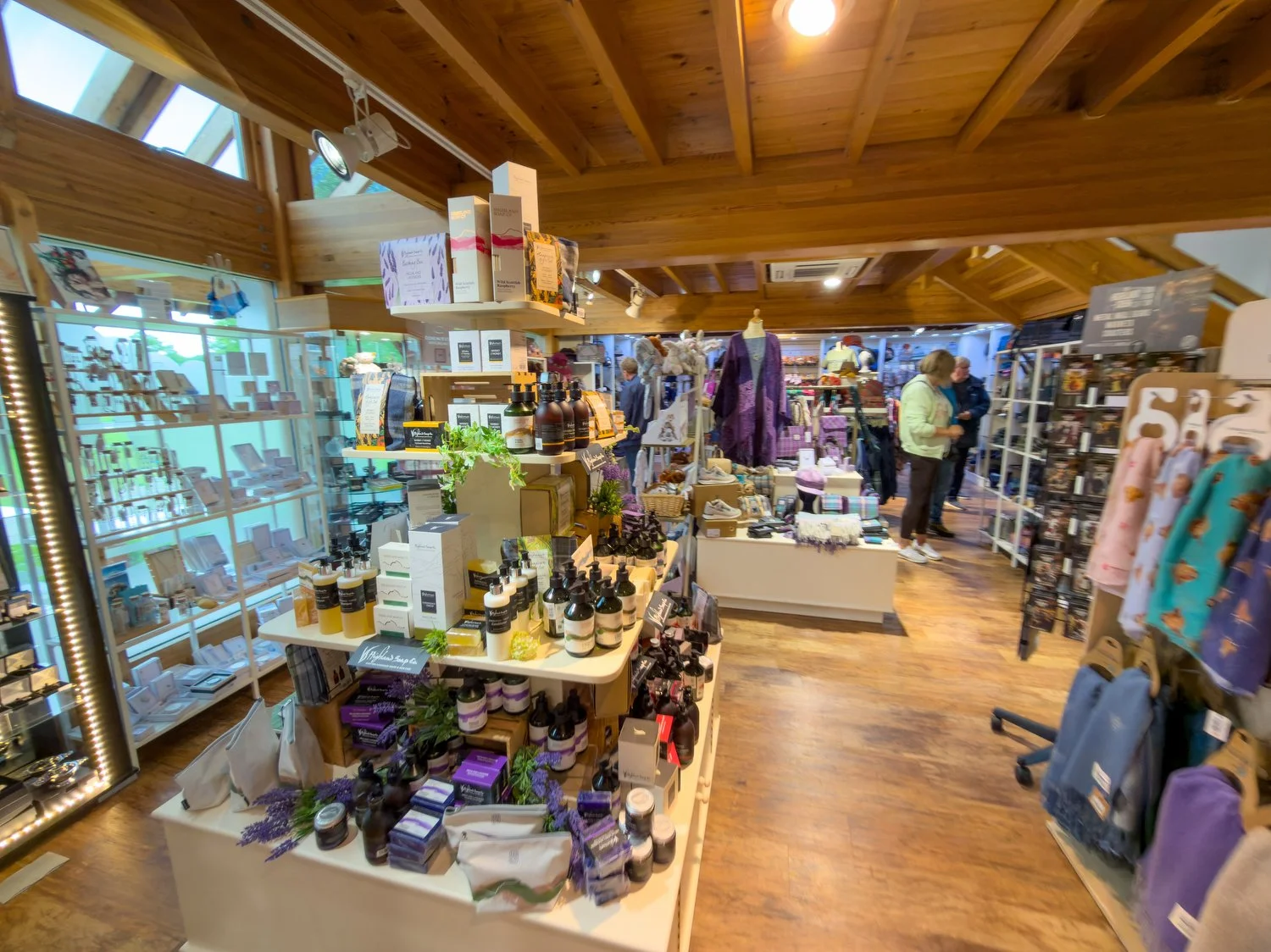
The large, well stocked Pavilion Gift Shop will be the first building you come across from the parking lot and serves as a sort of Welcome Center, so if you are not sure where to go, just inquire within and they will happily help you out.
Tours run roughly throughout the day, the last one leaves at 4.30pm, and each lasts about 50 minutes, led by one of the house guides. They are conducted in English, though translation sheets in other languages are sometimes available depending on the guide, so it is worth asking on arrival.
One practical note for anyone who finds standing tiring: the tour is on foot, takes in spiral stairs and some uneven historic floors, and moves at the group's pace, so wear comfortable shoes.
Wheelchair users or anyone unable to join the tour can watch the new video tour on the ground level.
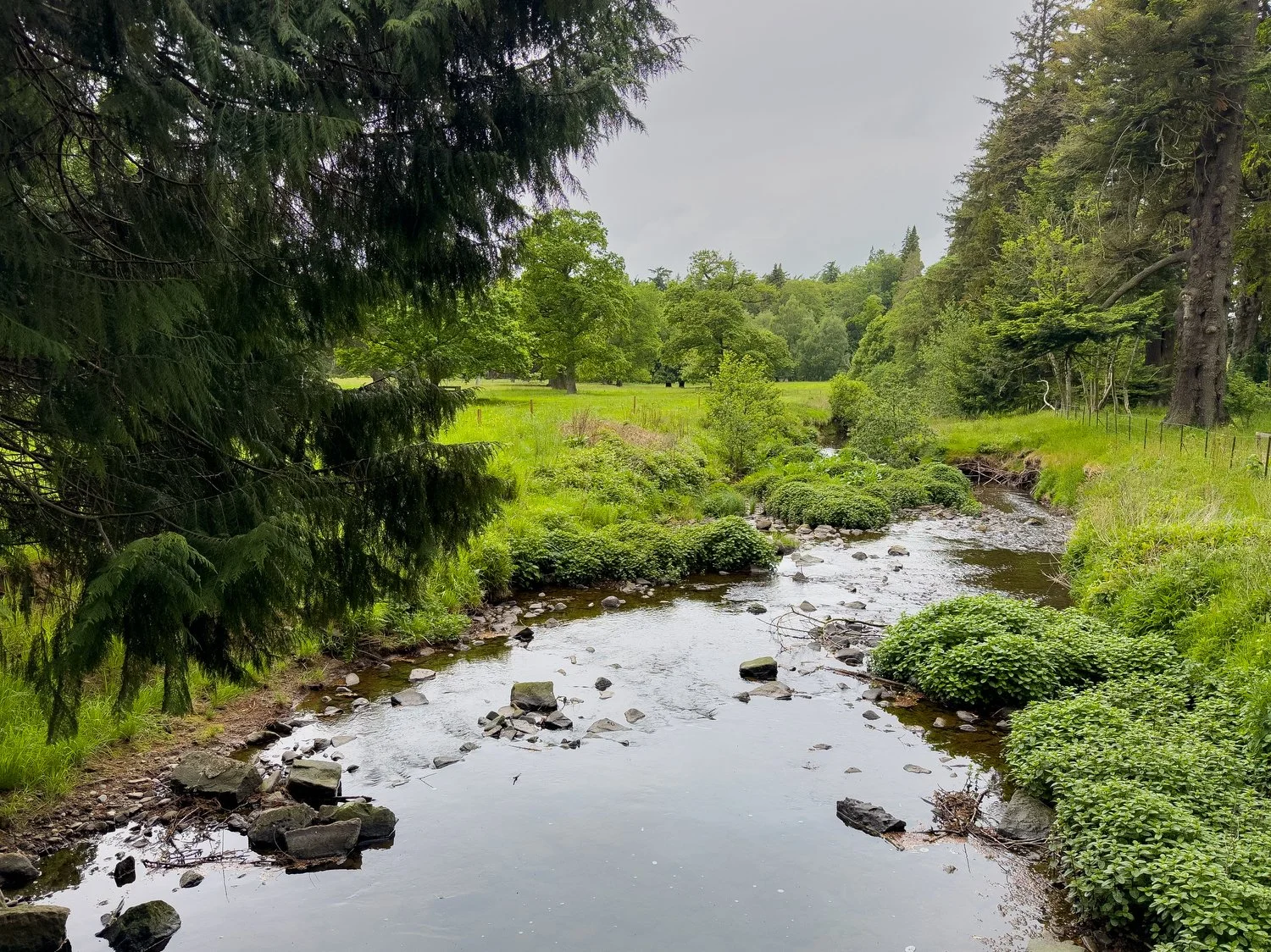
The peaceful Glamis Burn under an ominous sky. Get ready for eerie stories inside the castle!
The house guides are very good storytellers and lean into the ghostly legends in a light, playful way. They avoid some of the more fiendish tales that are out there about Glamis, (specifically the “Monster of Glamis” legend). Perhaps because such a story paints the family in a bad light, and probably has no truth to it anyway. But we did hear several tales of people being bricked into walls, never to be seen again. There’s lots of talk of “secret rooms” in the castle. Hmm. Spooky.
The guides also point out many details along the way that you would otherwise miss so it really brings the rooms to life.
Your castle ticket also includes whatever seasonal exhibition is running that year, at no extra charge. For 2026 and 2027, the castle is hosting a costume and fashion exhibition running from spring into October. This "Behind the Seams at Glamis" exhibition is located on the ground floor in the room adjacent to the video room in the Coach House
To be honest, I could not find this exhibit and I’m still a bit confused about where it was, but I enjoyed the exhibit about the Queen Mother in the Coach House.
The folks at Glamis, who graciously let us use some of their interior photos, offered this information about the exhibit:
The “Behind the Seams Exhibition” in the adjacent larger exhibition room includes original pieces of clothing, accessories, and documents dating from the 17th to the 20th century.
What You'll See Inside the Castle
The only way to see inside Glamis Castle is on the guided tour, and it is really worth it. I do think you’ll be missing out if you don’t get the Castle Tour ticket. The interior of the castle is just so unusual, and the guides really bring it all to life. Plus, it is relatively inexpensive for what you get.
Inside it’s almost eerie, with stone spiral staircases, the heavy walls and dark spaces, as if everyday is Halloween - but I didn’t get too hung up on all that. The ghost stories are a bit of fun, but to me, the Castle is at its most interesting as the scene of the lively weekend house parties of the 1920s, and there is a sense of both elegance and jolly fun about it.
The route takes in the Dining Room, the Crypt, the Drawing Room, the Chapel, the Billiard Room, King Malcolm’s Room, the Royal Apartments, Duncan's Hall and the Family Exhibition Room, and it is the stories attached to each that stay with you.
It is a little disappointing not to be able to take photos of the interior, because I love poring over them later and it helps me remember the little things. But I do understand why it is so.
Since we couldn’t take photos inside, we are sharing some images from their Instagram account. Also, many thanks to Glamis Castle for letting us use some of their own interior photos for this article.
Here are some highlights that struck me:
The Dining Room is a great place to start the tour, and you can imagine the pipers rounding the table at the elegant family dinners that were hosted there. It illustrates aristocratic life, and is decorated in a Victorian style. The house did not have electric lighting until 1929, so these dinners would have been candlelit or gaslit before then! The room is not just a museum piece - it is still used for various functions by the current owners. It has an unusual ceiling of plasterwork with Scottish thistles, English roses, and lions representing the Lyon family. Look for other lions in the castle and on the grounds - there are many!
The Crypt is the oldest part of the building and the spot where the sheer age of Glamis really lands, with walls thick enough to swallow sound. This is also the heart of the castle's ghost lore, including the famous sealed room and the legend of "Earl Beardie," supposedly condemned to play cards for eternity after a game on the Sabbath. None of it is history and all of it is marvelous, and a good guide knows exactly how to tell it.
The Drawing Room is the grand set piece, crowned by an enormous arched plaster ceiling dated 1621 and heavy with family heraldry. Stand beneath it and you understand at a glance how the family wished to be seen. I loved the pink colored walls and the little chairs by the hearth that were used by Princesses Elizabeth and Margaret as children.
There is a great photo of the entire Bowes Lyon family gathered there for the Golden Anniversary of Elizabeth’s parents, Claude and Cecilia, the 14th Earl and Countess. In the photo, Princess Margaret is only a baby on the Duchess’ knee and Princess Elizabeth (the future Queen Elizabeth II) is a little tot holding a stuffed dog.
| Castle | What It Is | Royal Connection | Adult Entry | Open Season | Best For |
|---|---|---|---|---|---|
| Edinburgh Castle | A real medieval fortress on a volcanic rock | Historic royal stronghold, home of the Crown Jewels of Scotland | Around £23.50 online, everything included | Year round, closed Dec 25 and 26 | First timers who want the classic castle on a hill |
| Inverness Castle | A Victorian courthouse reborn as an immersive experience | Light. More about Highland culture and folklore | Around £20 online, everything included | Year round, closed Christmas Day | Highland culture fans and that rooftop city view |
| Glamis Castle | A true old fortress and family home with turrets | Childhood home of the Queen Mother, loved by George VI | Around £19.50 with the interior tour included. Grounds only £9.50 | 20 March to 31 October, grounds to 22 December | Castle lovers who want a rich interior tour |
| Balmoral Castle | A grand Victorian country house built to look like a castle | A working royal home and Queen Elizabeth II's favorite | £18.50 grounds. Interior tour around £110, sold out 2026 | Approx 28 March to 9 August | Royal family fans and Royal Deeside scenery |
Duncan's Hall trades on the Macbeth connection, with a legend tying it to the murder of King Duncan. That is pure Shakespeare rather than fact, but it is an atmospheric room and a fine chance for your guide to untangle the play from the history.
The Chapel is a quiet highlight, with painted Biblical panels on the ceiling and walls and a real sense of stillness about it. It is also said to be the haunt of the Grey Lady, believed to be Janet Douglas, the Lady Glamis burned at the stake for treason in 1537. Whatever you make of the ghost, the human story underneath it is a genuinely moving one.
Also worth taking a look at is the 1688 painting Christ Wearing A Hat, by Jacob de Wet, a very unusual depiction indeed.
The Billiard Room is worth a pause. The enormous billiards table and a full piano hardly take up any space in the generous room. There are some key interesting photos in this space that brings the castle into the twentieth century.
One framed photo shows convalescing soldiers from the First World War enjoying the room. In 1914 at the outbreak of the war, the castle was given over to wounded soldiers as a convalescent hospital, and the teenage Elizabeth helped care for them, a detail that tells you a great deal about the woman she became.
In this room, with games and cards laid out, it is easy to imagine the family and their guests enjoying each other’s company during those exuberant shooting parties that Glamis became known for in the 1920s
King Malcolm’s Room is named thusly in memory of King Malcolm II, who died at Glamis in 1034, though not in this room. Actually, the exact circumstances surrounding King Malcolm’s death remain unclear but different legends suggest he was either assassinated, died in a hunting accident or from mortal battle wounds. There is a portrait of Mary Queen of Scots in the room, and it is believed that she used this room as her bed chamber when she visited Glamis in 1562.
This was the private chamber of the Lord and Lady of the house and there is some beautiful china on display here. There are a few different services and the designs feature family heraldry, with a blue lion and also three bows (for “Bowes”). In 1947 some of this china was given by the 15th Earl to his niece, HRH The Princess Elizabeth, as a wedding present when she married HRH Prince Philip. HM The Queen kindly later returned it to Glamis to be restored to the rest of the service.
Chasing royal history around Scotland? The Royal Yacht Britannia in Edinburgh was a real highlight for me. You get to walk the Queen's private rooms and even stop for tea aboard. Here is our full guide: the Royal Yacht Britannia in Edinburgh
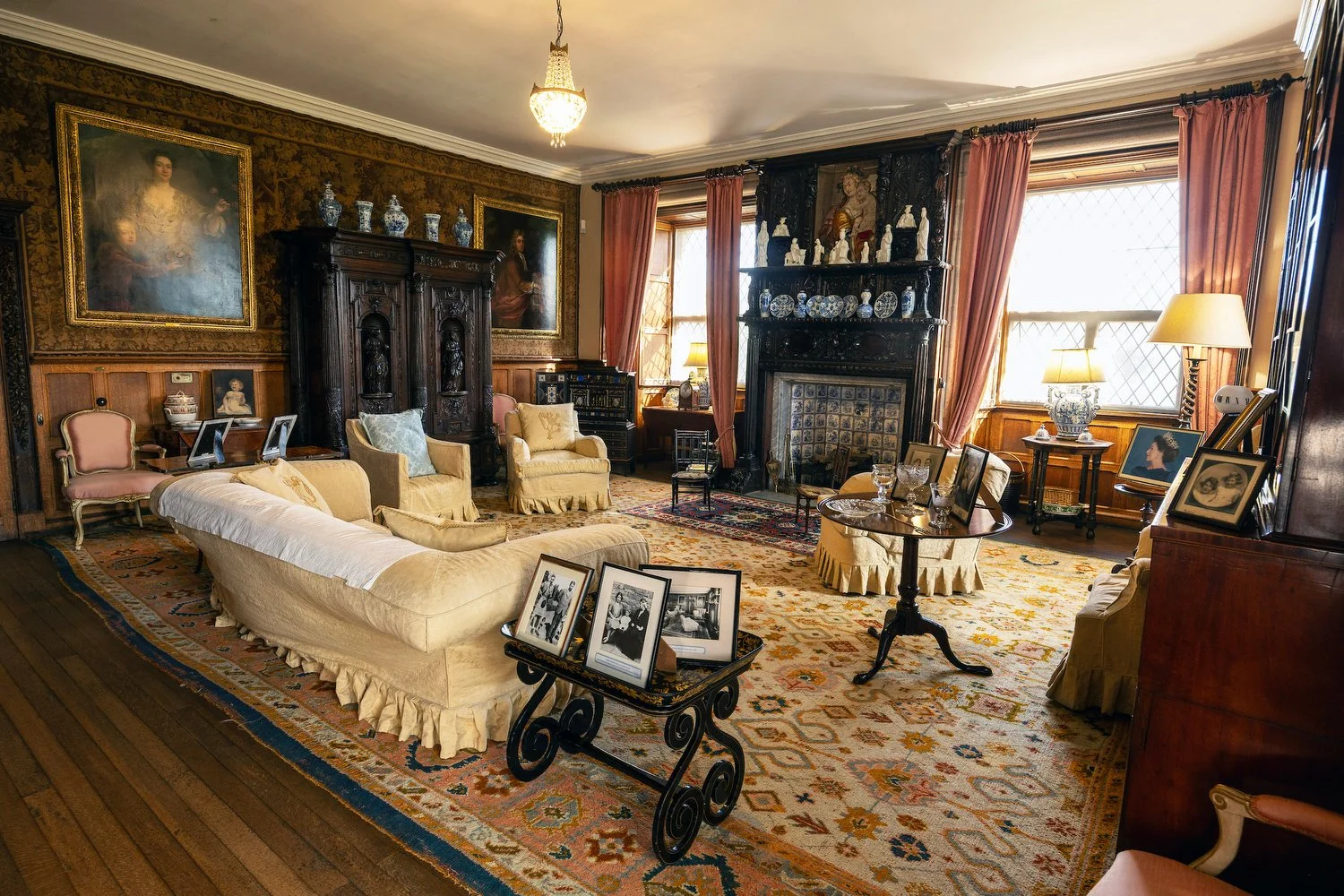
The Queen Mother’s Sitting Room, part of the Royal Apartments at Glamis Castle. Photo is Courtesy of Glamis Castle.
And then there are the Royal Apartments - the reason I came! When Elizabeth Bowes Lyon married the Duke of York, her mother set up a suite of rooms for the young couple to use when they came to Glamis, starting with the later part of their honeymoon. In this way, she hoped they would continue to come whenever they wanted. And they did.
The private rooms you get to see include the Queen Mother’s bedroom, the Yorks’ “country house” styled Sitting Room and the King’s Dressing Room, that the Duke (and later as King) used as a study during his visits to Glamis.
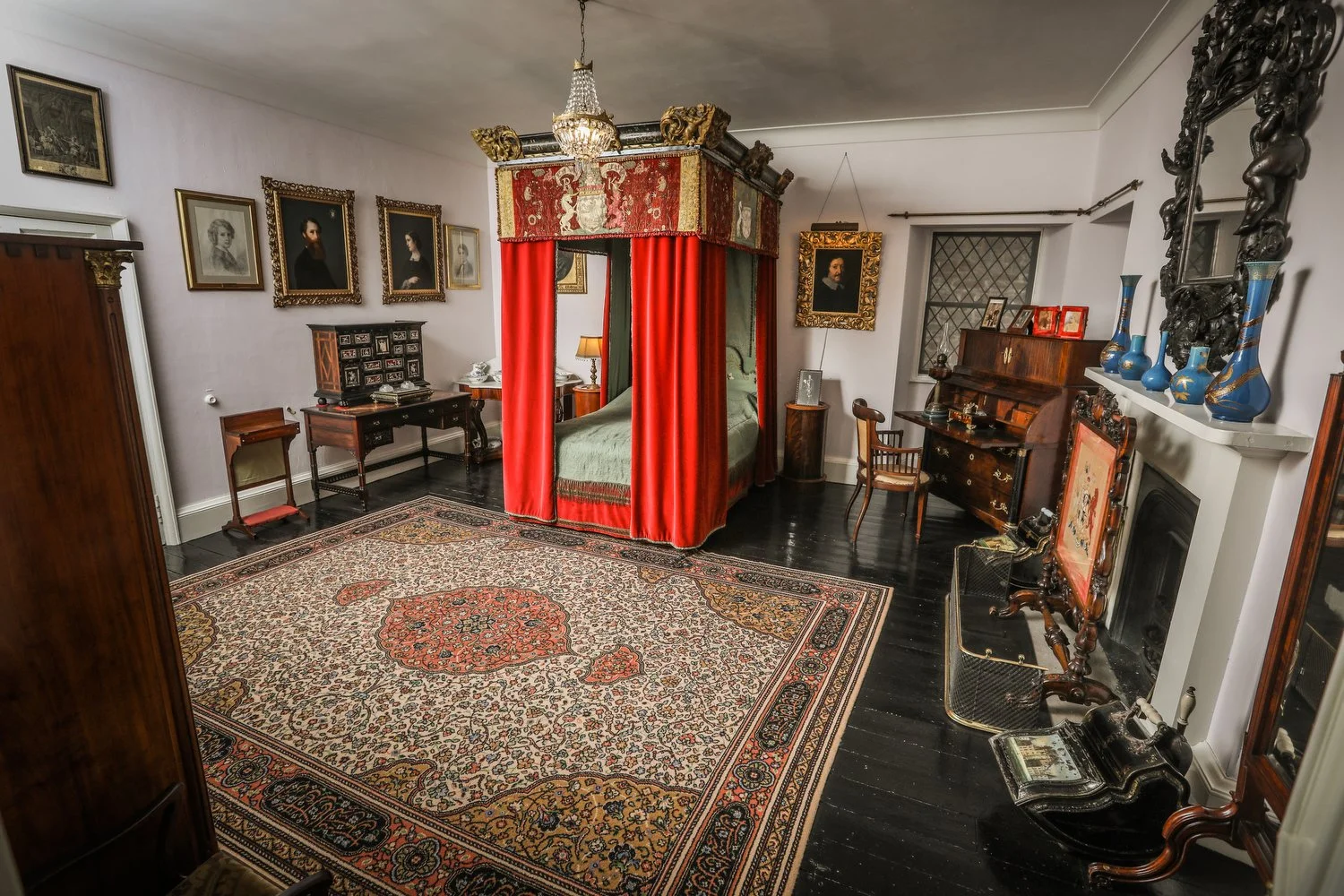
The King’s Dressing Room at Glamis Castle. Photo is Courtesy of Glamis Castle.
There is a small, modest desk there that he worked at - hardly fit for a king! I wonder how the infamous “red boxes” would even fit on the simple drop-front desk. But I found it very in character for him to use such a humble desk.
There is also a famous 17th-century four-posted bed in the room referred to as the Kinghorne bed, after Patrick, the 3rd Earl of Kinghorne, an important artifact in the house (but not of much interest to me personally.) The bed had many famous occupants, including Jacobite James Stuart, Bonnie Prince Charlie’s father. It has nothing to do with King George VI and wasn’t even in this room when he used it. But the guides have some very interesting things to tell you about it.
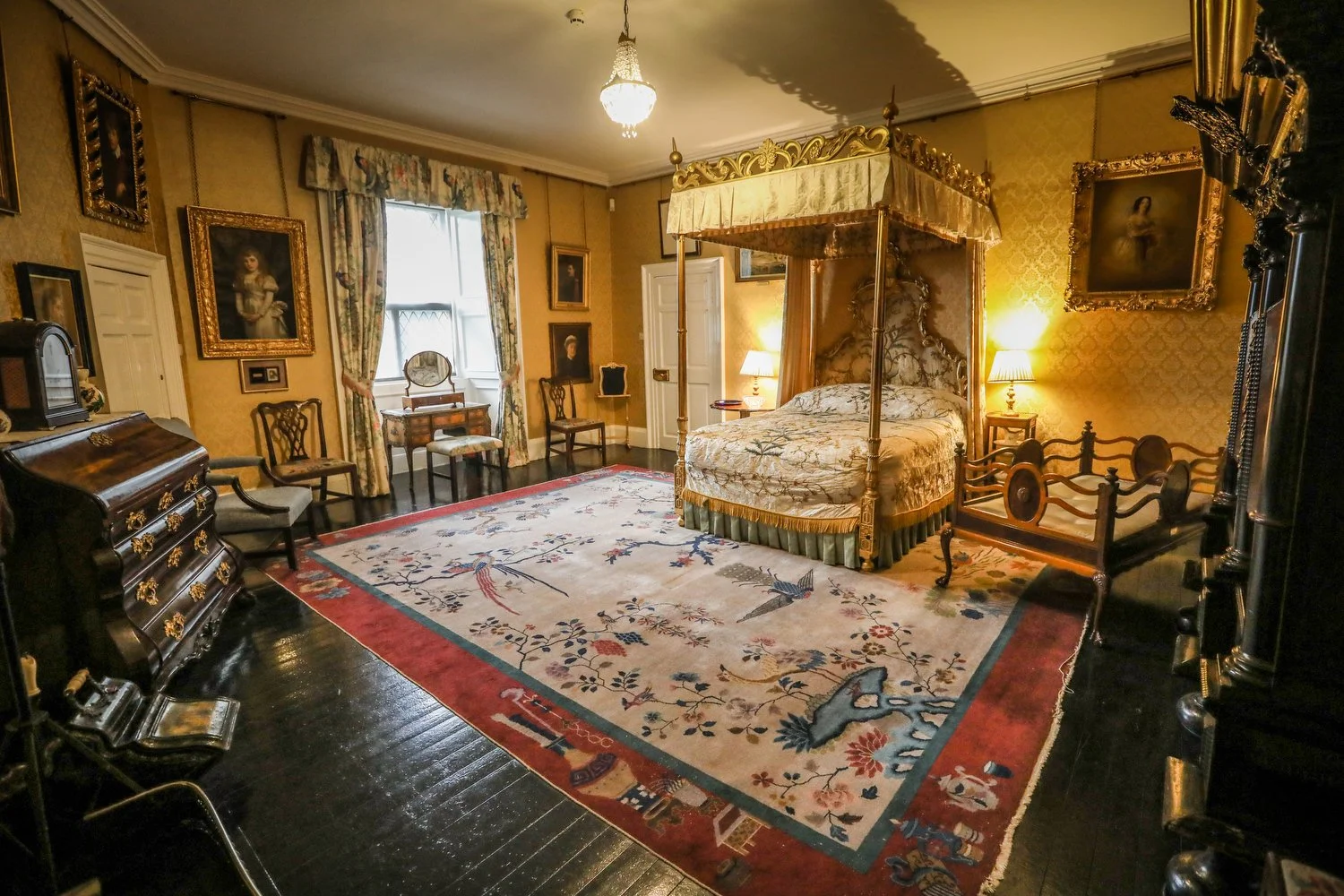
The Queen Mother’s Bedroom, at Glamis Castle. Photo is Courtesy of Glamis Castle.
I really wanted a few unhurried minutes to take in private spaces. There was so much to see! Princess Elizabeth’s baby cot in the bedroom; the comfortable chairs in the sitting room: a writing desk in a nook by the windows where I imagined Elizabeth writing her many letters; the “hot line” phone directly to Buckingham Palace; and of course the many family photos all over the room. I longed to see them up close! But with the main area of the room roped off and no photos allowed, plus reflections on the glass of the frames, they were pretty hard to see. Such a pity!
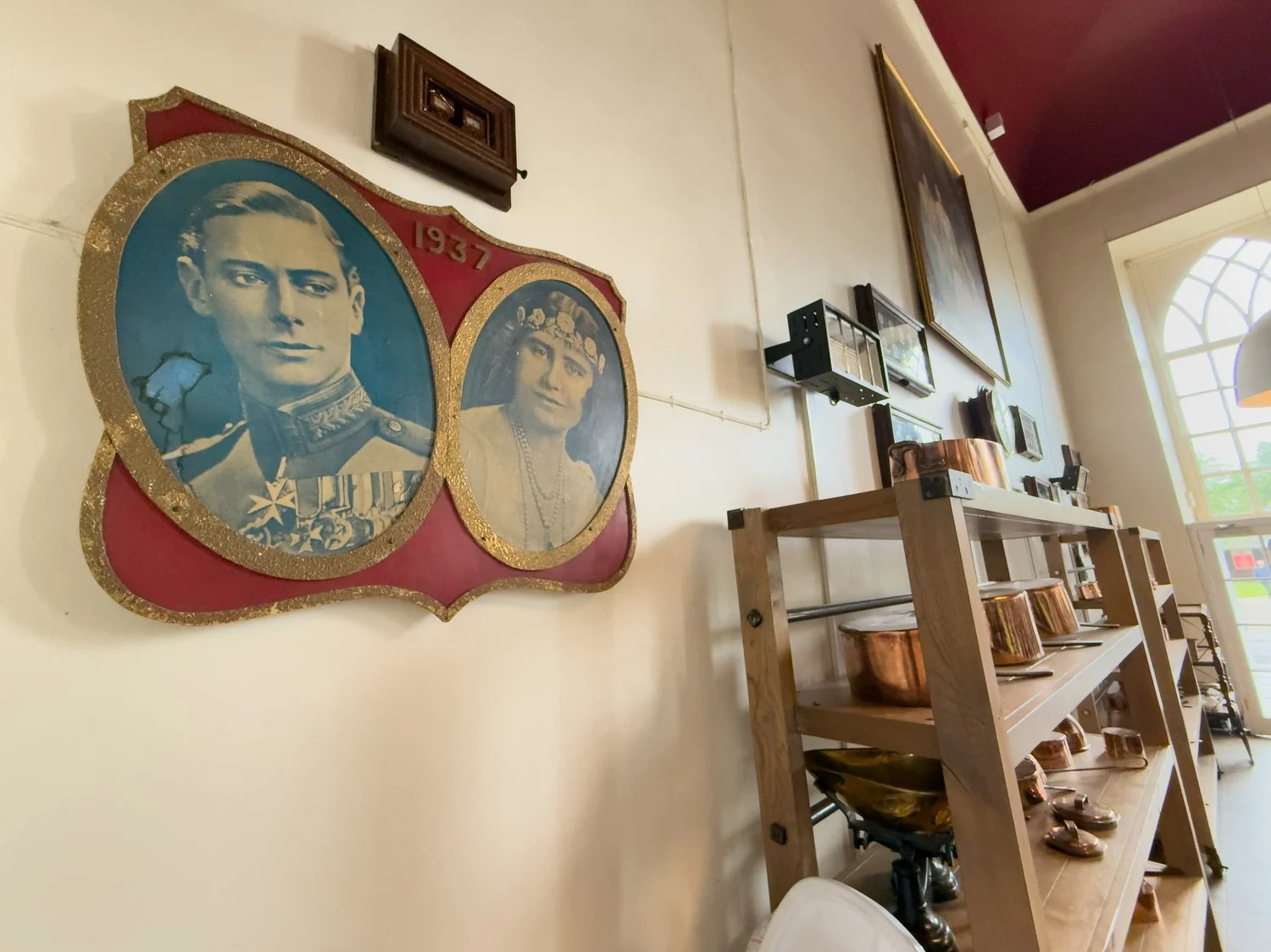
There was also some Coronation memorabilia here (and in other places about the Castle) and lo and behold, there was the same vintage souvenir plate from 1937 that my brother had found for me as a Christmas gift! I feel so connected!
I honestly could have stood there an hour, trying to commit it all to memory, but I had to keep up with the group!
In the Family Exhibition Room, where the tour leaves you, are displays of family photos, scrapbook pages, and invitations to historic events like royal weddings that were received by members of the Bowes Lyon family over the years. It was really interesting to see invitations to the weddings of Princess Margaret to Anthony Armstrong-Jones, Prince Charles to Lady Diana Spencer, and Prince William to Catherine Middleton. All in one place.
There is a somewhat “homespun” nature to the family exhibits. A lot of ordinary mattes and frames and hand typed captions. It’s nothing like the slick displays you might see at the Royal Palaces; it definitely feels more family curated. But there is something rather endearing about that.
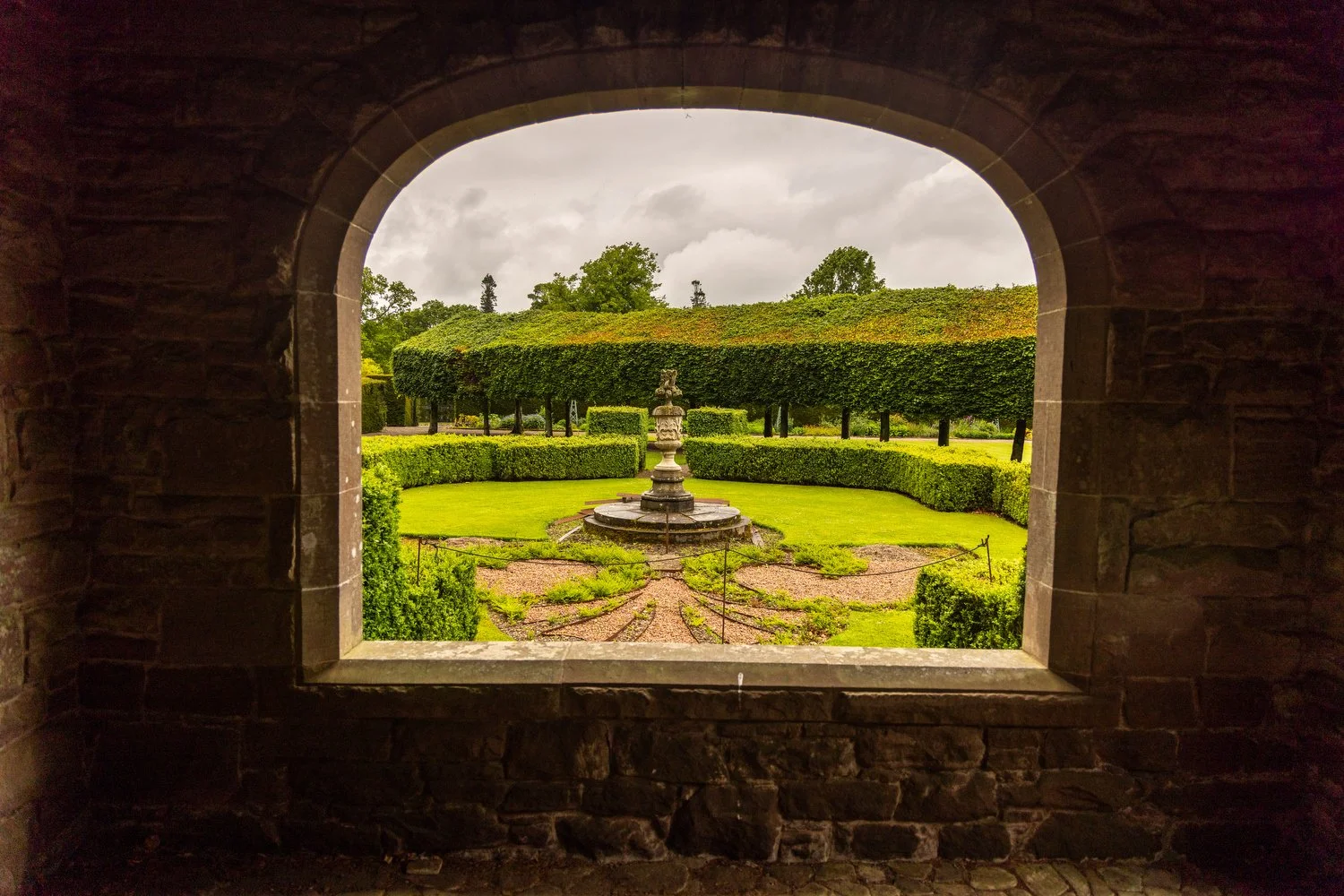
View of the Italian Garden at Glamis
The Gardens and Grounds
The Glamis Castle estate spans roughly 14,000 acres, and while the majority is a working estate that is used for farming, forestry, and field sports, the formal gardens are publicly accessible areas with either your Castle Tour or Gardens and Grounds ticket.
If the castle is the showpiece, the gardens are the reason to give Glamis a full half-day rather than a rushed couple of hours, and they are gentle on the legs.
The Italian Garden carries the strongest family story of all. It was laid out around 1910 by Cecilia, Countess of Strathmore, who was the Queen Mother's own mother and a keen and gifted gardener. It is a formal, sheltered space within high yew hedges, with pleached beech walks, deep herbaceous borders and a fountain, and ornamental gates added to mark the Queen Mother's 80th birthday. Knowing that her mother made it changes how it feels to stand there.
Just beyond the north-east corner of the Italian Garden, an avenue of yew hedges leads to the memorial to Princess Margaret, who was born at the castle in 1930. The memorial was designed by the 18th Earl and completed in 2006, and it is a calm, contemplative spot well worth seeking out. They seem to have a great affection for the princess at Glamis, and I was glad to see this respectful tribute to her.
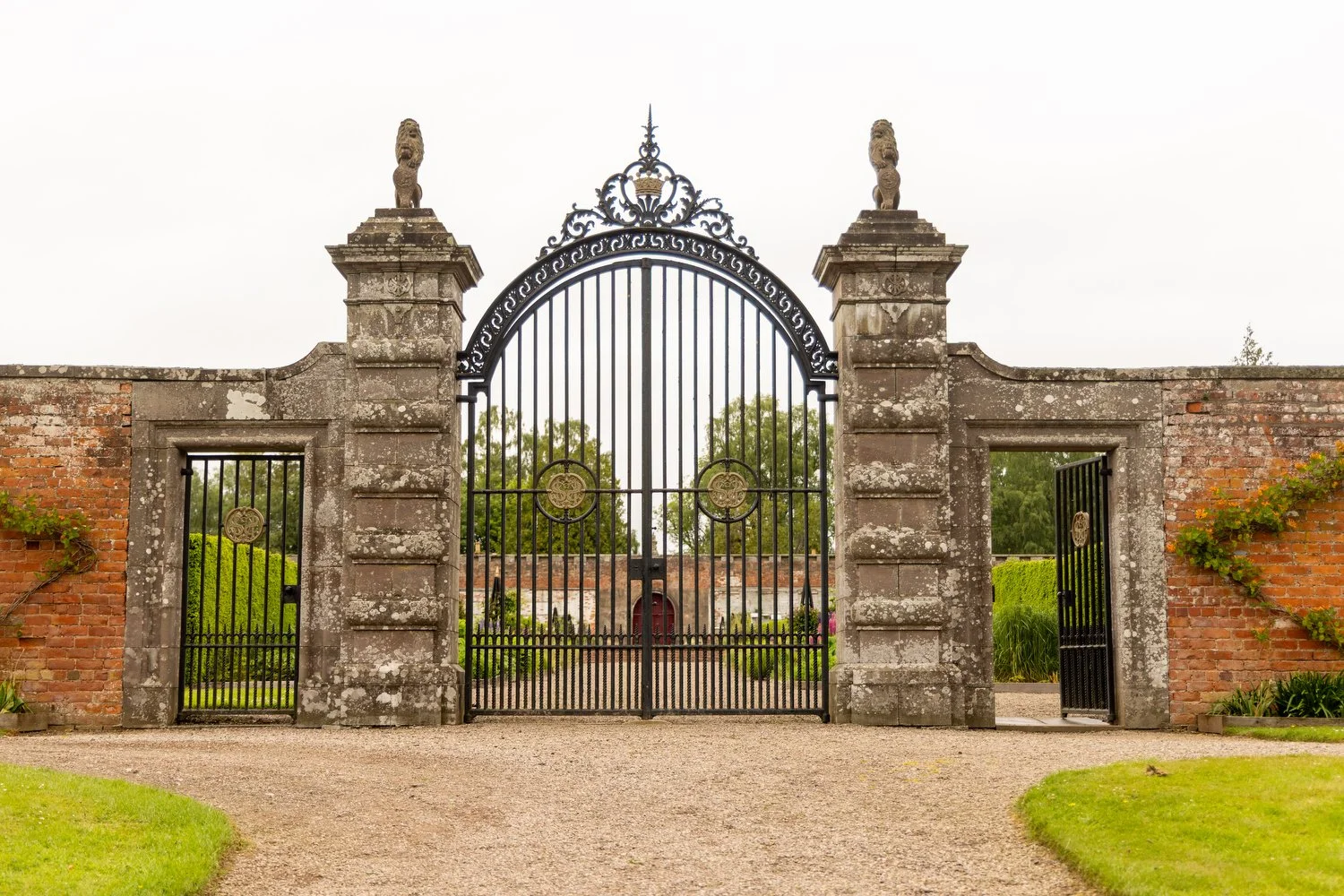
A grand gate leading to the Walled Garden, also called the Kitchen Garden, at Glamis Castle.
The Walled Garden, sometimes called the Kitchen Garden, is a working, productive garden as much as an ornamental one, with deep perennial borders, espaliered apple trees trained along the old walls, a central fountain and a Monet-inspired bridge. The fruit and vegetables grown here actually find their way onto the plates in the Castle Kitchen Restaurant, which is a nice loop to keep in mind when you stop for lunch.
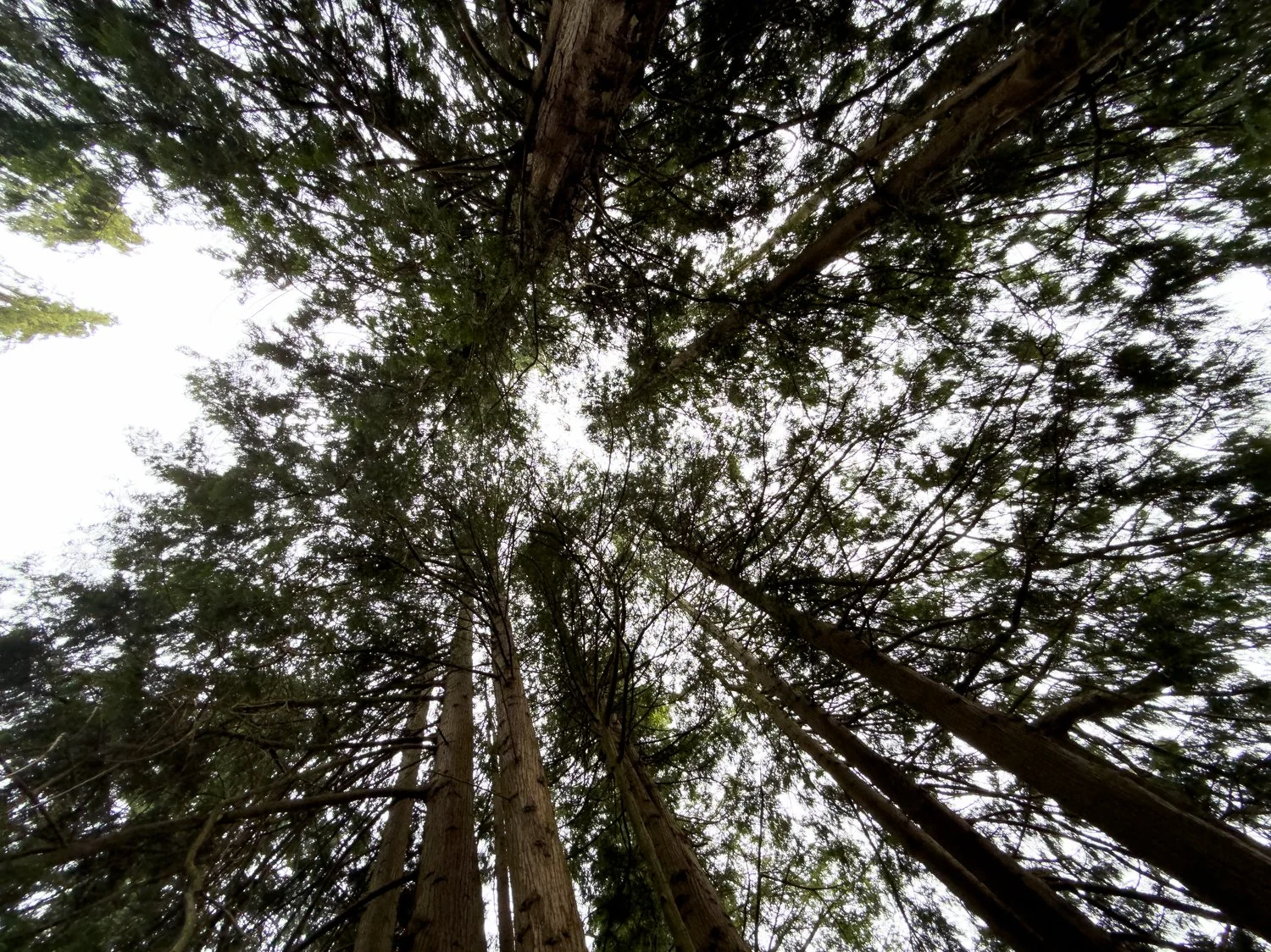
For those who fancy a longer but still easy wander, the Nature Trail runs for about three quarters of a mile through woodland and into the Pinetum, a stand of tall conifers, many of them North American species, first planted by the 13th Earl around 1870. Those trees seemed to soar into the clouds, and I stood underneath and took a rather dizzying spin!
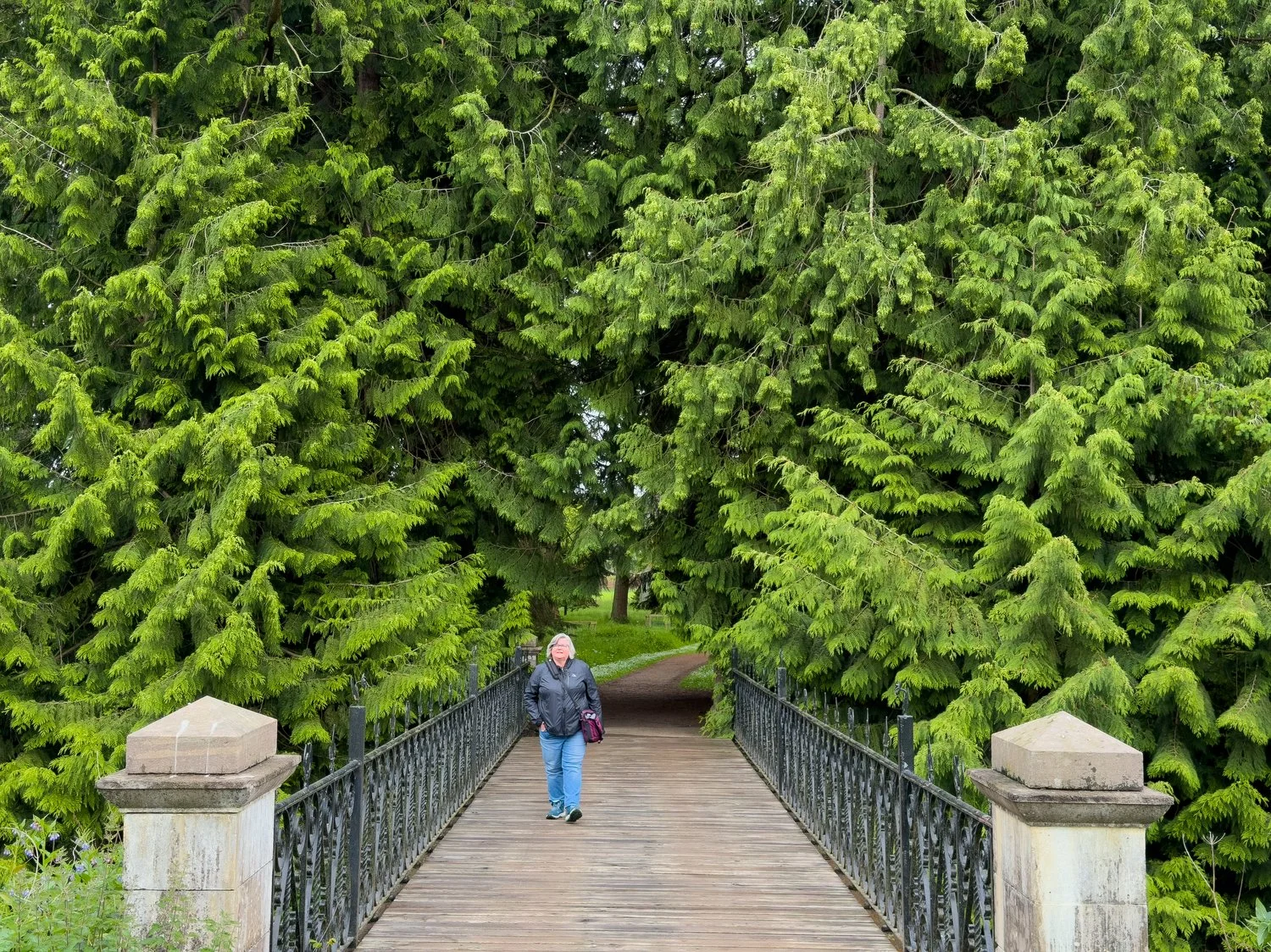
Along the way you pass the Macbeth Loop, a set of seven wood sculptures carved from estate timber and based on characters from the play, which is good fun.
Keep an eye out for red squirrels, roe deer, and, in a field near the castle, the resident Highland cattle, who are about as willing a photographic subject as Scotland offers. We had met a few of these sweet looking “Highland Coos” in Skye - and ok I might have brought home a little stuffed souvenir coo - but we didn’t happen to see any while wandering the grounds and Glamis.
None of this involves hills or hard walking. The paths are mostly flat and well kept, so you can see the best of the grounds at an easy pace and simply turn back whenever you have had your fill.
Glamis bills their gardens as a sensory experience and I have to agree. Not only is it a feast for the eyes, with rich greens of every shade and the saturated hues of every sort of flower, but the sounds and smells struck me vividly as well. The fresh scent of pine, of sweet things growing in the gardens, it definitely fills your senses.
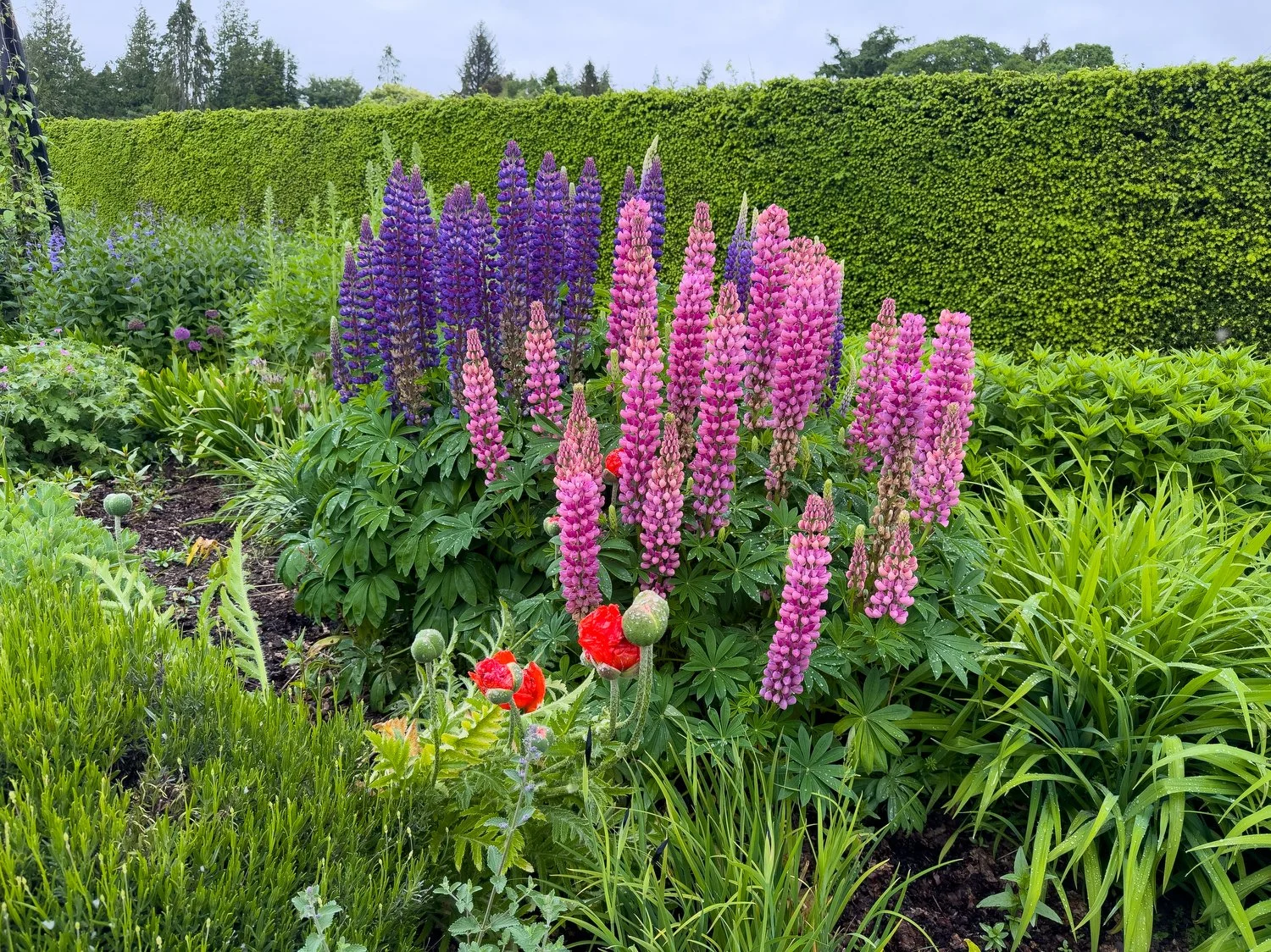
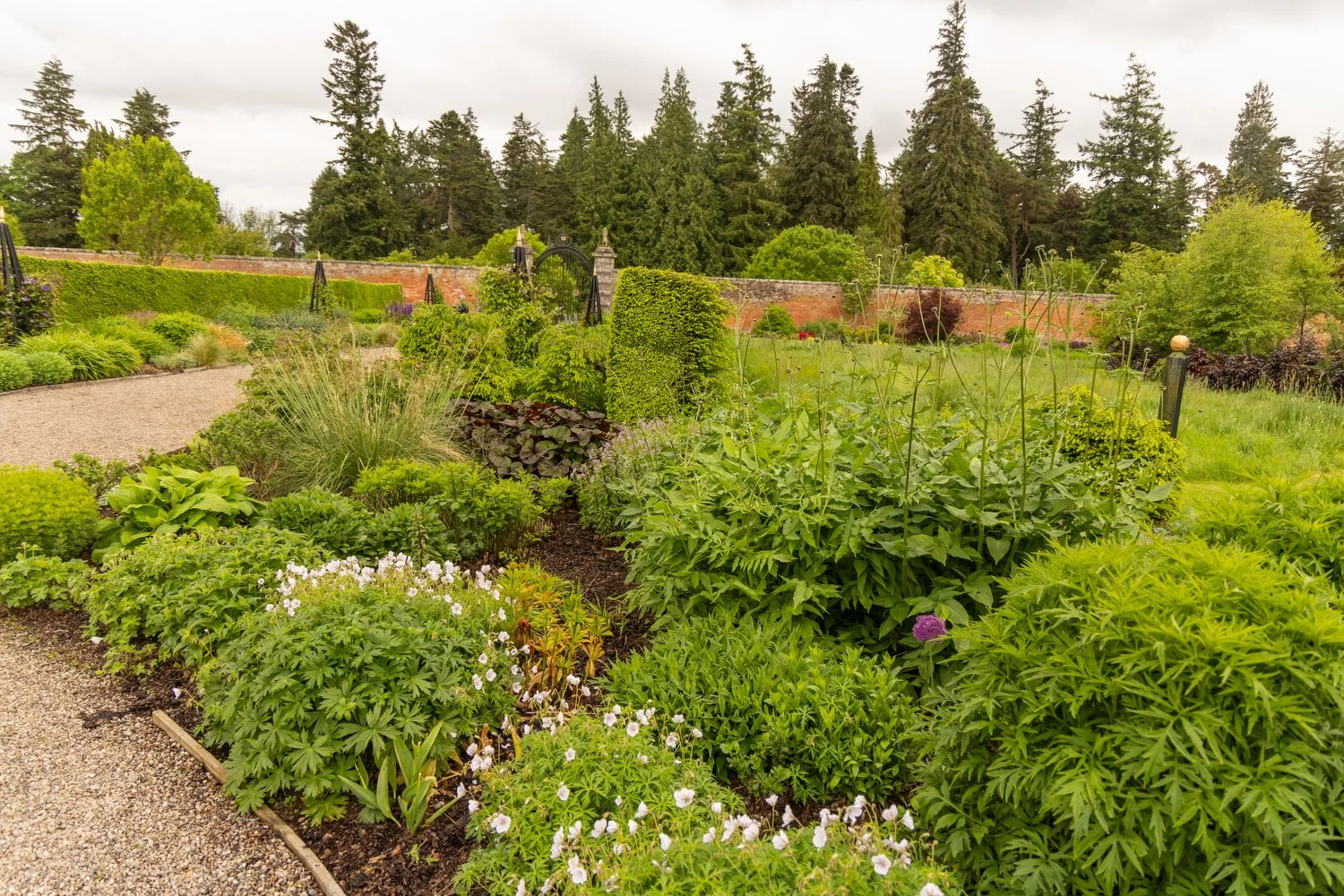
And I do have to mention how much bird song I heard while walking around the Glamis estate. The air was full of their music, but except for that and the gentle rushing of the Burn, it was quiet. So quiet - no road noise or mechanical rumbling of any kind. I truly felt far away from the “junketing world”, as it has been described.
According to my Merlin app, European Robins and Willow Warblers were my most prolific serenaders. But I have to admit my very favorite was the Common Chiffchaff, which may be common to Scots but new to my American ears. It seemed to be following me around in the Kitchen Garden and might just have the most appropriate onomatopoeic name ever.
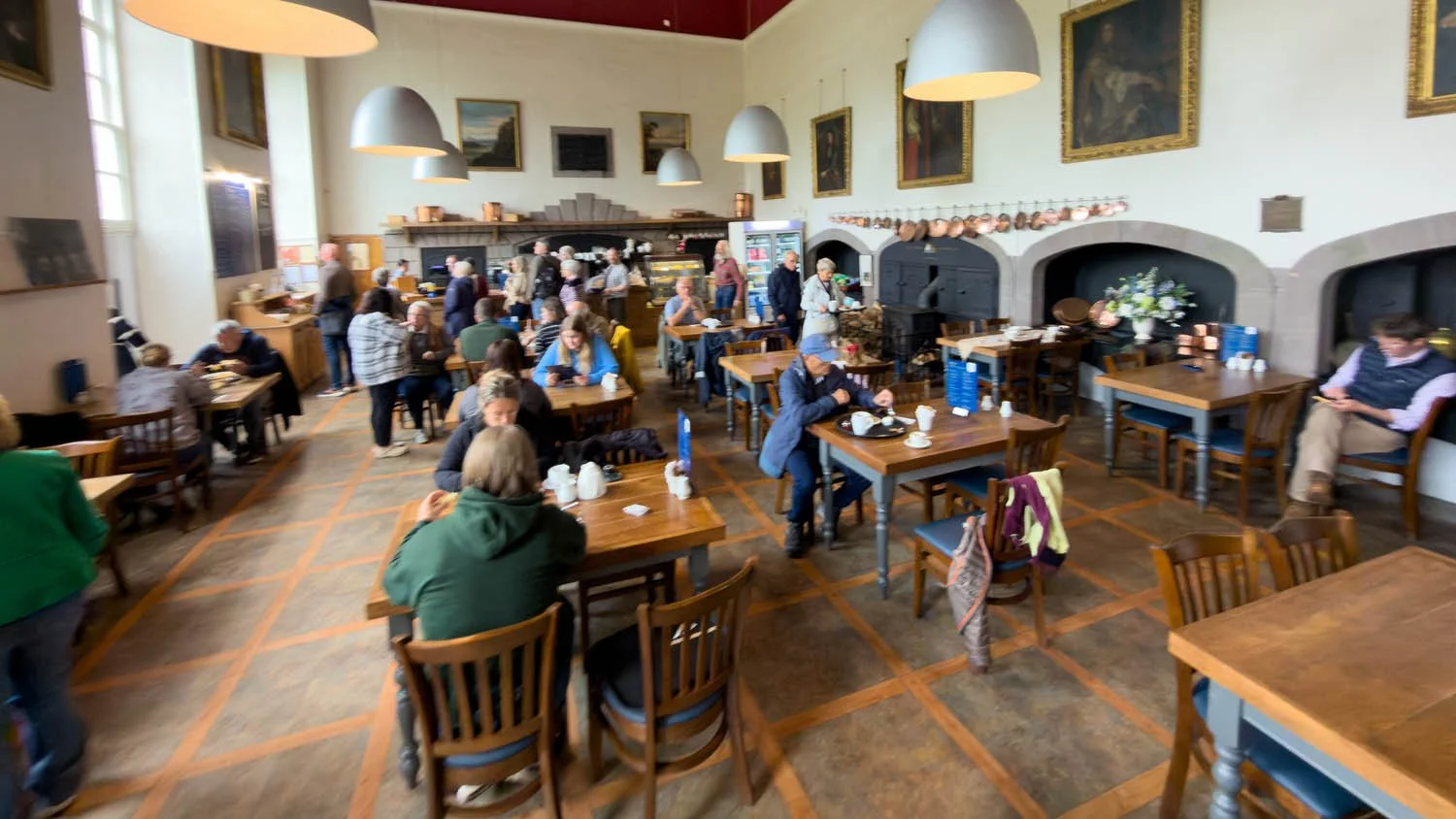
The charming Castle Kitchen Restaurant is set in the castle’s original Victorian kitchens.
Castle Kitchen Restaurant
The restaurant at Glamis is located in the castle’s original Victorian kitchens. We decided to have lunch there and it was a really nice experience. The atmosphere of being in the old kitchen with its beautifully preserved 19th-century architecture and vaulted ceilings is a perfect topper to the authentic castle experience.
There are copper pots hanging on the walls, historic ovens, and other vintage decorations. I noticed an elaborate Coronation portrait on the wall from 1937 with an interesting looking bell of sorts above it for ringing up servants. It showed “Chintz Room” and “Countess’ Bath Room” - stuck in time from another age. Hmm. Hope the ghosts aren’t still waiting for their snacks!
It’s casual dining where you go up to the counter and order the food and then it is brought to your table. The menu selection is elevated but not fussy, with many of the fresh ingredients coming from the Kitchen Garden, just as they would have in the past. There are some interesting breakfast rolls on the menu, as well as salads and vegetarian options, and everything is dressed up thoughtfully. They even offer a venison burger, which seems appropriate here in stalking country.
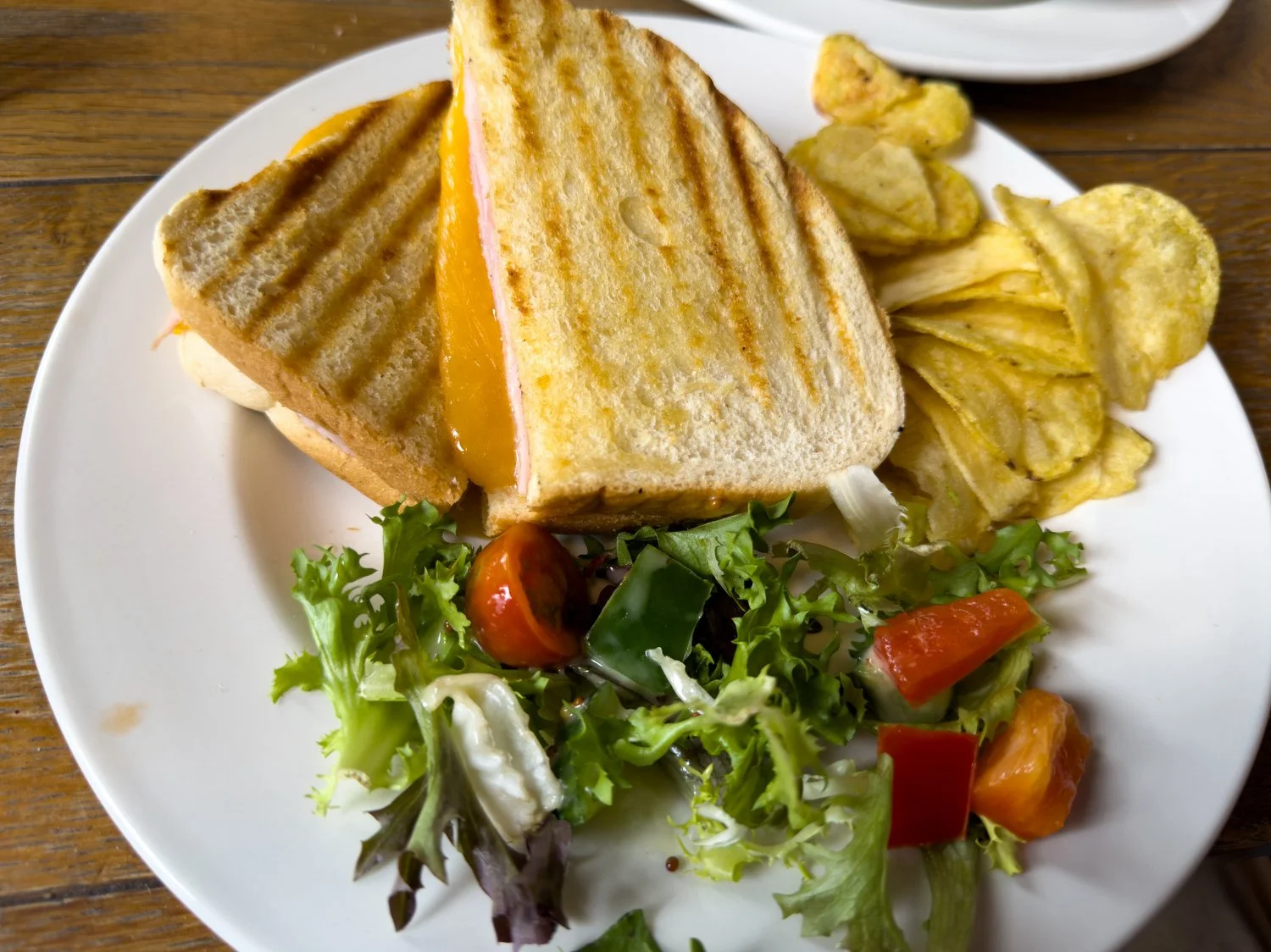

We had a big fluffy scone and “toasties” (toasted sandwiches if you’re not used to UK lingo) - ham, cheese & tomato for John, and cheese & chutney for me. I’ve been eating this sandwich a lot in Scotland and I’m definitely a fan!!! We also shared their version of “loaded fries”. All very satisfying with a nice cup of Earl Grey. We stayed there quite a while. No one rushed us out, but it was quite busy, so we didn’t want to overstay.
Speaking of tea, you can also have Afternoon Tea at the cafe, which requires a reservation.
For more of a “grab and go” snack, the Old Lauder is a takeaway stand outside that offers sweet treats, hot or cold drinks, a daily sandwich selection and baked goods.
All in all, Glamis Castle has so much to offer, even a great lunch!
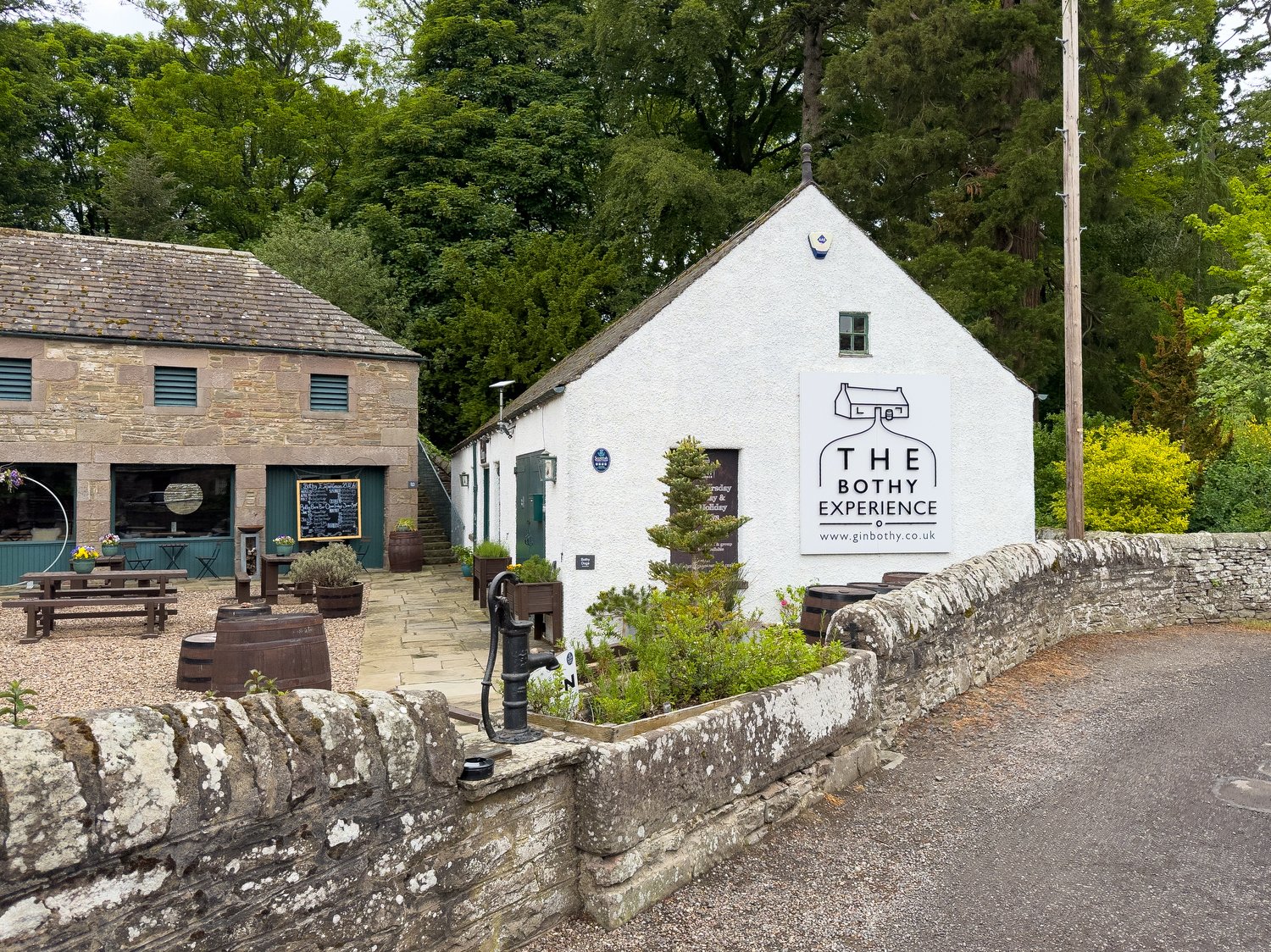
The Bothy Distillery, just outside of Glamis Castle.
What else is nearby - gin, a royal research ship, and what a local at a historic inn told us
Right outside Glamis Castle, in the village of Glamis is The Bothy Distillery. It’s in a cool “villagey” building and features tastings, tours and afternoon tea, as well as a retail shop. What is interesting is that this started out as a jam company, but they had so much fruit juice left over that they started mixing it with gin and a star was born.
It sounded like my kind of place - I mean, jam and gin, how could you go wrong? (I often joke to my sister that I treat jam as a food group.) But we spent so much time at Glamis that it was closed by the time we left, so no Gin Bothy Experience for us! It’s still on my list, though. The gin is also for sale at Glamis Castle Pavilion Gift Shop.
Speaking of imbibing, we really enjoyed the Johnnie Walker Experience in Edinburgh. It’s great for the whisky novice. Read our review here - The Johnnie Walker Experience: An Honest Review for Whisky Beginners.
After a full day at Glamis, we drove to Dundee to settle in for the night. It’s a quick drive, 20 or 25 minutes or so, so we took a little walk around town. It was fun hearing Monday evening bell practice emanating from the Old Steeple Church in the city center. It went on for quite a while; celebratory bells like you might hear for a wedding at Westminster Abbey! Trusty Google helped me figure out what all that ringing was about.
It was kind of nice having “real” AC at the Hampton by Hilton Dundee City Centre after some of the quaint, but very lovely accommodations we’d been enjoying throughout our Scotland trip. Even if it was just for one night - for it was back to Edinburgh for us after that. But not before a little more unscheduled time in Dundee.
Let me take you back a night before the Glamis visit. We had spent a full day at Balmoral Castle, and had driven over to Stonehaven for the night. What a great stop!
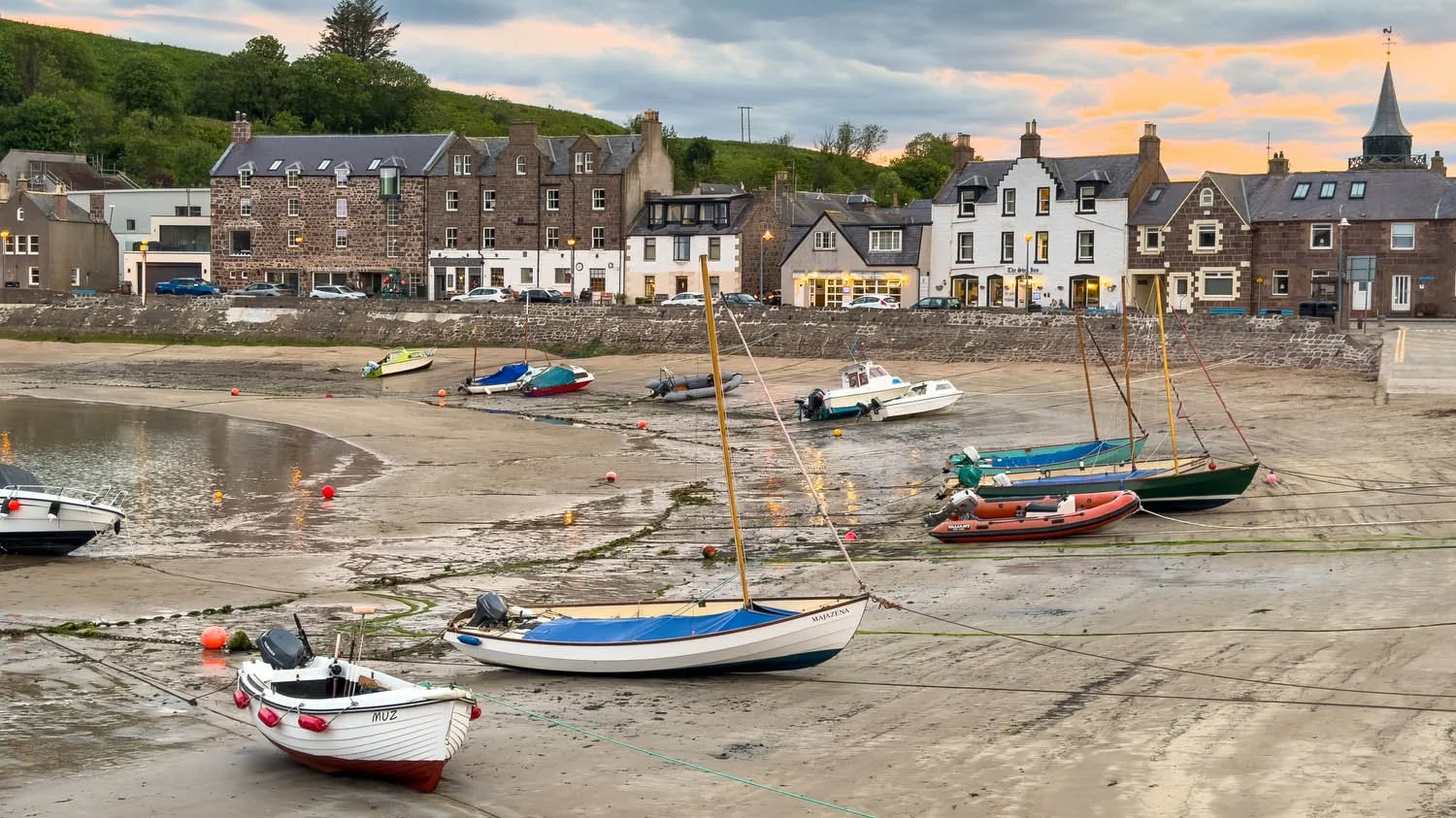
The harbor at Stonehaven at low tide. The peaked white building in the background, center right, is the Ship Inn, from 1771.
We stayed in the historic Ship Inn, established 1771, overlooking the harbor. It was beautiful taking a walk there that evening. We even got a heads up from a fisherman about a pod of dolphins frolicking in the water just beyond the harbor. A perfect night.
We had dinner at the Inn, and it was very, very good. Very fresh seafood and local beer. The people are so warm and friendly, real Scottish hospitality at its best. We happened to be sitting alongside a retired army vet, whose wife had already called it a day and went to bed, and we got to talking about the area and about our trip. He was native to the Angus area and knew it well.
I was reluctant at first to tell him we were going to Glamis the next day - I’m not sure why, but you never know sometimes if people might think you are silly if you want to see things related to royalty. But his face lit up when we said it. He recommended stopping in Forfar to see a church where the Queen Mother worshiped as a child, and a pub known to have royal visitors. Honestly, he couldn’t have been nicer. We didn’t get to stop in Forfar this time, as it was just too much to fit in, but something to keep in mind for next time.
He recommended spending a little time in Dundee afterward, checking out the RRS Discovery, and the small Victoria & Albert Museum wing at the harbor. We knew it was there from researching our trip but weren’t planning to visit. But he spoke so highly of it, and we do like visiting historic ships after all. So the day after our Glamis visit, we spent the morning in Dundee at the Discovery and the V&A.

RRS Discovery, the first designated Royal Research Ship, journeyed to Antarctica, 1901–1904. The ship-like building on the left is the Victoria & Albert Museum satellite in Dundee.
The RRS Discovery is a historic ship that made the journey to Antarctica in 1901, carrying Robert Falcon Scott and Ernest Shackleton on their first and highly successful trip. It was built in Dundee, so that’s why it is on display there today. I have to say, it’s a really interesting attraction and I would recommend it if you find yourself in Dundee, but it felt way more haunted than Glamis did! You can find out more about it at the Dundee Heritage Trust website.
Right next to it is a satellite of the Victoria & Albert Museum, which we visited as well. It’s a very striking design, made to fit into its location by resembling a ship. As a museum though, there isn’t too much there. Its focus is on design. We did enjoy a snack upstairs on the outdoor deck which was a very pleasant little spot.
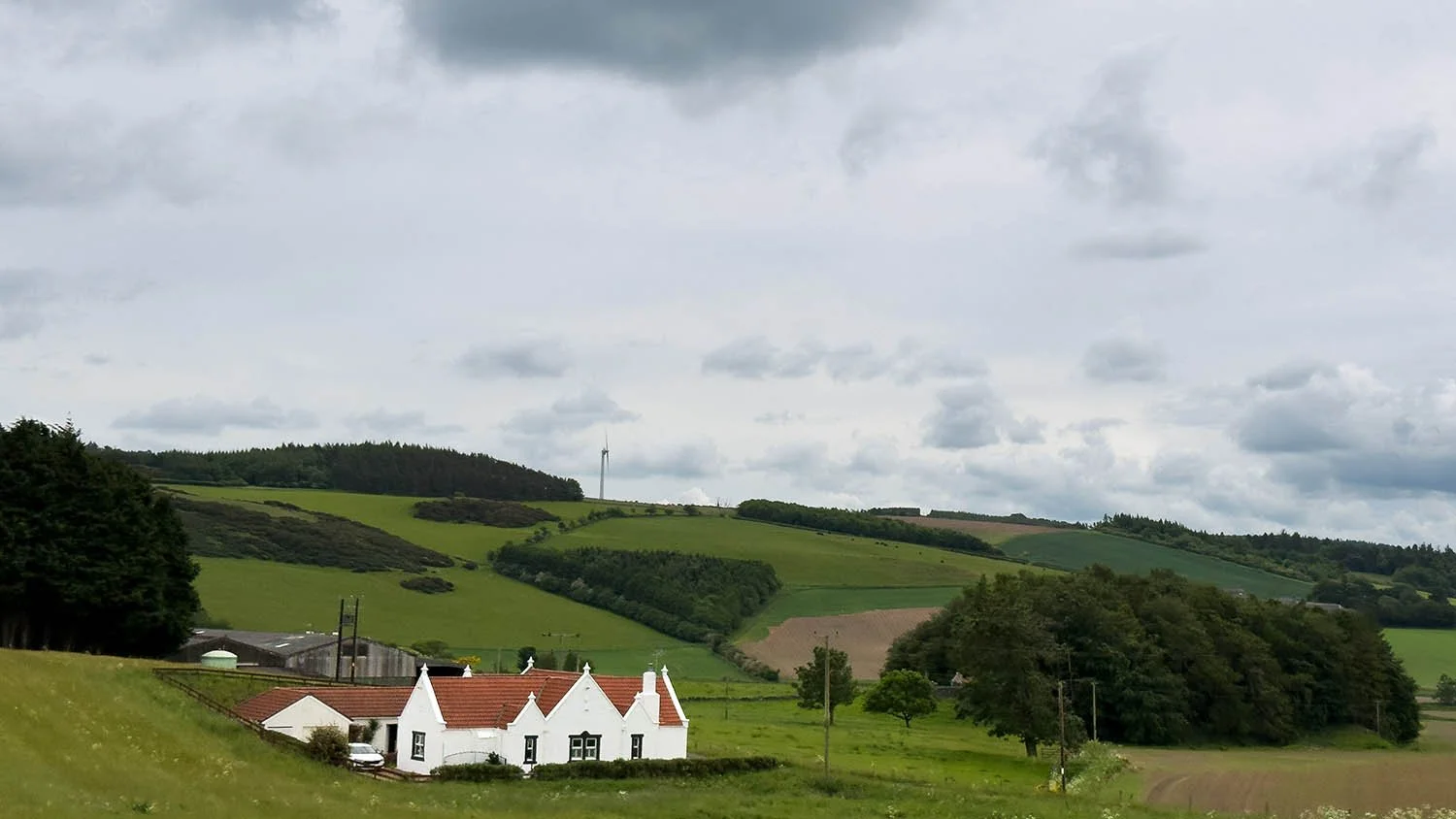
On the road between Dundee and Edinburgh. Nothing quite like driving in Scotland.
As we left the area and headed back to Edinburgh for the last leg of our Scotland adventure, I felt very satisfied with our sojourn into the Highlands and our visits to the estates of Balmoral and Glamis. It was epic, unique, and truly memorable.
About the Authors

|
John and Debbie O'Boyle are the team behind The Empty Nest Explorers. John is a professional photographer whose work has been published by The New York Times, NBC News, and Getty Images. He is a member of the American Society of Media Photographers, has been part of a Pulitzer Prize-winning team, and has received two New York Emmy nominations. Debbie is a writer with 30+ years of professional photography experience, formerly with The Star-Ledger and NJ.com. Together, they create in-depth travel guides for couples and empty-nest travelers who want to make the most of every destination. |
Our other Scotland travel posts:

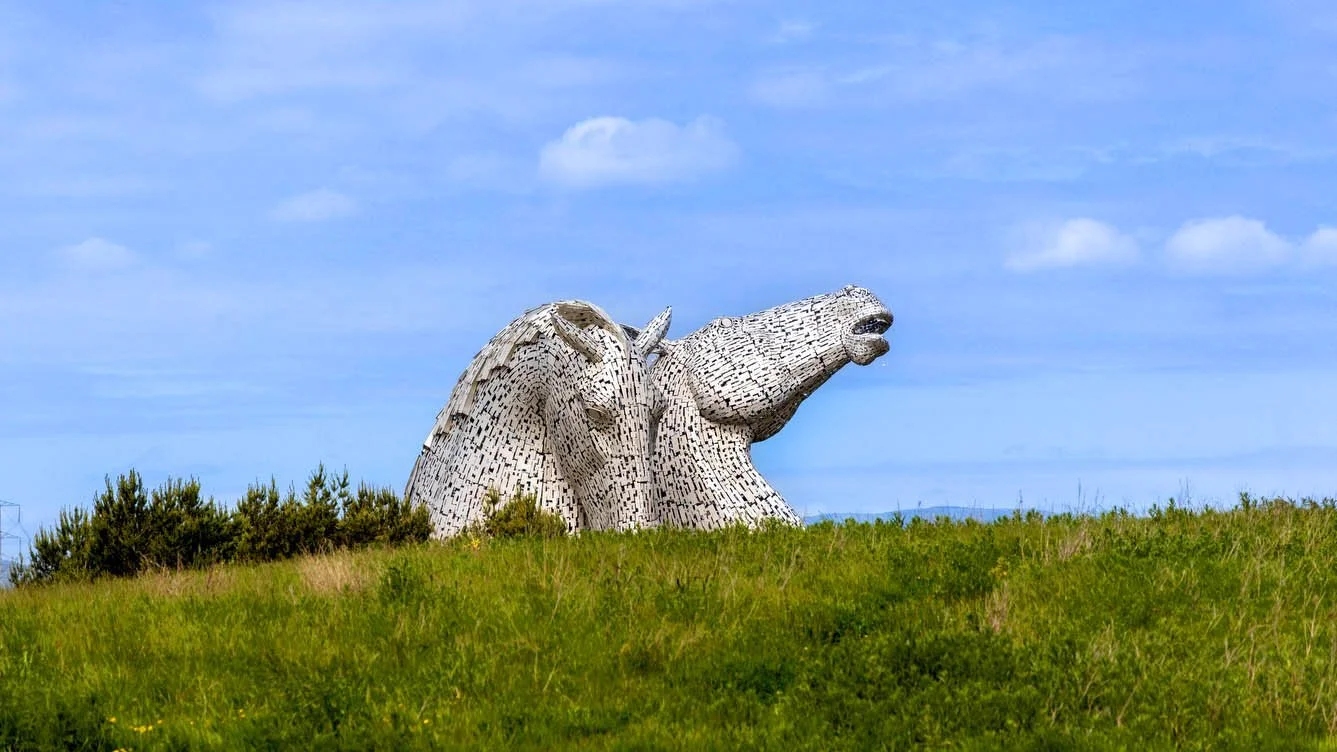



While The Royal Mile is touristy, it's also the historic heart of Edinburgh.
Here's our honest walk from the castle down to the palace, with the closes, St Giles' Cathedral, Victoria Street, and the best free stops along the way.